
You have an idea. You’re excited. But you hesitate: should you build a Proof of Concept (PoC), a Prototype, or go straight to an MVP? Choosing the wrong path can burn money fast and slow you down. And this isn’t just a feeling — about 35% of tech startups fail because they build something nobody wants. That often happens when teams skip validation and jump into development too early.
Some founders think building = progress, but reality says otherwise. Around 72% of startups use an MVP approach to test ideas and refine their product before fully investing. This helps them cut development costs by up to 60 % and reach market faster.
These stages aren’t strict rules. Some projects need all three. Others skip one or two depending on risk, team, and goals. Validation early helps save money and focus on what truly matters.
What Is a Proof of Concept (PoC)?
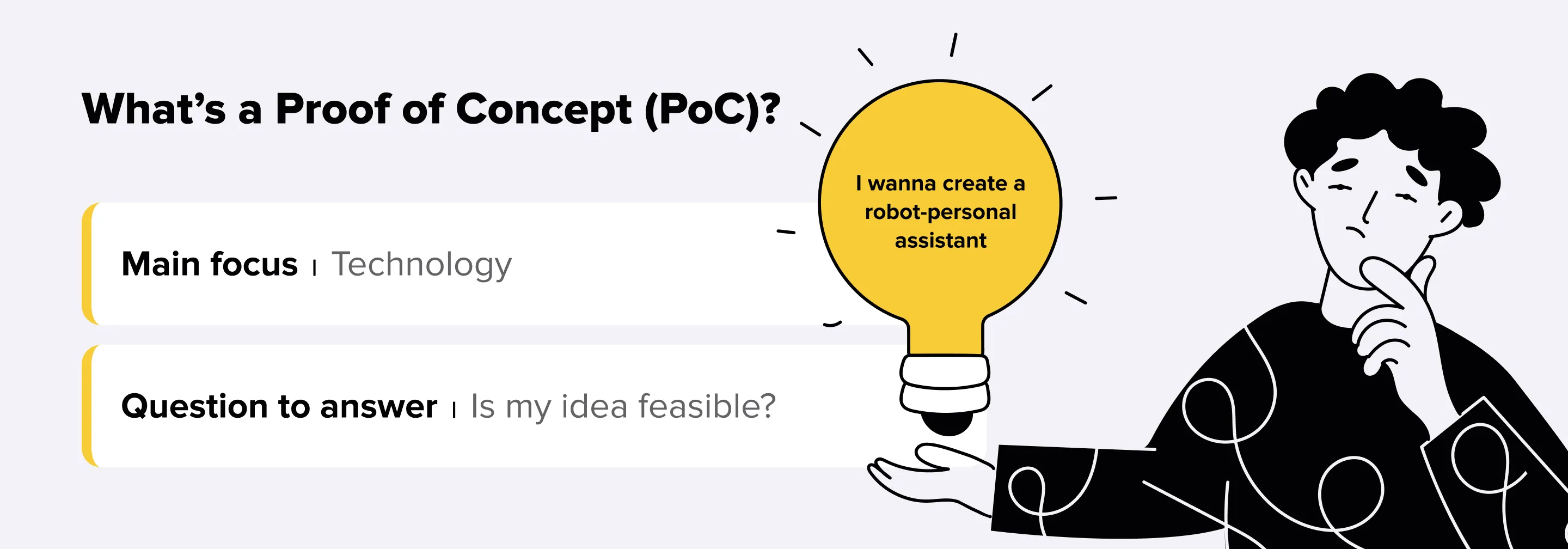
A Proof of Concept (PoC) exists to answer a very narrow question: is this idea technically possible at all? At this stage, there is no focus on user experience, visual design, or business value. The goal is purely technical. You check whether the chosen technology, architecture, or integration can work under real conditions.
A PoC is usually an internal exercise. It rarely has a user interface and often looks messy. That’s expected. The point is to attack the riskiest technical assumption first, before serious money enters the picture. Timelines are short. Sometimes a few days are enough. In more complex cases, it may take up to two or three weeks. Costs stay relatively low compared to later stages.
Teams typically build a PoC when working with untested technology, complex system integrations, AI or machine-learning models with uncertain accuracy, or strict regulatory requirements. Instead of guessing, you test and document what works and what doesn’t.
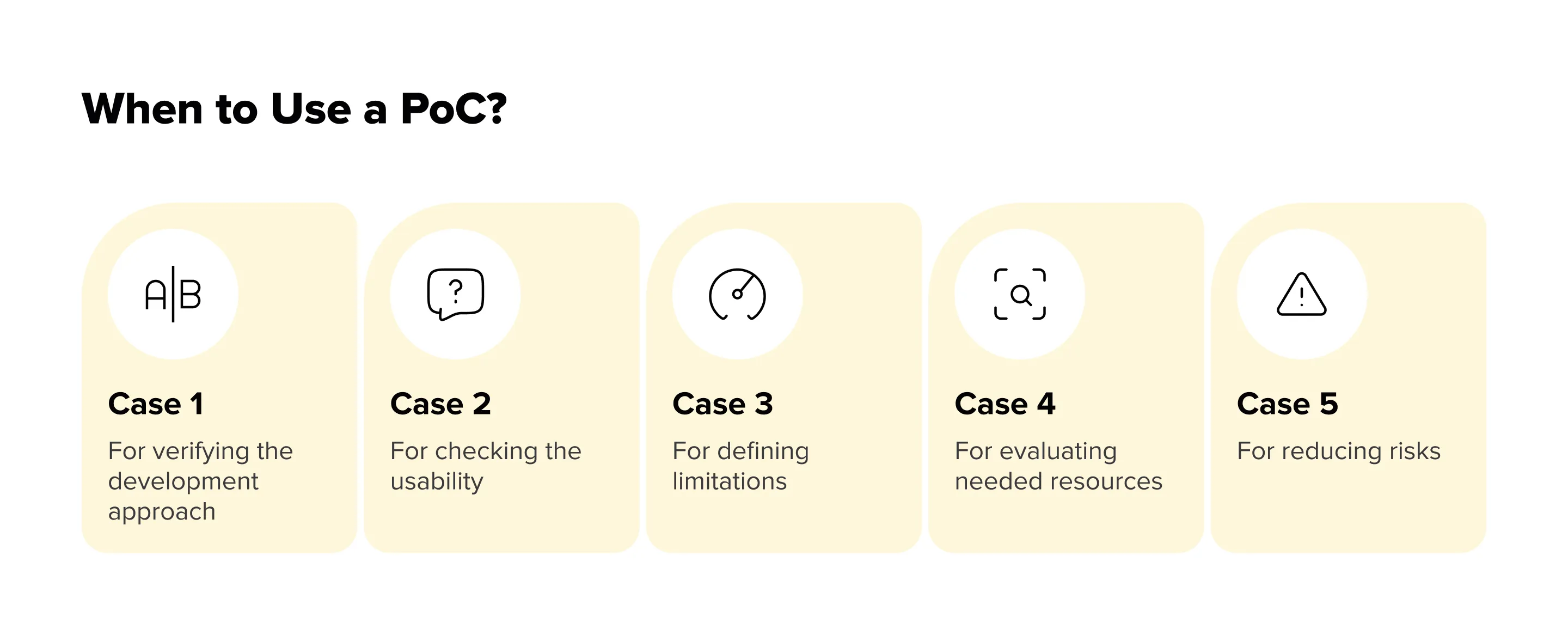
The outcome of a PoC is clarity. You get working code, architectural insights, and a clear understanding of limitations. Most importantly, you get a rational go-or-no-go decision. If the PoC fails, that’s not a loss. It’s a controlled stop that prevents a much more expensive failure later.
What Is a Prototype?
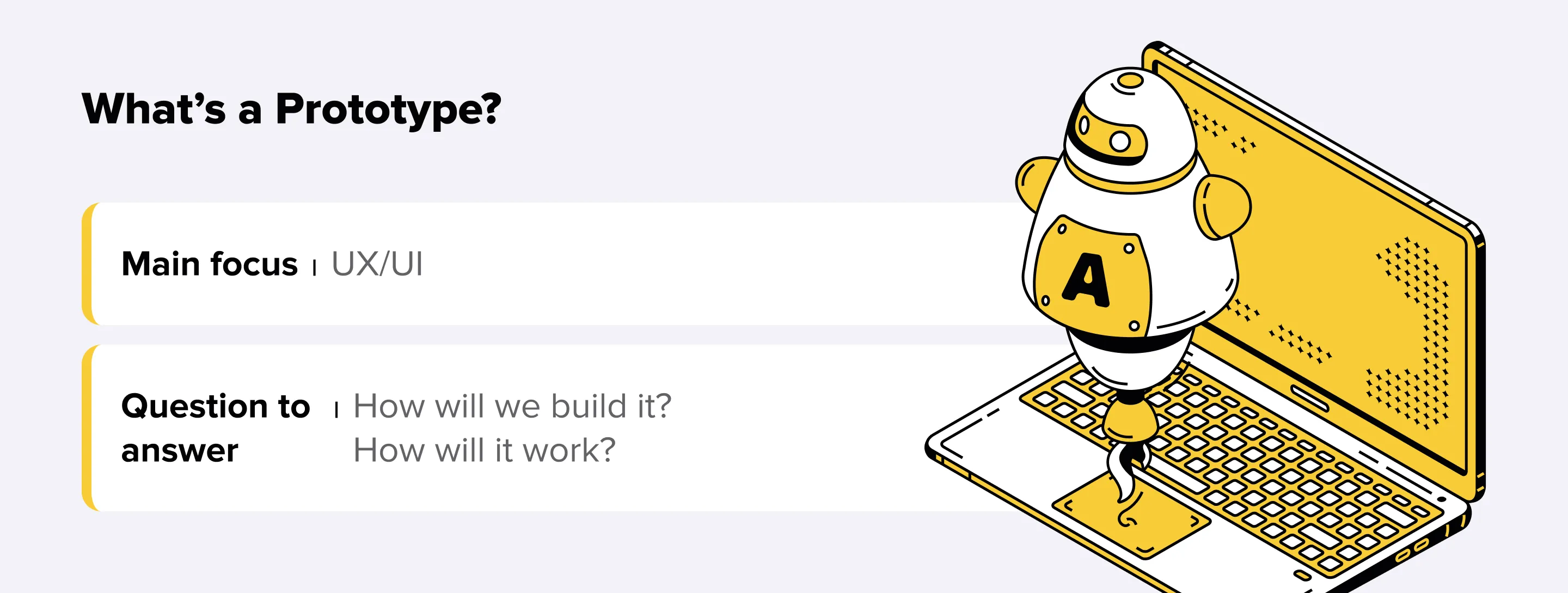
A Prototype shifts attention from technology to people. At this stage, the core question is whether users will understand the product and feel comfortable using it. Instead of testing feasibility, the prototype explores how the product looks, feels, and behaves during real interactions.
In practice, prototypes focus on user flows, interface structure, and interaction patterns. According to the project needs, they usually have the following characteristics:
Proof of Concept vs Prototype vs MVP: Complete Guide to Choosing the Right Approach
validate user experience and navigation logic
test design decisions before development
require no backend or full business logic
can be low-fidelity or high-fidelity
take around 2–6 weeks to create
are shared with stakeholders, investors, and test users
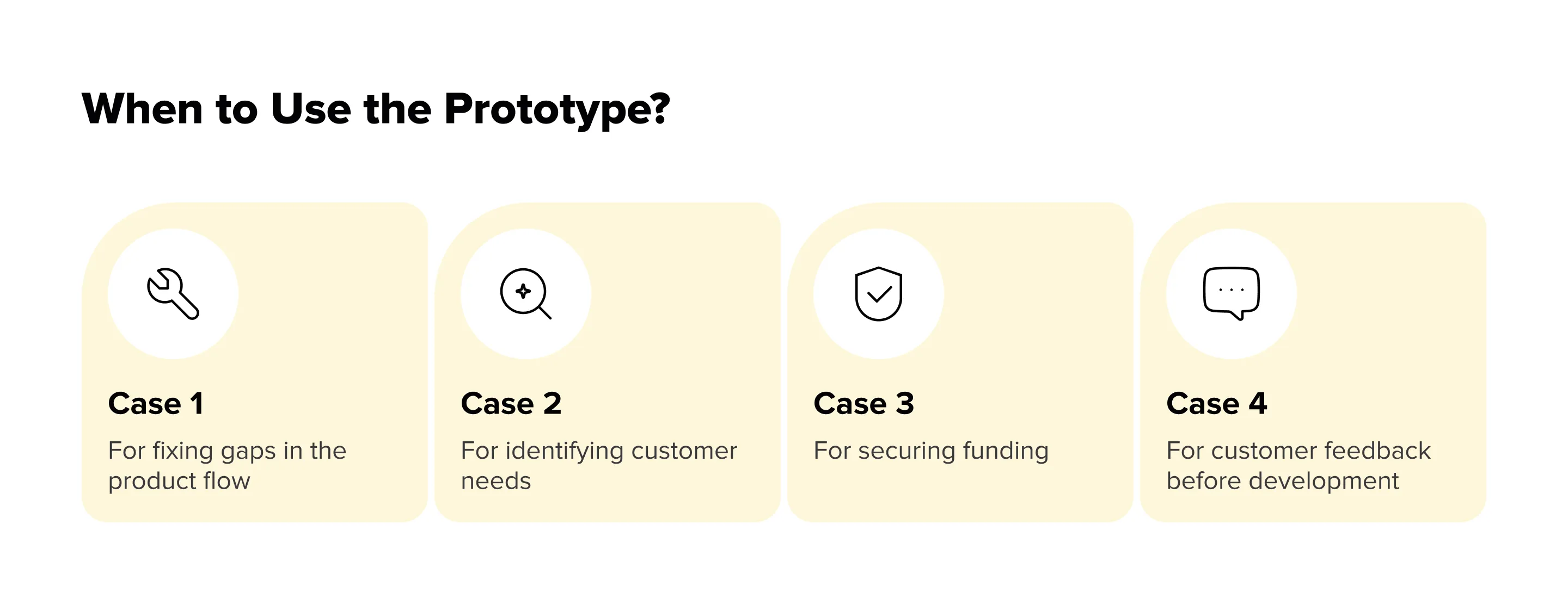
A good example is a marketplace or e-commerce product with multiple user journeys. A prototype allows buyers, sellers, and admins to walk through their flows and share feedback early. This helps align stakeholders and reduce uncertainty. Problems found at this stage are quick and inexpensive to fix, unlike the same issues discovered after development begins.
What Is a Minimum Viable Product (MVP)?
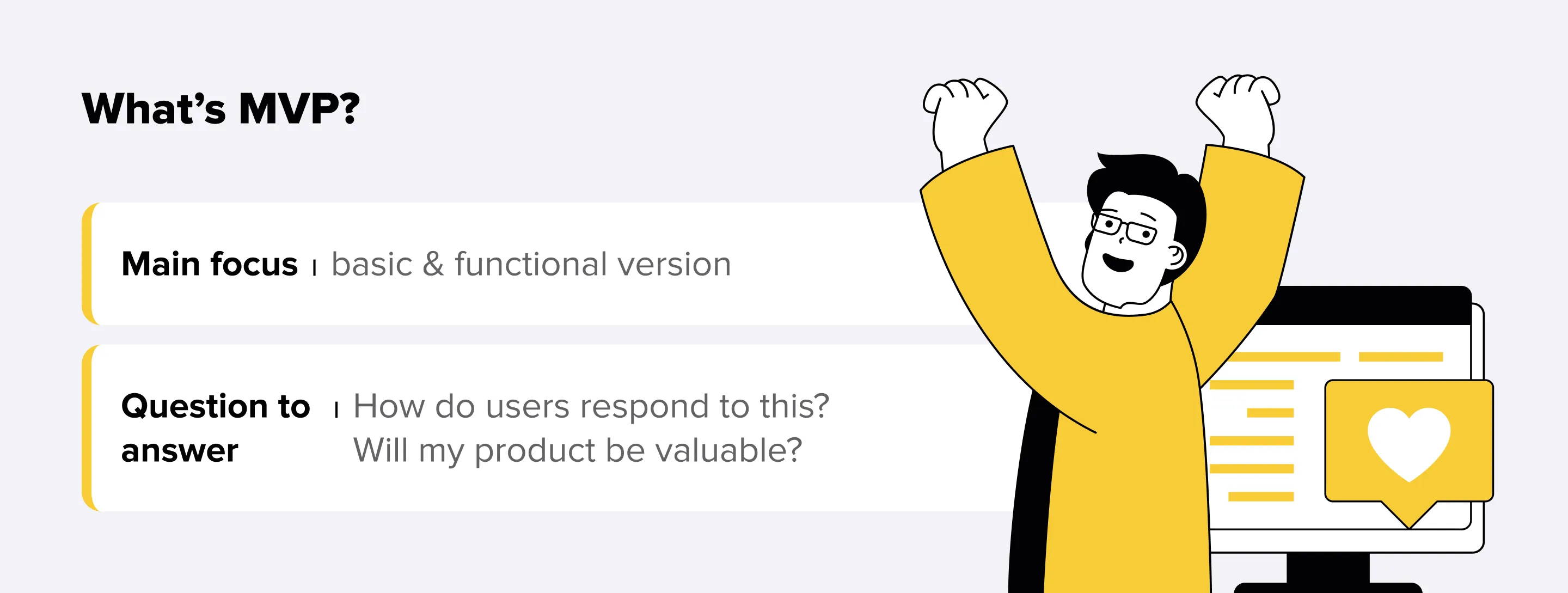
A Minimum Viable Product is the first version of a product that users can actually use. It answers a simple question: will people find value and use it in real life? In the proof of concept vs prototype vs MVP flow, this is where real behavior replaces assumptions.
An MVP is a fully functional product, not a demo. It contains only core features, but they work end to end and include basic business logic. “Minimum” does not mean low quality. It means limited scope with solid execution.
A common mistake is treating MVP as something cheap or rushed. Users do not tolerate poor experience just because it is an MVP. A good MVP solves one clear problem well instead of many problems badly.
For example, a team building a project management tool for remote teams may skip PoC and go straight to build an MVP. The first release includes tasks and basic collaboration only. Real users show what matters, and the roadmap is shaped by usage, not guesses.
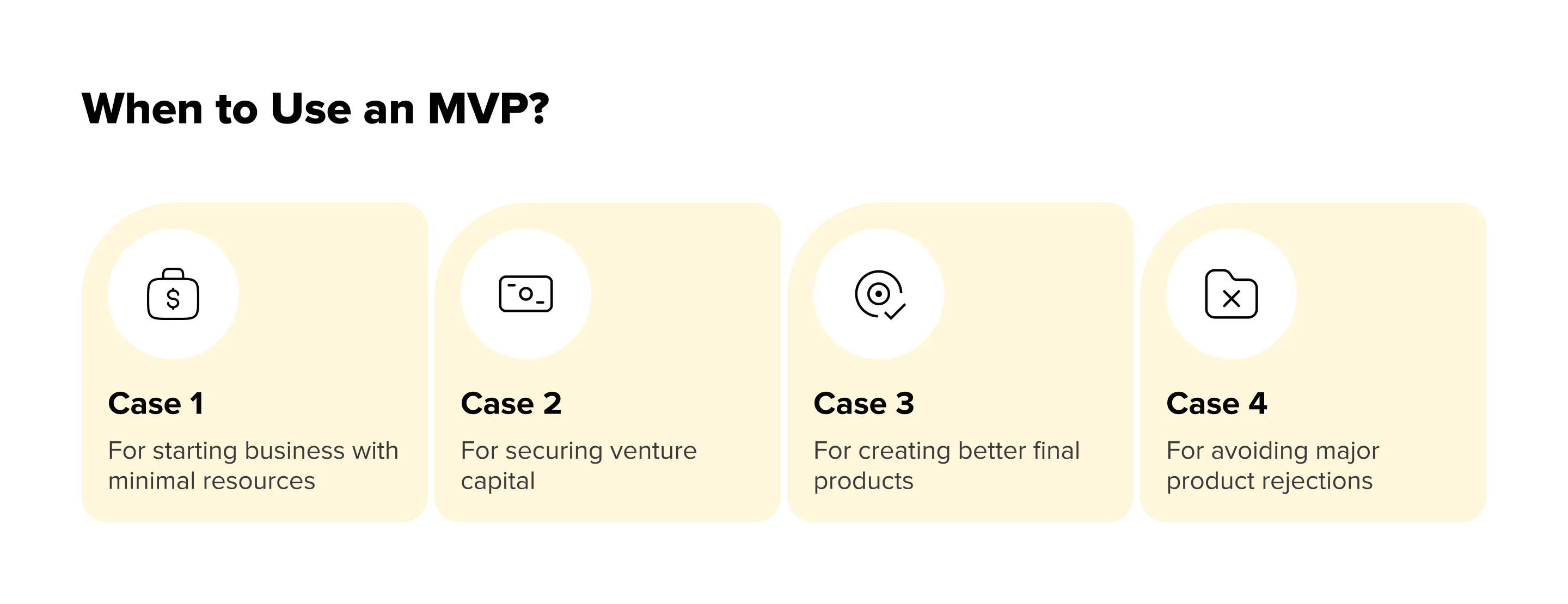
If an MVP fails, it is still a win. Teams can pivot, refine the audience, or stop early without major losses.
Proof of Concept vs Prototype vs MVP: Key Differences
When teams plan a new digital product, one of the first questions is whether to start with a Proof of Concept (PoC), a Prototype, or an MVP (Minimum Viable Product). Each option serves a different purpose and validates a different type of risk. PoC focuses on whether the idea is technically feasible. A Prototype helps understand how users interact with the solution. An MVP checks whether real customers are ready to use and pay for the product.
Here’s a practical view:
Dimension | PoC | Prototype | MVP |
Core Question | Can the technology work? | Is the solution understandable and usable? | Will users adopt and pay? |
Main Goal | Reduce technical uncertainty | Validate UX and flows | Validate business model |
Validation Type | Engineering validation | User behavior validation | Market validation |
Functionality | Minimal (proof only) | Demo/simulation | Fully working |
Typical Artifacts | Spike code, scripts, architecture notes | Clickable Figma, interactive UI | Production-ready app |
Timeline | Days to 2-3 weeks | 2-6 weeks | 2-6 months |
Success Metric | Feasibility confirmed | Usability issues reduced | Retention, conversion |
Cost Range | $5K-$25K | $10K-$50K | $50K-$200K+ |
Deliverable | Technical report | Interactive mockup | Production app |
Risk Addressed | Technical risk | Design/UX risk | Market risk |
Failure Impact | Low (early catch) | Medium (design pivot) | High (investment) |
Taken together, the table shows that PoC, Prototype, and MVP are not interchangeable steps but distinct tools for reducing different risks. PoC minimizes technical uncertainty before serious investment. Prototype lowers design and usability risks through early feedback. MVP carries the highest responsibility, as it puts a working product in front of real users to test market demand. Choosing the right format depends on which risk is most critical at the current stage of product developmen
Sequential vs Standalone: When to Use Multiple Stages
It is a common myth that product development must always follow PoC → Prototype → MVP. In reality, the proof of concept vs prototype vs MVP path depends on risk, budget, and time. Some products need all stages. Many succeed with just one or two.
Using all three stages makes sense when uncertainty is high on several levels. This happens with novel technology combined with complex UX and an untested market, such as AR social platforms or AI healthcare diagnostics. High investment requirements, multiple funding rounds, or strict regulatory demands also justify staged validation.
In other cases, teams use PoC + MVP and skip the prototype. This works well when technical risk is high, but the interface is simple. Backend platforms, APIs, and data processing tools often fall into this category. Here, functionality matters more than polish, and speed to market is critical.
The Prototype + MVP path fits products built on proven technology but with complex user flows. Marketplaces, workflow tools, and consumer apps rely heavily on UX. A prototype helps validate design before committing to full development.
Sometimes, only an MVP is needed. Low-risk products with standard UX patterns and validated demand can move directly to market.
Strategic sequencing saves money. Losing $15K on a failed PoC is far safer than losing $200K on an unvalidated MVP.
Cost & Timeline Expectations
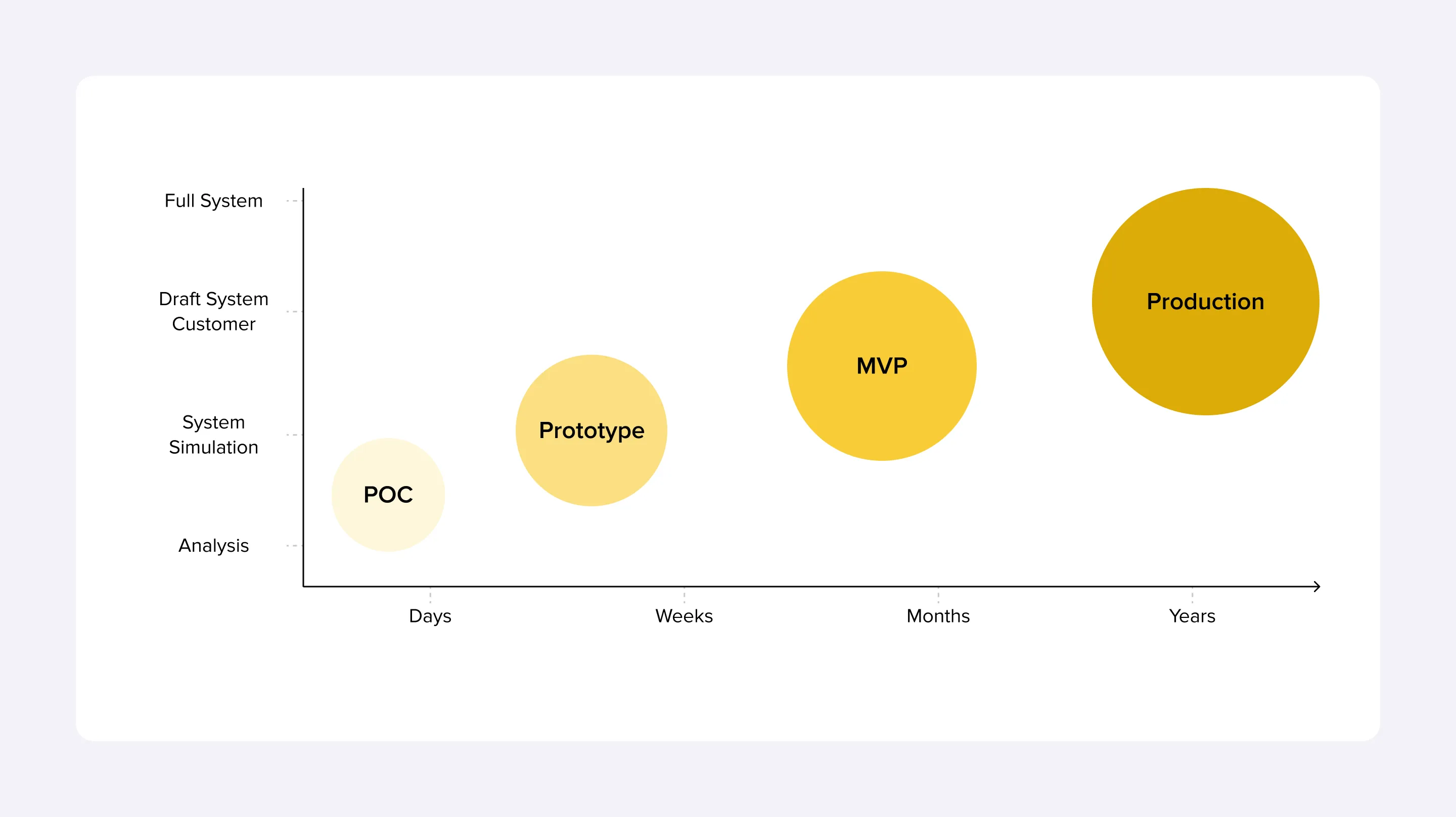
Cost and timing vary widely across PoC, Prototype, and MVP. The biggest drivers are team location, technology complexity, design depth, and integrations. Many teams optimize budgets through outsourcing and offshoring, especially at early validation stages. Offshore teams usually cost less than US or EU teams, while still providing access to strong technical expertise. Simple CRUD products are cheaper than AI or ML systems. Custom design, third-party APIs, and multi-platform builds increase scope fast. Team seniority and project management overhead also affect the budget.
Hidden costs are often missed early. Infrastructure like AWS or Azure, third-party services such as Stripe or Twilio, design tools, QA time, deployment, documentation, and knowledge transfer all add up.
Costs can be reduced without harming quality. Starting with a responsive web app is cheaper than native mobile. Proven tech stacks save time. No-code tools work well for prototypes. Outsourcing and offshoring are effective for non-critical stages that do not require constant stakeholder involvement. Most savings come from strict focus on core features.
Rushing rarely helps. A “2-month MVP” often becomes four months due to fixes. Realistic planning wins.
Cost Breakdown Table
Stage | Complexity Level | Cost Range | Timeline | Team Size |
PoC | Simple | $5K-$15K | 1-2 weeks | 1-2 developers |
PoC | Complex | $15K-$40K | 2-4 weeks | 2-3 developers + architect |
Prototype | Low-fidelity | $10K-$20K | 1-3 weeks | 1 designer |
Prototype | High-fidelity | $20K-$50K | 3-6 weeks | 2 designers + frontend dev |
MVP | Simple | $50K-$100K | 2-3 months | 3-5 team members |
MVP | Medium | $100K-$200K | 3-4 months | 5-8 team members |
MVP | Complex | $200K-$500K+ | 4-6 months | 8-12 team members |
Industry-Specific Recommendations
Different industries carry different levels of technical, design, and market risk. That is why the proof of concept vs prototype vs mvp choice should always depend on context, not habit. Below are practical patterns that work well in real projects.
SaaS B2B products
The usual path is Prototype → MVP. Technical risk is often low because stacks and architectures are proven. What matters most is user workflows and integrations. A prototype helps refine flows before you build an MVP.
Examples include CRMs, analytics tools, and internal dashboards.
Consumer mobile apps
Here, design decides adoption. Teams typically skip PoC and move with Prototype → MVP. High-fidelity prototypes help test UX and attract investors. Competition is intense, so early feedback is critical.
Examples: social apps, food delivery, fitness trackers.
FinTech and regulated products
This space almost always requires all three stages: PoC → Prototype → MVP. Security, compliance, and reliability create high technical risk. A PoC verifies feasibility, a prototype validates UX under regulation, and the MVP tests market demand. This is especially true for fintech development platforms like payment systems or lending apps.
Hardware + software products
The biggest risk lies in integration. Teams usually follow PoC → MVP, skipping prototypes. Once hardware communication works, UX can be validated directly on the MVP.
Examples: IoT devices, wearables, smart home systems.
AI and ML products
Accuracy and performance are unknown early. A PoC is essential to test models. If results are strong, teams move straight to MVP.
Examples: chatbots, recommendation engines, image recognition tools.
Marketplaces and enterprise software
Both usually follow Prototype → MVP. Marketplaces must validate flows for all sides. Enterprise tools benefit from prototypes for stakeholder alignment.
Choosing between PoC, Prototype, and MVP should always reflect the industry context. There is no universal path that fits every product. Some markets demand deep technical validation. Others fail faster due to poor UX or weak market fit. Understanding where the highest risk lies helps avoid unnecessary stages and focus effort where it matters most. When validation matches industry realities, product decisions become clearer and development moves forward with fewer surprises.
Real-World Success Stories
One clear example of a practical product validation journey from Lampa’s portfolio is the Dogiz pet care app. We started with idea validation to better understand core user needs, including pet health tracking, access to services, and engagement features. To avoid premature technical decisions, our team chose to begin with early visual prototypes, which helped us align on design direction and key user interactions before any code was written.
Based on user feedback and several iteration cycles, we refined the concept and moved into MVP development. The result was a user-friendly mobile app that centralizes dog care tools and services in one place for pet owners. This step-by-step approach allowed us to identify and mitigate risks early, ensuring decisions were guided by real user insights rather than assumptions.
Another example from our work at Lampa is Audiokitab, a digital reading platform. In this project, we focused on user-centric design as a key validation tool before launch. Our design process emphasized usability and thoughtful user experiences around audiobook listening and text navigation. While detailed technical decisions are not publicly disclosed, our UX-led approach combined prototyping with early user feedback, helping us validate interaction patterns and refine the product experience before deeper development began.
Both cases demonstrate how we at Lampa use product validation, design, and discovery activities to help clients test ideas early, reduce uncertainty, and move into development with confidence.
How to Approach Product Validation the Right Way
Product validation is essential but not always straightforward. Choosing the wrong path can waste time and money. A strategic partner helps you determine whether PoC, Prototype, or MVP is most appropriate for your idea and executes that approach with precision. At Lampa, the first step is always strategic guidance: assessing technical, design, and market risk so you can choose the right validation path. Lampa then helps define success criteria and realistic timelines and budgets tailored to your product.
For PoC Expertise, senior developers assess feasibility, recommend scalable architecture, and deliver a clear go/no-go decision with rationale, typically within 1–3 weeks. Prototype Excellence means user-centered design, interactive prototypes, usability testing, and investor-ready materials. Finally, in MVP Development, full-stack teams apply agile methods with a quality focus and analytics for data-driven decisions. Lampa works with B2B SaaS, FinTech, HealthTech, E-commerce, and marketplace products, while also supporting clients across a wide range of other industries.
Not sure whether you need a PoC, Prototype, or MVP? Contact Lampa for a complimentary validation strategy consultation. We’ll assess your project and recommend the right approach.