
Chasing every new trend is the fastest way to waste budget and slow your team down. But ignoring the right ones is just as risky – competitors move faster, systems get outdated, and delivery starts to break. In 2026, enterprise software development trends are not about hype. They are about choosing what really helps teams move faster, scale проще, and stay stable.
The change is already clear: by 2026, around 40% of enterprise apps are expected to use AI agents, compared to less than 5% a year earlier, according to Gartner. This kind of growth means one thing – waiting too long is no longer an option.
Why Enterprise Software Development Trends Matter in 2026
Deadlines are getting tighter. Legacy systems are still at the core of key processes. At the same time, business teams expect faster releases, better data, and smooth digital experiences. This gap keeps growing – and teams feel it every sprint. This is where the right enterprise software development trends start to matter. Not as ideas, but as real tools. Automation reduces manual work. Cloud-native architecture removes bottlenecks. AI moves from testing to real use, helping teams make better decisions.
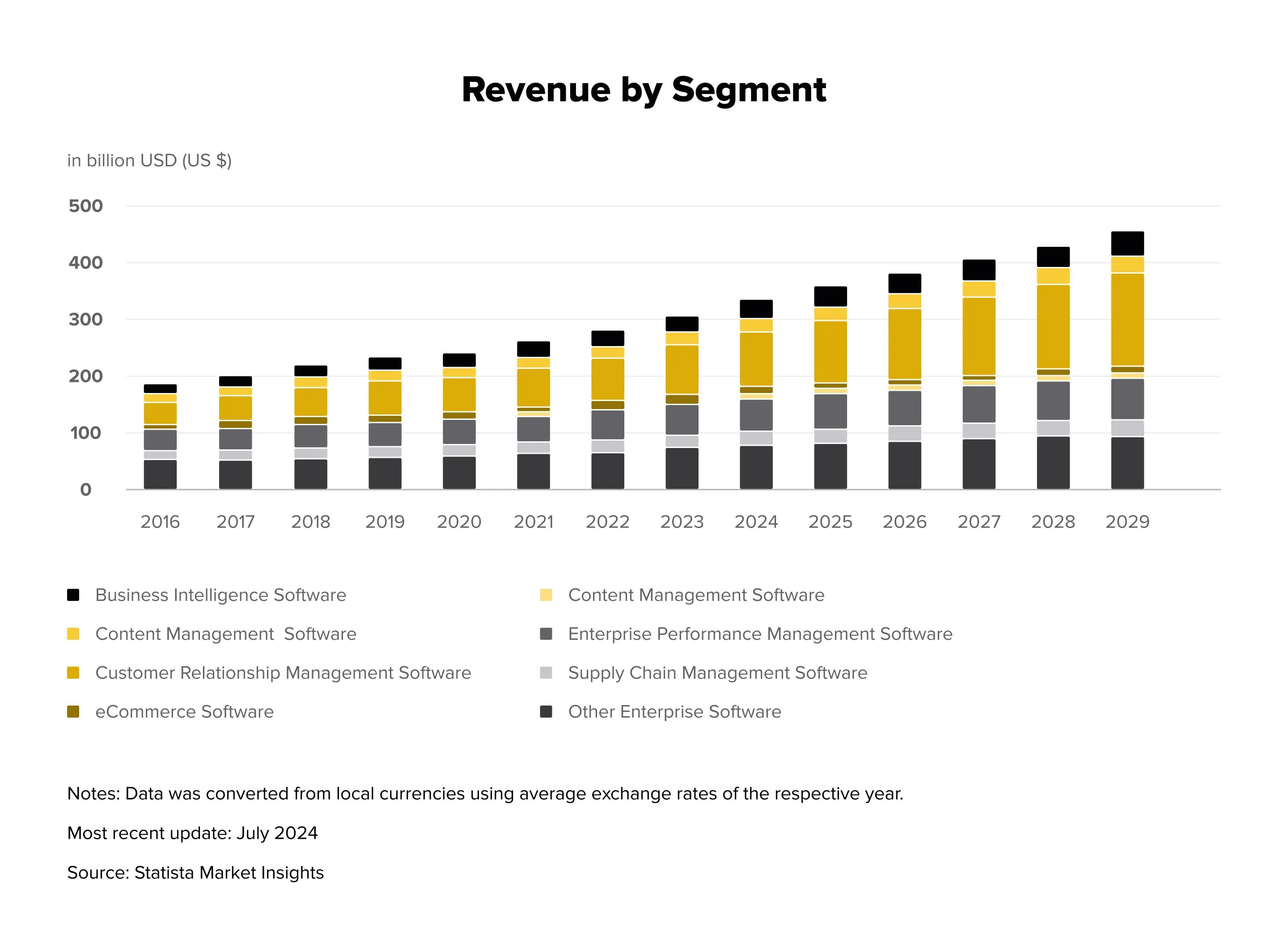
The numbers confirm this. According to Statista, the global enterprise software market keeps growing, while AI adoption in enterprises has already passed 50% in many industries. This is not just a trend – it’s already changing how products are built and scaled.
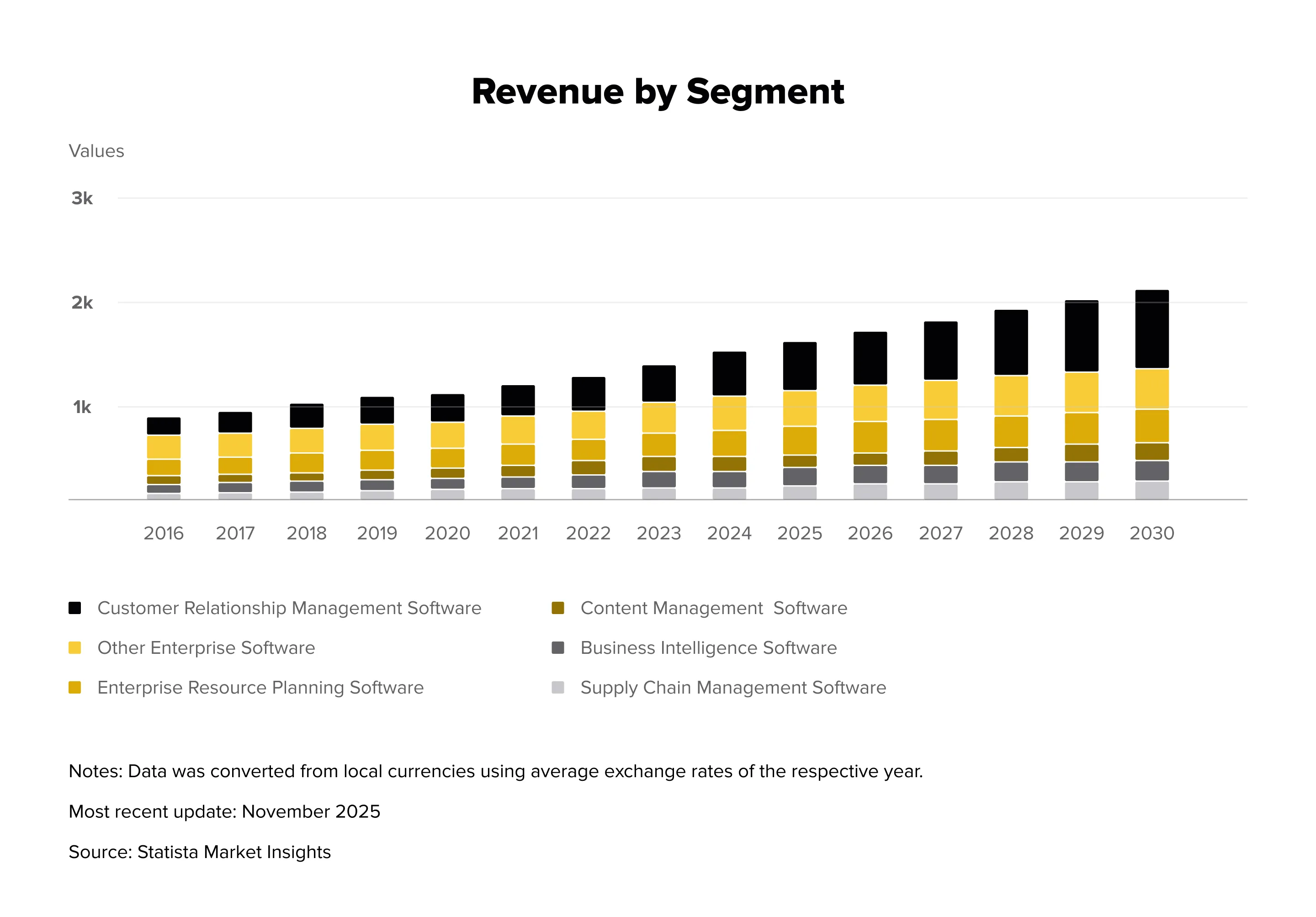
The value is clear: faster delivery, systems that scale without issues, and products that improve over time instead of being rebuilt. The trends that matter are the ones that help close the gap between business expectations and what teams can actually deliver.
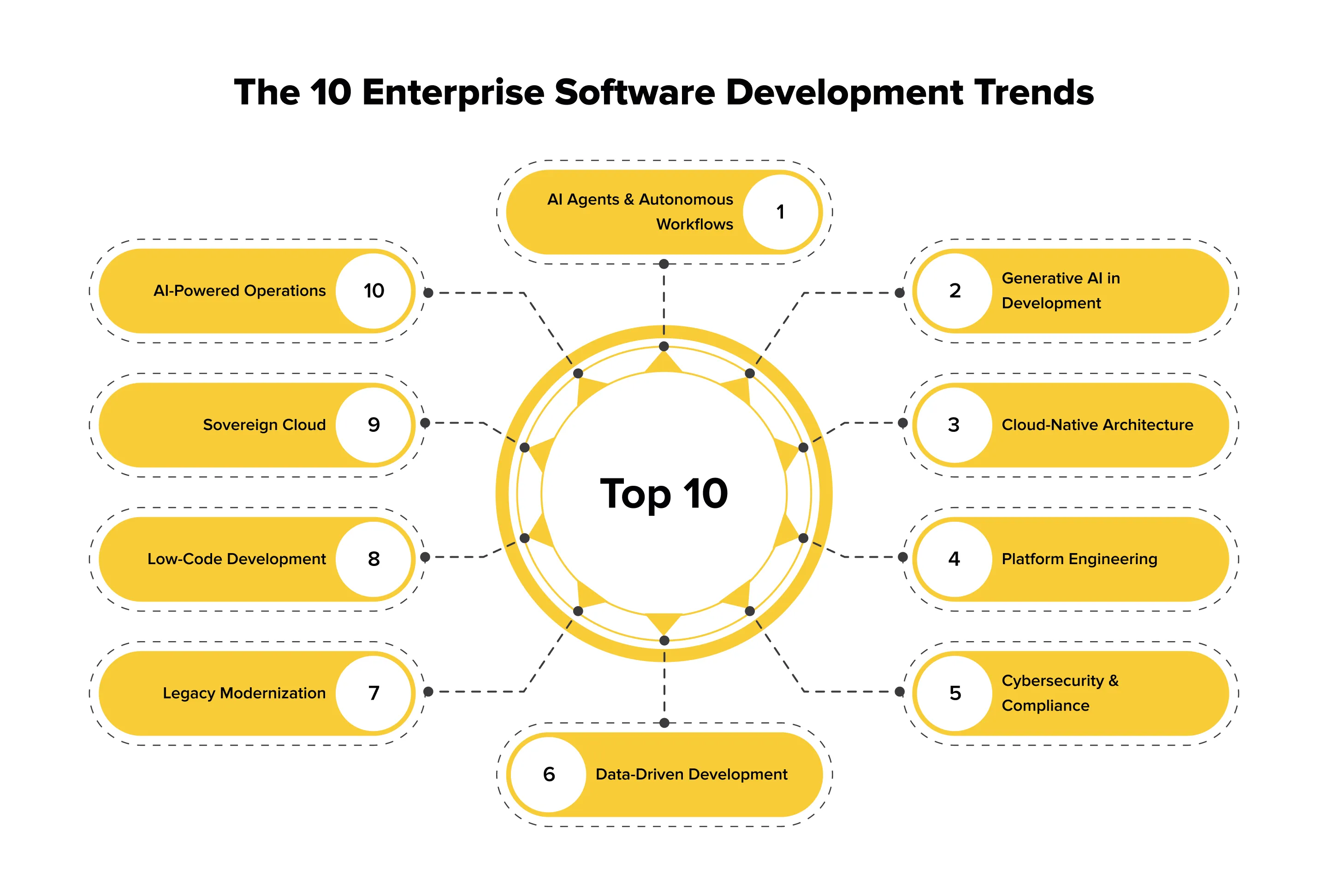
The 10 Enterprise Software Development Trends Shaping 2026
These trends were selected based on four factors: real AI adoption rates, consistent enterprise demand, scalability under production load, and long-term business viability. Each one is already moving beyond early adoption into daily operations. This is not about experimentation. These are the directions where enterprise software is actively being built, funded, and scaled.
1. AI Agents and Autonomous Workflow Orchestration
AI agents are evolving into autonomous systems capable of executing multi-step workflows without constant human involvement. In enterprise environments, they coordinate tasks across supply chain, HR, finance, and IT operations. They make real-time decisions based on live data and predefined rules, while staying within governance and compliance boundaries.
Platforms such as Microsoft Copilot Studio, Salesforce Agentforce, and ServiceNow are leading adoption. The strongest value appears in high-volume, rule-based processes like procurement or internal support. At the same time, organizations need governance layers, security controls, and audit mechanisms. Without them, automation can introduce operational risks instead of reducing them.
2. Generative AI Integration in Development Platforms
Generative AI is changing how enterprise teams build and maintain software. Developers now use AI for code generation, completion, and refactoring, which reduces repetitive work and accelerates delivery. It also helps identify technical debt earlier through automated code analysis.
Tools like GitHub Copilot, Amazon CodeWhisperer, and Google Gemini Code Assist are now embedded into development workflows and CI/CD pipelines. This shifts development from manual execution to AI-augmented delivery across the full lifecycle.
This approach delivers the most value in large-scale environments with continuous development cycles. However, hallucination risks and inconsistent outputs require oversight. AI works best when combined with structured AI development services that align tools with real business processes.
3. Cloud-Native Architecture and Scalable Infrastructure
Cloud-native architecture has become the dominant approach to building enterprise systems. Applications are deployed as containerized services and orchestrated using tools like Kubernetes. This allows workloads to scale dynamically across hybrid and multi-cloud environments.
Organizations such as Netflix and Spotify demonstrate how cloud-native systems support resilience, auto-scaling, and fault isolation. Workloads are distributed across providers like AWS, Azure, and GCP, with some industries moving toward sovereign cloud for compliance.
This model is ideal for systems requiring flexibility and uptime. However, it introduces orchestration complexity and potential vendor lock-in, which must be addressed at the architecture level.
4. Platform Engineering and Internal Developer Platforms
Platform engineering focuses on building internal platforms that standardize development processes. These platforms provide self-service infrastructure, deployment pipelines, and reusable tools tailored to enterprise needs.
Companies like Spotify and Zalando use internal developer platforms to reduce cognitive load and increase development speed. Developers no longer manage infrastructure manually, which improves efficiency and consistency.
The main challenge is the initial investment. Building an effective platform requires alignment between technical and business goals, often supported by business analysis services to ensure the platform solves real operational needs.
5. Cybersecurity, Compliance, and Governance Platforms
Security is now embedded directly into the development lifecycle. DevSecOps integrates automated security checks, compliance validation, and real-time threat detection into pipelines. Platforms like Palo Alto Prisma, Snyk, and Wiz provide continuous monitoring and reporting.
This approach is essential in regulated industries such as finance, healthcare, and government. It ensures systems remain compliant and secure throughout development and deployment. The trade-off is increased complexity and slower release cycles, but in these environments, compliance is non-negotiable.
6. Data-Driven Development and Analytics Platforms
Data-driven development integrates analytics directly into the software delivery process. Teams track key performance indicators across development workflows using platforms like Datadog, Amplitude, and Grafana.
Real-time metrics influence product decisions, sprint planning, and release strategies. AI-powered anomaly detection helps identify issues early, reducing operational risk.
This approach works best in environments with large datasets and continuous releases. However, managing data governance and ensuring data quality remains a significant challenge for many organizations.
7. Technical Debt Modernization and Legacy Migration
Technical debt modernization is a priority for enterprises running on legacy systems. Outdated architectures slow development, increase costs, and limit scalability. AI-assisted tools help identify critical issues in large codebases, allowing teams to focus on areas that block progress instead of relying on assumptions.
Most organizations choose incremental migration over full system replacement. This reduces risk while improving flexibility and performance step by step. Although modernization requires investment, it becomes necessary when legacy systems prevent growth or integration with modern platforms.
8. Low-Code Platforms and Development Velocity
Low-code platforms accelerate development by reducing manual coding. Tools like Microsoft Power Platform, Mendix, and OutSystems offer visual environments, pre-built templates, and integrations with enterprise systems. They are effective for internal tools and workflow automation, helping reduce backlog and speed up delivery. However, complex systems still require custom development for scalability and control.
9. Sovereign Cloud and Data Residency Compliance
Sovereign cloud enables organizations to control where data is stored and processed, ensuring compliance with regional regulations. Providers like AWS, Azure, and Google offer dedicated environments for regulated industries. While this approach strengthens governance and data security, it comes with higher costs and less flexibility than standard public cloud.
10. AI-Powered Supply Chain and Operational Software
AI-powered supply chain systems use analytics to optimize logistics, inventory, and supplier coordination. Real-time dashboards provide visibility across operations, helping teams respond faster to disruptions and improve efficiency.
AI also enhances demand forecasting and inventory planning by analyzing historical and external data. This reduces stock imbalances and improves decision-making.
Solutions from SAP, Oracle, and Blue Yonder deliver the most value in large-scale operations. However, they depend on high-quality data and require complex integration, which can slow adoption.
Enterprise Software Development Trends: Comparison Table
This table is a quick way to match enterprise software development trends with your current priorities, system limits, and team readiness. Use it to decide what actually fits your context, not what looks good on paper.
Trend Name | Primary Benefit | Adoption Stage | Core Technology | Best For | Complexity Level |
AI-powered development | Faster coding and automation | Mainstream | AI | Teams improving delivery speed | Medium |
Generative AI in apps | Enhanced user experience | Emerging | AI | Customer-facing platforms | High |
Cloud-native architecture | Scalability and flexibility | Mature | Cloud | Large-scale enterprise systems | Medium |
Microservices architecture | System flexibility and modularity | Mature | Platform | Complex enterprise applications | High |
Low-code / no-code platforms | Faster MVP development | Mainstream | Platform | Startups and non-technical teams | Low |
DevSecOps practices | Integrated security | Mainstream | Security | Regulated industries | Medium |
Data-driven architecture | Better decision-making | Mainstream | Data | Analytics-focused products | Medium |
API-first development | Seamless integrations | Mature | Platform | Ecosystem-based platforms | Medium |
Edge computing | Real-time data processing | Emerging | Data | IoT and real-time applications | High |
Platform engineering | Improved developer experience | Emerging | Platform | Large engineering organizations | High |
How to Pick the Right Trends for Your Organization Without Getting Burned
Chasing every trend rarely ends well. But ignoring them completely is just as risky. The real challenge is understanding what actually fits your business – and what will only slow you down. Start with a simple filter: does this trend support your goals and KPIs? If it doesn’t help you deliver faster, reduce costs, or create new revenue – it’s not a priority. Many teams still adopt trends because they sound promising, not because they solve real problems.
Next, look at your current architecture and team. Even the best enterprise software development trends fail if your systems can’t support them or your team isn’t ready to use them. For example, moving to microservices without strong DevOps practices often creates more chaos than value. Scalability is another key filter. Some solutions work well at a small scale but break under real enterprise load, while others require heavy investment before they show results.
You also need to think about governance and compliance. Trends like AI or data platforms can introduce risks if your organization isn’t ready to manage them properly – and this is where many projects slow down or fail. In practice, strong teams focus on 2-3 trends at a time – the ones with clear business impact and a realistic path to adoption. Mature organizations don’t treat trends as a wishlist. They build a roadmap, test step by step, and scale what actually works.
What This Looks Like When It Actually Works
A good example is the Axor project delivered by Lampa. The client needed to simplify how users interact with a complex product catalog. Instead of adding more filters or static logic, the team built an AI-driven layer that understands intent and adapts results in real time. This approach reduced friction in navigation and improved how quickly users found relevant products. The result was a measurable increase in engagement and more consistent conversions across sessions.
What stands out here is not just the technology, but the shift in logic – from fixed rules to adaptive interaction. Similar patterns can be seen elsewhere. Netflix uses AI to shape content discovery at scale. Shopify applies AI to help merchants generate product content faster. JPMorgan Chase uses it to process large volumes of internal data more efficiently. In each case, the value comes from applying AI, where it removes real bottlenecks.
The Next Step Isn't Reading More — It's Making a Decision
Most trends around generative AI in retail point in one direction: value comes from focus, not experimentation for its own sake. Teams that move with a clear use case and realistic expectations see results faster than those chasing every new tool.
If the question now is where GenAI actually fits your business, it helps to look at it from a practical angle. Lampa works with retail teams to define that direction, build the right solution, and make sure it delivers in real conditions.