
The global digital transformation market is moving fast. By 2030, it is expected to exceed $4.46 trillion. Yet scale does not equal success. Research by McKinsey shows that only one out of three digital transformation initiatives reaches the expected ROI.
The core issue is not a lack of trends or technologies. The real challenge is applying the right trends at the right stage, with a clear strategy and measurable outcomes.
What is Digital Transformation?
Digital transformation is no longer optional—it has become essential for business survival. Nearly all organizations are now pursuing some form of digital change, with about 94% actively transforming, making a fully analog approach unsustainable.
The focus has shifted from technology itself to measurable outcomes. In 2026, strategies aim at revenue growth, cost efficiency, resilience, and customer loyalty. AI accelerates this shift by automating processes, speeding decisions, and generating insights at scale. Yet, rapid adoption exposes a major bottleneck: the skills gap. Around 67% of organizations lack sufficient digital talent, causing many initiatives to stall—not from technology limits, but from teams being unprepared to implement and scale effectively.
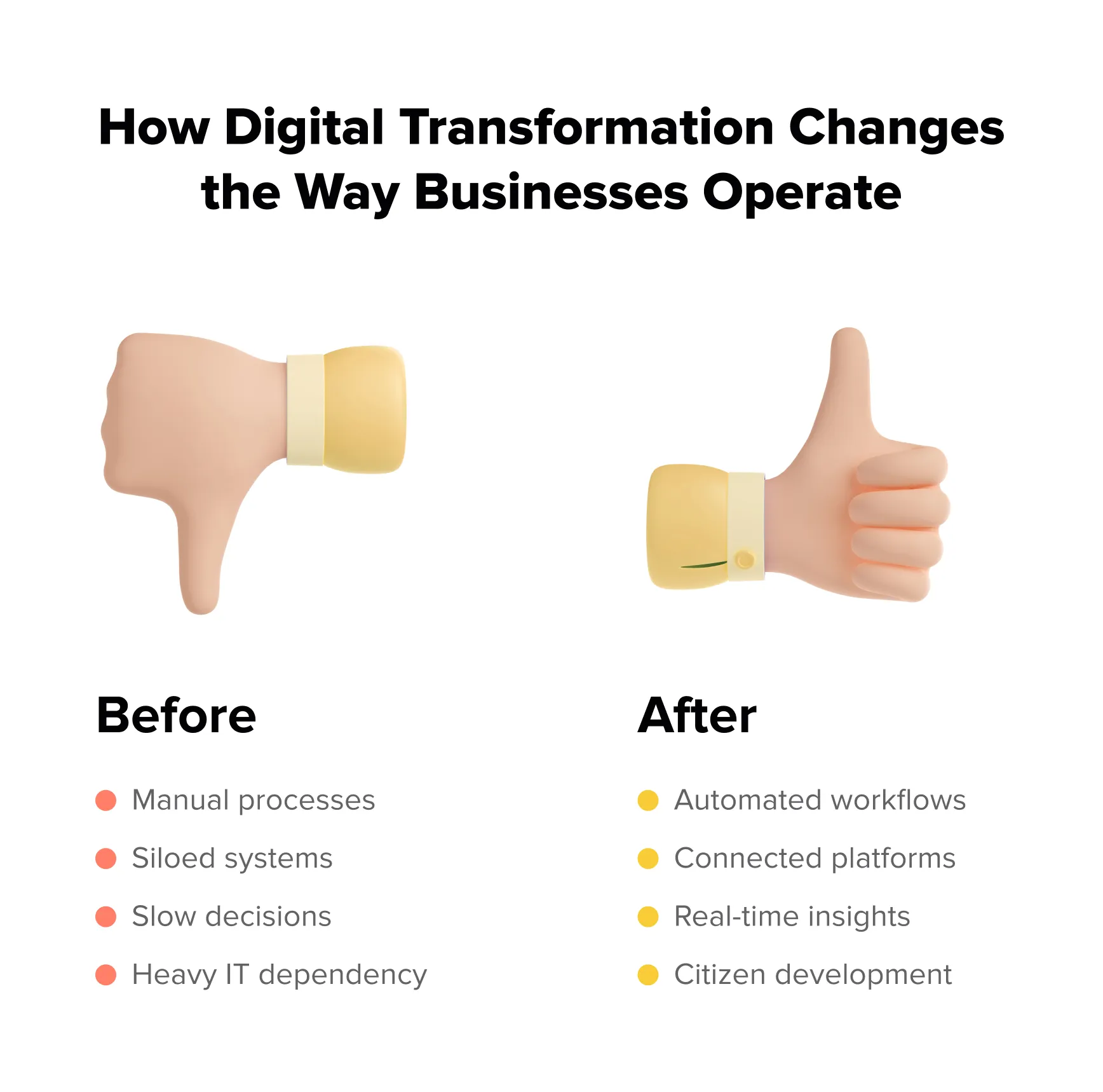
Digital Transformation as a Maturity Model
Because of these challenges, digital transformation should be viewed as a maturity journey rather than a checklist of technologies. Most organizations fall into one of three maturity phases. Each phase has its own priorities, risks, and investment logic.
Understanding this structure helps avoid common mistakes, such as deploying advanced AI before data foundations exist or scaling automation on unstable infrastructure.
Phase | Timeline | Focus Areas | Investment | Key Outcome | Main Risk if Skipped |
Foundational | 0-2 years | Cloud infrastructure, data foundation, cybersecurity, core systems. | $500K-$2M | Stable and scalable digital base. | Fragile systems, poor data quality, security breaches. |
Growth | 2-5 years | Automation, AI adoption, analytics, customer experience. | $2M-$10M | Operational efficiency and competitive advantage. | Low ROI from AI, automation failures, siloed insights. |
Innovation | 5+ years | Agentic AI, composable architecture, advanced analytics, quantum exploration. | $10M+ | Market leadership and rapid innovation. | High costs without business impact, loss of focus. |
Each trend in digital transformation discussed further in this guide is explicitly tied to one of these phases. This approach helps companies focus on what truly delivers value at their current stage.
Jumping ahead without completing earlier phases often leads to wasted budgets, frustrated teams, and underperforming solutions. Building the right foundation first creates the conditions for sustainable growth — and prepares the organization for the advanced trends discussed next.
Foundational Phase: Core Technologies
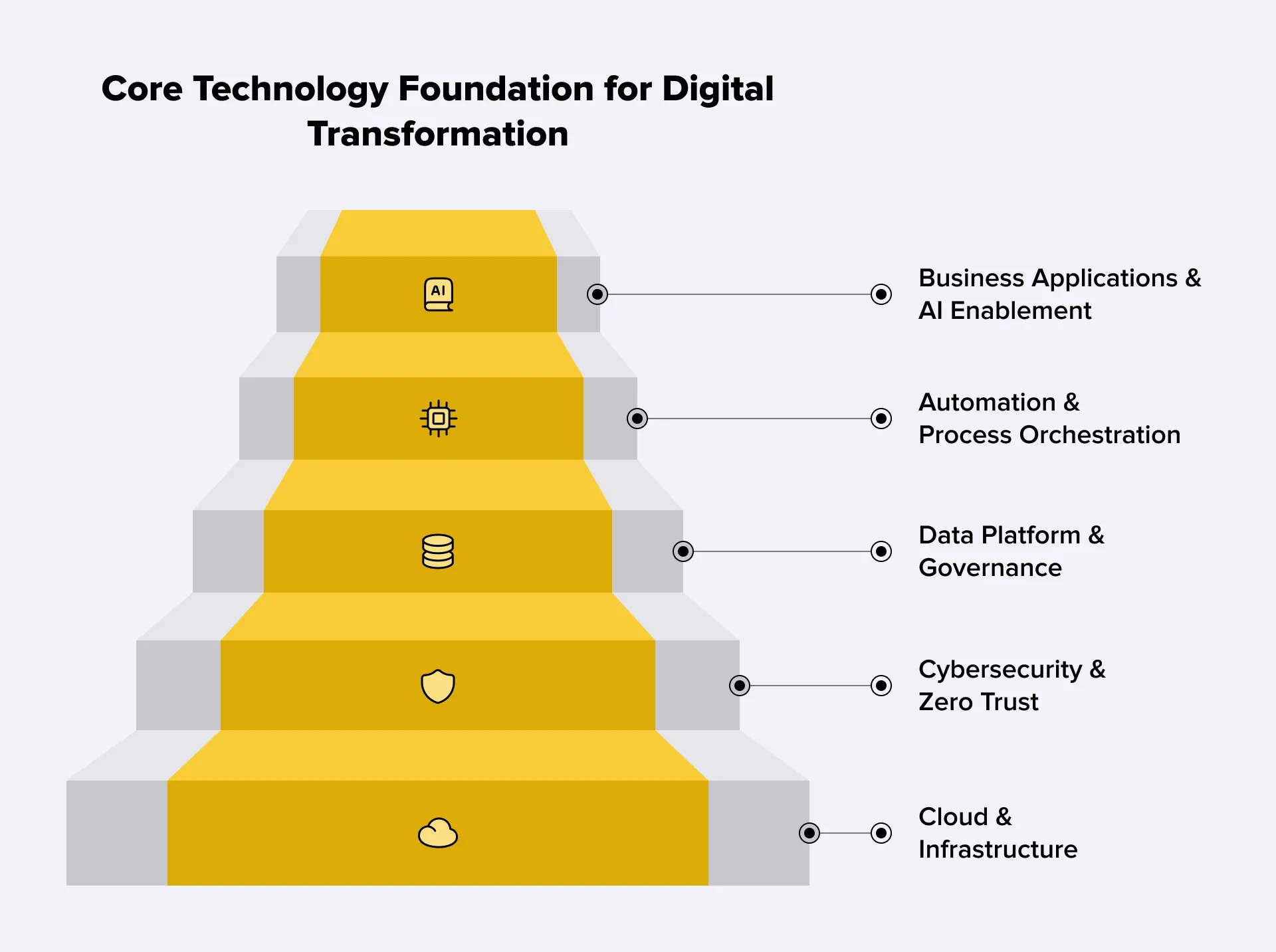
The foundational phase establishes the backbone for digital transformation. Cloud infrastructure, data platforms, cybersecurity, and process automation create a secure, scalable platform that supports speed, resilience, and growth, ensuring advanced technologies like AI or predictive optimization can be adopted without fragile or costly failures. When done right, this phase enables all future initiatives, including complex programs such as а digital transformation in the retail industry, where performance, resilience, and customer experience are tightly interconnected.
Cloud Infrastructure Modernization
Modern cloud infrastructure goes beyond simple migration, using hybrid or multi-cloud setups to balance scalability, security, and regulatory needs. Combined with cloud-native development and DevOps, deployment cycles can be 5–10× faster.
Organizations typically cut infrastructure costs by 30–40%, handle traffic spikes 10× larger without extra planning, and benefit from built-in compliance frameworks. Instant access to AI and ML services further accelerates innovation while reducing capital expenses.
Implementation usually takes 6–12 months, requiring cloud architects and DevOps engineers, with budgets of $200K–$1M. Key risks include migration failures, downtime, and vendor lock-in. Payback occurs within 12–18 months, with some reporting up to 200% ROI by year three.
Practical tip: start with non-critical workloads to prove value before moving mission-critical systems.
Data Infrastructure & Analytics Foundation
A modern data foundation relies on a scalable stack — data lakes, warehouses, ETL pipelines, and BI tools — with real-time analytics increasingly replacing batch reporting. Strong data governance around quality, ownership, security, and access is essential, especially when AI is part of the roadmap.
The impact includes up to 40% faster decision-making, 15–25% revenue growth from data-driven insights, and about 30% less reporting effort. Implementation is medium to high complexity, typically taking 9–15 months with budgets of $300K–$2M. While risks include data quality issues and silos, payback usually comes within 18–24 months, with early gains from improved reporting and longer-term value from predictive analytics.
Key trends to watch include real-time data streaming, data mesh architectures, and unified data platforms that consolidate tools.
Cybersecurity & Zero Trust Architecture
Zero Trust security follows the principle of “never trust, always verify,” enforcing continuous checks through identity management, multi-factor authentication, encryption, and real-time threat detection. Security is embedded early in development using cloud-native tools rather than added later.
The value includes up to 70% fewer breaches, 80% less breach-related downtime, automated compliance reporting, and stronger customer trust, with cyber insurance costs often dropping by about 25%. Implementation typically takes 12–18 months, costs $500K–$3M, and requires skilled security teams. While ROI is hard to quantify upfront, the avoided cost of a breach — averaging $4.45M — makes the investment compelling.
Security is not optional. Skipping this phase can destroy digital transformation investments overnight.
Process Automation (RPA) & Workflow Optimization
Modern cloud infrastructure extends beyond basic migration to hybrid and multi-cloud models that balance scalability, security, and regulatory needs. Combined with cloud-native development and DevOps, this approach enables deployment cycles 5–10× faster than traditional environments.
The impact is measurable: organizations see 30–40% lower infrastructure costs, handle 10× traffic spikes without advance planning, and gain built-in compliance with standards like SOC 2, ISO, and GDPR. Cloud platforms also provide on-demand access to AI and ML services without upfront hardware investment, accelerating innovation while reducing capital expense.
Growth Phase: Advanced Technologies
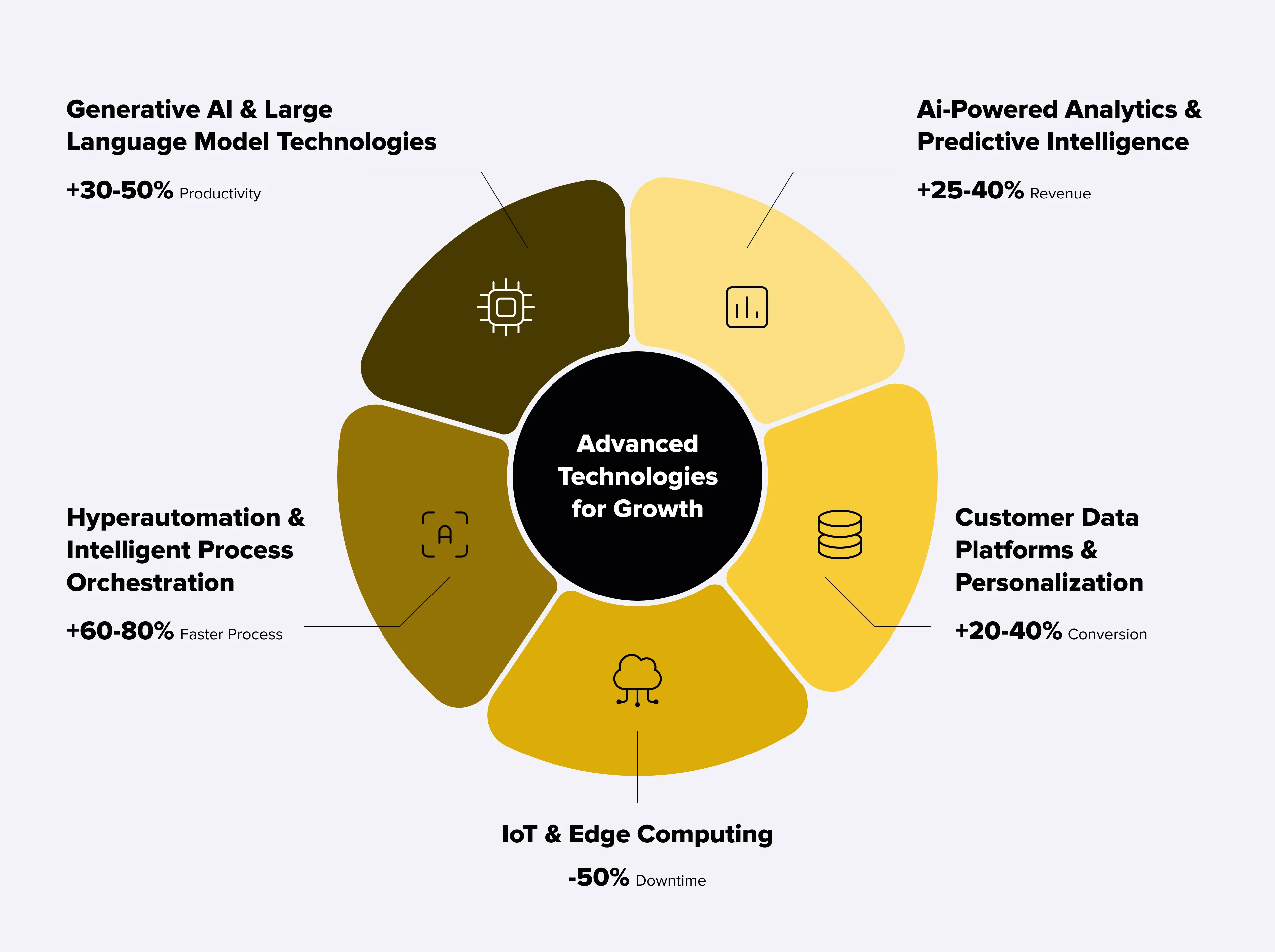
After building a strong foundation, these five advanced technologies accelerate organizational growth. They rely on mature cloud and data infrastructure to operate effectively and deliver compound benefits that strengthen competitive advantage. Implemented strategically, they enable faster decision-making, higher productivity, and more personalized customer experiences. For industries investing in IoT application development, leveraging these technologies can be a game-changer, allowing real-time operations, predictive insights, and seamless automation across business processes.
Generative AI & Large Language Models
Generative AI and large language models such as ChatGPT, Claude, and Gemini are reshaping content creation, coding, and customer service. Enterprises increasingly adopt them through APIs, fine-tuning, and RAG patterns, with projections showing up to 80% adoption by 2026.
The impact includes 30–50% productivity gains, 40% lower content costs, and 10× faster document or code generation, with many organizations automating up to 70% of customer inquiries. Implementation typically takes 3–6 months with medium complexity and budgets of $100K–$1M. While risks include hallucinations, bias, and data leakage, payback often occurs within 6–12 months. The most effective starting points are internal documentation, chatbots, and code assistance, avoiding critical or highly regulated use cases at first.
AI-Powered Analytics & Predictive Intelligence
Predictive analytics leverages machine learning to forecast outcomes like customer churn, demand shifts, maintenance needs, or fraud, enabling proactive, real-time decisions.
Organizations can achieve 25–40% lower churn, 30% fewer stockouts or overstocks, 50% less unexpected downtime, 60% better fraud detection, and 15–30% higher revenue. Implementation takes 9–15 months, with budgets of $500K–$3M, requiring data scientists, ML engineers, and domain experts. Key risks include model drift, poor data quality, overfitting, and explaining “black box” predictions.
ROI generally occurs within 12–24 months. Starting with well-defined, high-impact problems like demand forecasting or customer segmentation ensures measurable results before tackling sparse or highly complex datasets.
Hyperautomation & Intelligent Process Orchestration
Hyperautomation expands RPA with AI-based exception handling and end-to-end process orchestration, enabling intelligent, adaptive workflows across systems. Companies typically achieve 60–80% faster processes, near-100% accuracy, and up to 10× higher throughput without increasing headcount. Implementation is complex, usually taking 12–18 months with budgets of $1M–$5M, and requires strong change management due to legacy integration and organizational impact. ROI is typically realized within 18–30 months, especially when organizations start with one end-to-end process, prove value, and scale gradually.
Customer Data Platforms & Hyper-Personalization
Customer Data Platforms (CDPs) unify customer data across web, mobile, in-store, and support channels, enabling real-time personalization with AI-driven segmentation, recommendations, and omnichannel orchestration.
The impact is significant: 20–40% higher conversion rates, 30% better retention, 25% higher lifetime value, and up to 15% additional revenue. Implementation takes 6–12 months, costs $300K–$2M, and requires marketing technologists, data engineers, and UX designers. Risks include data privacy, system integration challenges, and over-personalization.
ROI usually occurs within 9–15 months, with quick wins from email and website personalization. Full omnichannel orchestration adds lasting value, provided privacy is carefully managed using zero-party data, transparency, and compliance with GDPR/CCPA.
IoT & Edge Computing for Real-Time Operations
IoT and edge computing collect operational data via sensors and process it locally for fast decisions, while digital twins simulate and optimize equipment and processes in real time.
Benefits include up to 50% less unplanned downtime, 20–30% higher operational efficiency, 40% lower maintenance costs, 25% fewer defects, and 60% fewer safety incidents. Implementation is complex, taking 12–24 months with $1M–$10M budgets, requiring IoT architects, engineers, and data scientists. Risks include connectivity, security, and managing large networks. ROI appears in 18–36 months, with fastest returns in Manufacturing, Logistics, Energy, and Healthcare. Even for less operationally intensive firms, strategic IoT investment supports future innovation and resilience.
Innovation Phase: Latest Digital Transformation Trends
The innovation phase represents the cutting edge of digital transformation, where early adoption can deliver significant competitive advantage. These technologies are still maturing, adoption is limited, and implementation requires a solid foundation from the previous phases. Attempting them without stable cloud, data, security, and automation capabilities often leads to high risk and low ROI. Early adopters are using these trends to differentiate, accelerate time-to-market, and explore entirely new business models, positioning themselves ahead of competitors.
Agentic AI & Autonomous Systems
In healthcare mobile app development, agentic AI can automate patient triage, optimize appointment scheduling, and support clinical decision-making with minimal human intervention. Multi-agent AI systems collaborate, continuously learn, and self-optimize, representing a fundamental shift from assisted AI to fully autonomous intelligence. The market is projected to reach $93.2B by 2032.
Agentic AI enables near-instant decisions, handles multiple operations simultaneously, and continuously improves, cutting operational costs by up to 70% and uncovering optimizations beyond human capability. Key applications include autonomous insurance claims, algorithmic trading, self-optimizing production, and complex customer service automation. Implementation is complex (18–36 months, $2M–$10M+, requiring AI researchers, MLOps engineers, system architects, and ethicists) with risks like unpredictable behavior and regulatory challenges. ROI typically appears after 24–48 months; adoption should start with controlled pilots, keep humans in the loop, and expand gradually.
Composable Architecture & Modular Systems
Composable architecture transforms monolithic systems into modular, interchangeable components using microservices, API-first design, and MACH principles. Benefits include faster feature launches, safe experimentation, 30% lower development costs, and 40% quicker time-to-market. Implementation is complex—18–36 months for legacy systems—requiring architects, developers, and integration specialists, with budgets of $2M–$15M. Risks include integration challenges, governance issues, and technical debt, while ROI typically appears in 24–48 months as agility and innovation accelerate, making it ideal for large enterprises or frequent M&A activity.
Quantum Computing & Advanced Analytics
Quantum computing offers a fundamentally new approach, solving certain problems exponentially faster than classical systems. Promising applications include drug discovery, financial modeling, logistics optimization, and quantum-safe cryptography, enabling solutions in minutes that would otherwise take years. Implementation is complex, requiring 3–5+ years, $5M–$50M budgets, and specialized talent, with risks from immature technology and limited practical use cases. ROI is uncertain and long-term, so most organizations should adopt a “watch and learn” approach — monitor progress, explore potential industry applications, and build awareness and partnerships for future adoption.
Industry-Specific Adoption Priorities
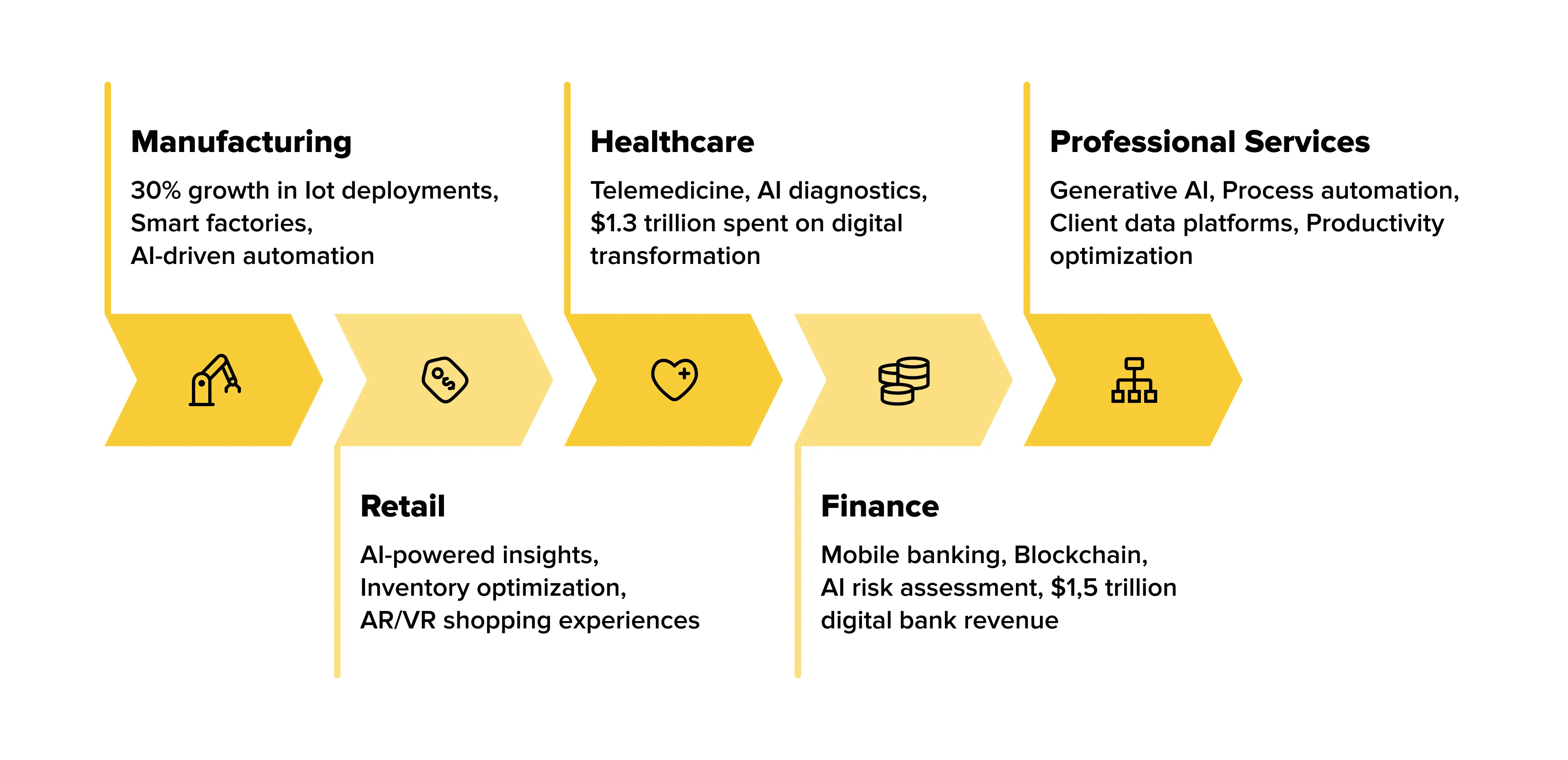
Different industries prioritize digital transformation trends based on their unique operational challenges, regulatory requirements, and customer expectations. While some technologies deliver broad benefits across sectors, targeted adoption ensures that investments address specific pain points, improve efficiency, and drive measurable business outcomes.
Understanding these priorities allows organizations to allocate resources effectively, achieve faster ROI, and build momentum for broader initiatives. By focusing on the trends that matter most, companies can modernize strategically without overextending budgets or capabilities.
Manufacturing
Manufacturing relies heavily on operational efficiency, equipment reliability, and production quality. IoT and edge computing enable predictive maintenance, reducing downtime and extending asset life, while AI-powered analytics supports quality control and demand forecasting. Hyperautomation streamlines supply chain and production workflows, and digital twins optimize plant operations through virtual simulations.
Typical investments range from $2M–$10M over 2–3 years, with expected ROI of 30–40% operational cost reduction and a 25% improvement in overall equipment effectiveness (OEE). A practical quick win is launching a predictive maintenance pilot on the most critical equipment, demonstrating immediate value and establishing a foundation for scaling automation and analytics initiatives.
Retail & E-commerce
Retail and e-commerce companies prioritize these trends to address fragmented customer data, fluctuating demand, and increasing expectations for personalized experiences. Customer Data Platforms (CDPs) solve the problem of siloed data by creating a unified customer view, enabling personalized offers and messaging across channels. Generative AI is commonly used for product descriptions, marketing content, and customer support automation, reducing operational costs and time to market. Cloud infrastructure allows businesses to scale reliably during peak traffic periods, while AI-driven analytics supports smarter inventory planning and dynamic pricing decisions.
Typical investments range from $1M to $5M over 18–24 months, with realistic ROI including 20–30% conversion rate improvement and up to 15% basket size growth. A proven quick win is implementing a CDP to centralize customer data and launch basic personalization early.
Financial Services
Financial institutions must balance compliance, efficiency, and risk management. Cybersecurity and Zero Trust protect sensitive data, while AI analytics detect fraud, assess credit, and manage risk. Process automation streamlines back-office and compliance workflows, and agentic AI is emerging for claims and underwriting. Investments typically range from $3M–$15M over 2–4 years, with expected ROI of 40% lower operational costs and 60% improved fraud detection. A practical quick win is automating document processing in back-office operations, which reduces manual effort and accelerates compliance. Companies exploring AI software development can integrate advanced predictive models into core services to further enhance operational efficiency.
Healthcare
Healthcare organizations focus on patient care, operational efficiency, and data interoperability. Cloud infrastructure supports EHRs and secure data sharing, while robust data platforms enable analytics on patient records. IoT and edge computing allow remote monitoring, and AI analytics supports diagnosis and operations.
Investments typically range from $2M–$10M over 2–3 years, with ROI including a 30% reduction in administrative costs and improved patient outcomes. A quick win is integrating cloud-based EHRs to enhance data access and care delivery.
Professional Services
Professional services firms prioritize efficiency, client satisfaction, and knowledge management. Generative AI speeds up proposals and deliverables, while process automation streamlines workflows and billing. Customer Data Platforms centralize client information, and AI analytics optimize resource use and project performance. Investments typically range from $500K–$3M over 12–18 months, with expected ROI of 40% productivity gains and 20% margin improvement. A quick win is using generative AI for proposals and client deliverables, freeing staff for higher-value work.
Driving Digital Transformation: 4-Phase Implementation Framework
Successful digital transformation requires a phased approach, building a strong foundation, proving value early, and scaling based on evidence.
Phase 1: Assessment audits technology, data, processes, and skills, secures stakeholder buy-in, defines timelines, and sets KPIs. Activities include workshops, architecture reviews, and maturity assessments, producing a roadmap, business case, and KPI framework. Costs are low (5–10% of budget), with ROI mainly from risk reduction. Key risks are misaligned expectations and unclear ownership.
Phase 2: Foundation establishes cloud infrastructure, data platforms, and security while delivering quick wins. Activities cover cloud migration, data integration, security design, and basic automation. This phase consumes 40–50% of the budget, with ROI in 12–24 months. Risks include scope creep, migration failures, and resistance to change.
Phase 3: Growth deploys advanced technologies and scales proven pilots. The strategy is to start with 1–2 high-impact use cases per technology, prove value (often ROI >200%), then expand. Deliverables include scaled solutions and measurable business impact. Risks center on over-scaling before value is proven.
Phase 4: Innovation embeds continuous optimization and experimentation. DT becomes an operating model, not a project, supported by an innovation culture and emerging technology pilots.
This structured framework reduces risk, accelerates time to value, maximizes ROI, and ensures continuous improvement becomes part of everyday operations.
Keys to Successful Digital Transformation: Critical Factors & Pitfalls to Avoid
Understanding digital transformation risks is crucial, as nearly half of initiatives — about 48% — fail to meet their goals (Gartner). Failures are rarely due to technology alone; they usually stem from misaligned priorities, weak execution, and overlooked organizational challenges. Identifying these risks early helps companies make better decisions, avoid common pitfalls, and improve the likelihood of successful, value-driven transformations.
Executive Commitment: Nearly 80% of failures stem from weak leadership support. Secure commitment by framing DT in business terms (revenue, cost, risk), showcasing competitor progress, delivering quick wins, providing regular updates, and tying bonuses to DT metrics. Red flags include “IT will handle it,” CIO-only ownership, or sudden budget cuts.
Data Foundation First: About 67% of AI initiatives fail due to poor data quality. Allocate ~40% of the DT budget to data foundations — warehouse, ETL, governance, and quality — before GenAI. Expect 9–15 months for a solid base.
Change Management: Technology is easier than people; up to 70% of resistance comes from employees. Invest 15–20% of the budget in communication, training, champions, and celebrating wins.
Start Small, Scale Fast: Big-bang approaches fail up to 90% of the time. Use 3–6 month pilots with clear metrics. Scale only when ROI >200%, satisfaction >80%, and stability is proven.
Strategic Vendor Partnership: Use a clear Build vs Buy vs Partner framework. Evaluate vendors on industry expertise, track record, cultural fit, pricing transparency, and exit options.
Technology Hype vs Reality → to avoid costly missteps, separate experimentation from execution, require proofs of concept before major investments, validate assumptions by speaking with real users, and prioritize proven technologies that deliver practical business value.
Measuring Your Digital Transformation Initiative: Success Metrics & KPIs
Clear KPIs are essential for digital transformation, linking technology investments to business outcomes and making progress visible. They enable leadership to validate value, prioritize resources, and adjust initiatives early, preventing small issues from becoming costly failures and keeping transformation aligned with strategic goals.
Category | What It Measures | Key Metrics | Targets | Frequency |
Financial | Business value and return on investment. | ROI by initiative, TCO, cost savings, revenue growth, payback period. |
| Quarterly |
Operational | Efficiency, reliability, and execution speed. | Cycle time, error rates, system uptime, deployment speed, productivity. |
| Monthly |
Strategic | Competitive position and long-term impact. | Market share, time to market, innovation rate, talent attraction. |
| Quarterly |
Cultural | Adoption, engagement, and sustainability. | Digital adoption, training completion, change sentiment, innovation ideas. |
| Monthly |
Tracking financial metrics validates ROI, operational metrics ensure efficiency, strategic metrics confirm competitive impact, and cultural metrics measure sustainability. Together, they enable data-driven optimization throughout the DT journey.
The Future: What's Next After 2026
The next wave of digital transformation is already emerging. Between 2027 and 2030, early enterprise adoption of AGI may appear, 6G will enable speeds up to 100× faster than 5G, and fully autonomous operations could take hold in controlled environments like logistics or manufacturing. Brain-Computer Interfaces are likely to remain experimental until 2030+.
To stay ahead, companies need an innovation radar: a small dedicated team, quarterly trend reviews, pilot budgets around 10% of IT spend, and partnerships with universities. A learning culture and flexible, composable architecture are essential. Digital transformation is never “finished” — it becomes how the business operates.
How to Accelerate Your Digital Transformation with Strategic Partners
Digital transformation progresses faster and more reliably with strategic partners, who bring cross-industry experience, proven frameworks, and fresh perspectives. They help prioritize initiatives, sequence investments, and focus on measurable business outcomes, reducing wasted effort and keeping transformation aligned with growth, efficiency, and long-term resilience.
In this context, Lampa works as a practical digital transformation partner for mid-market companies with revenues between $10M and $500M. We combine technical expertise with real business understanding gained across manufacturing, retail, financial services, healthcare, logistics, and other industries.
If you’re planning your next digital step or looking to reduce uncertainty early, a short conversation or complimentary assessment with our team can help clarify priorities and shape a realistic roadmap.
Conclusion: Your Digital Transformation Journey
Digital transformation is never truly complete. Technology keeps evolving, and so do customer expectations, markets, and risks. Successful companies don’t treat DT as a one-time project — they build the ability to adapt continuously. While 94% of organizations are engaged in digital transformation, only around 48% achieve meaningful success. The difference lies in strategy. Random technology adoption rarely works. A phased, maturity-based approach helps prioritize the right initiatives, sequence investments, and turn trends into lasting business value.