
Choosing the right Android app development framework in 2026 is not just a tech decision. It affects your app’s performance, launch speed, costs, and scalability. The right framework can make a product feel polished and responsive. This guide will walk you through the best options for Android development – whether you’re a solo developer or building for business.
Why Android App Frameworks Matter in 2026
In 2026, the mobile world is moving fast. Picking the right Android app development framework matters more than ever. Demand for high-quality apps is growing alongside the number of Android users worldwide. Today, Android holds roughly 72–73% of the global mobile OS market, with nearly 3.9 billion active users on Android devices. This massive reach means your choice of framework affects not just how quickly your app is built, but also how well it performs on real devices and how wide your audience can be.
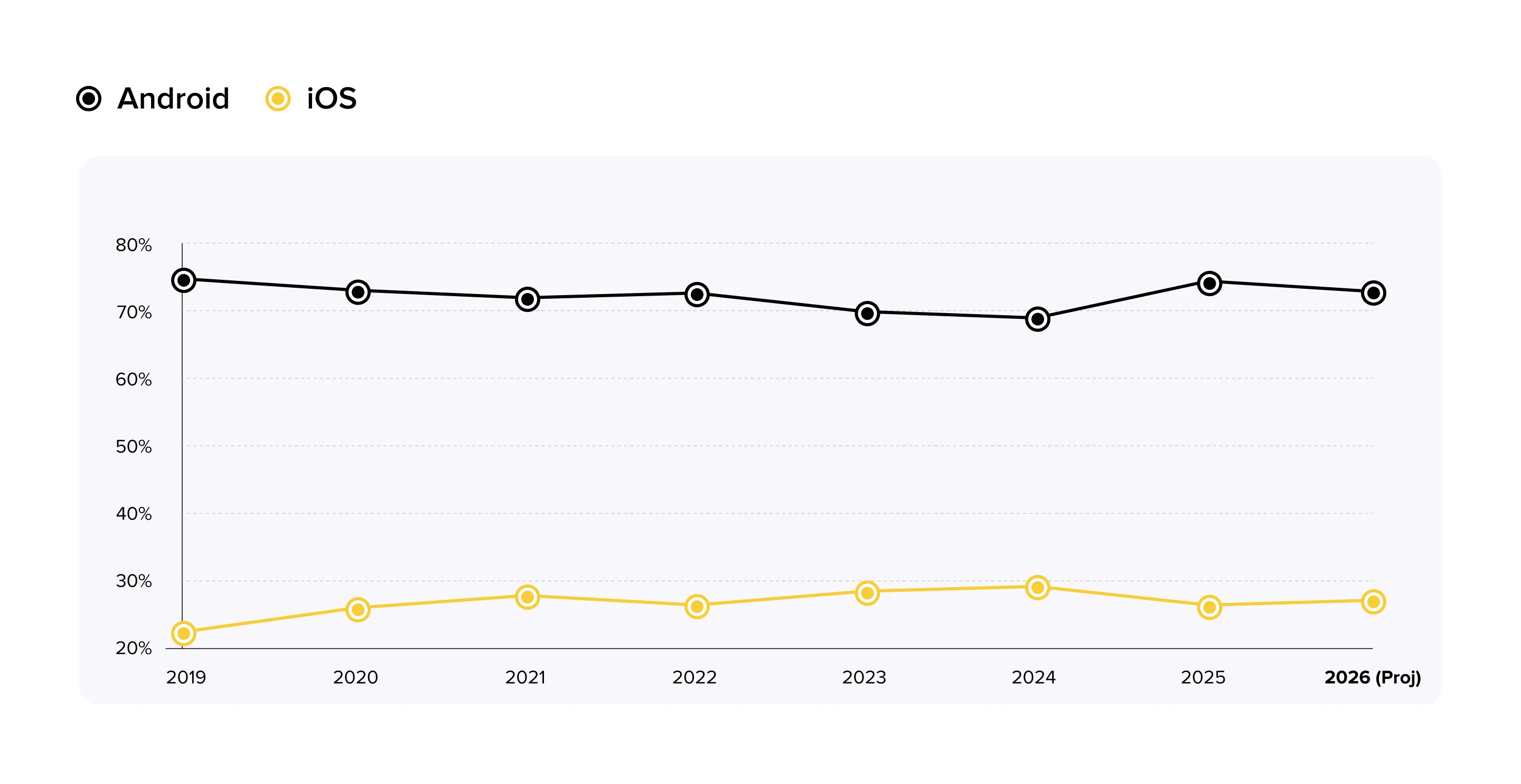
Here’s how the right Android development framework shapes your project:
Best Android App Development Frameworks
Development speed and time-to-market – Some frameworks let you write code once and use it across many devices. That can cut weeks off your timeline.
Cost efficiency and resource allocation – The right tools help you save money on dev hours and reduce ongoing maintenance costs.
App performance and user experience – Performance is key for engagement. Frameworks with near-native performance levels help your app feel fast and smooth.
Scalability and future-proofing – Good frameworks grow with your app and adapt as requirements change.
Access to device features and native capabilities – Integrations with cameras, sensors, AR, notifications, and more make your app feel modern and powerful.
These factors define not only how your app is built, but how it survives in a competitive market. A strong framework choice helps you launch faster, scale with confidence, and deliver a product users actually enjoy using. In 2026, this is not just a technical decision — it’s a business strategy.
Framework choice, however, only gets a product to the starting line. Getting it discovered once it's live in Google Play or the App Store is a separate discipline — Netpeak is one of the agencies that focuses specifically on App Store Optimization, helping apps convert that technical foundation into actual visibility and downloads.
Top 8 Best Frameworks for Android App Development in 2026
The landscape of Android app development frameworks keeps evolving, and 2026 brings stronger tools, clearer standards, and sharper competition. Below is a curated list of the best frameworks for Android app development, selected based on performance, industry adoption, community strength, market share, and long-term viability. Each framework solves different challenges, so the right choice depends on your product goals.
1. Flutter
Flutter remains a dominant force among best frameworks for Android app development in 2026. With roughly 42% market share in cross-platform development, it continues to attract startups and enterprises building apps across Android, iOS, web, and desktop from a single codebase.
Flutter relies on Dart and uses a widget-based architecture that gives full control over UI components. Its hot reload feature reduces development time and allows developers to see changes instantly during the development process. Thanks to its own rendering engine, Impeller, Flutter delivers stable performance without relying on native UI components.
Well-known products such as Google Ads and Alibaba run on Flutter. It works especially well for MVPs, marketplaces, fintech solutions, and scalable mobile platforms.
The trade-offs are practical rather than critical: larger app sizes and a smaller Dart talent pool compared to JavaScript-based ecosystems.
2. React Native
React Native is one of the most widely adopted Android app frameworks for cross-platform mobile application development. Holding about 38% of the market, it remains a strong choice for teams that want to share code between Android and iOS while keeping access to native APIs.
The framework uses JavaScript or TypeScript, which means access to the largest global developer pool. It supports hot reload, integrates smoothly with third-party libraries and tools, and allows developers to build mobile interfaces that closely match native look and feel.
Apps such as Instagram and Tesla use React Native in production. It performs well for social platforms, delivery services, and content-driven apps across Android devices.
However, animation-heavy or graphics-intensive applications may experience performance dips compared to fully native solutions.
3. Jetpack Compose
Jetpack Compose defines modern Android development in 2026. As Google’s official UI toolkit, it replaces traditional XML layouts with a declarative Kotlin-based approach.
Instead of separating layout files and logic, Compose allows developers to write UI directly in Kotlin. This reduces boilerplate code and speeds up the development process. Integration with Android Studio is seamless, and the framework works directly with the Android SDK to provide full access to native device APIs.
Key advantages include:
Cleaner and more readable native code
Faster UI iteration
Improved performance optimizations introduced in 2026
Long-term support from Google
Jetpack Compose is the strongest option for Android-only projects that require building native high-performance mobile applications. It is also the most future-proof path for Android application development, focused entirely on the Android app ecosystem.
4. Kotlin Multiplatform (KMP)
Kotlin Multiplatform (KMP) by JetBrains is gaining strong momentum in 2026. Instead of forcing a shared UI, it focuses on sharing business logic across platforms while keeping native UI layers intact. This makes it one of the most practical Android app frameworks for teams that prioritize long-term scalability.
KMP allows gradual adoption. You can integrate it into an existing project built in Android Studio without rewriting the entire app. That flexibility reduces risk and shortens the development process.
Companies such as Duolingo and Philips use Kotlin Multiplatform in production. It delivers native compilation and strong performance across Android devices.
The limitation is clear: UI must still be implemented separately for each platform. For Android-first products, however, KMP offers a balanced mix of shared logic and fully native experience.
5. Expo
Expo strengthens the React Native ecosystem and significantly simplifies mobile application development. In 2026, it remains one of the most widely adopted tools inside React Native projects.
Expo removes complex native configuration at the beginning. Developers can start building immediately, access pre-built libraries and tools, and test apps on Android devices through Expo Go. SDK 52 introduces extended support for Jetpack Compose and SwiftUI components, plus stable over-the-air updates.
This platform works especially well for:
MVP launches
Startup validation
Rapid product iterations
Hybrid mobile app development with minimal setup
Expo accelerates faster development and reduces initial costs. However, advanced native modules may require custom development builds, which slightly increases complexity in larger projects.
6. Xamarin / .NET MAUI
Xamarin has evolved into .NET MAUI, Microsoft’s unified cross-platform solution. With around 11% market share, it remains relevant in enterprise-grade Android app development frameworks.
Built on C#, it integrates deeply with Visual Studio and Azure. This ecosystem makes it attractive for companies already invested in Microsoft technologies. Developers gain access to native APIs while maintaining a shared codebase across mobile platforms.
Apps like Alaska Airlines rely on this stack. It is frequently chosen for finance, logistics, and regulated sectors, including healthcare mobile app development.
The main trade-off is slower community-driven innovation compared to frameworks like Flutter or React Native. Still, for corporate software development, stability often outweighs speed of change.
7. Ionic + Capacitor
Ionic combined with Capacitor represents a practical hybrid approach. Holding roughly 16% of the hybrid market, it allows developers to build apps using web development skills — HTML, CSS, and JavaScript.
Capacitor replaced Apache Cordova as a more modern runtime. It provides improved access to native device APIs and supports integration with Angular, React, and Vue.
Ionic is suitable when:
Web teams transition into mobile platforms
Budget constraints require efficient delivery
The project includes web apps and PWAs
Rapid development cycles are a priority
Because it relies on WebView, performance may not match fully native frameworks in graphics-heavy or game development scenarios. Still, for business applications and content-driven platforms, it remains a practical option.
8. NativeScript
NativeScript is an open-source framework for building apps that require direct access to native platform APIs without relying on WebView. Developers write in JavaScript or TypeScript, yet the code compiles into native instructions.
NativeScript supports Angular and Vue.js, includes hot module replacement, and offers 100% access to native APIs. This makes it suitable for apps that demand deeper system integration or advanced native device APIs.
It works best for teams that want native performance but prefer a JavaScript stack. The limitation is a smaller ecosystem compared to larger Android app development frameworks like Flutter or React Native.
Best Frameworks for Android Development: Comparison Table
To make the choice easier, here’s a clear comparison table of the best frameworks for Android development. It helps quickly evaluate each option by core criteria — from performance and language to learning curve and ideal use cases. This overview is especially useful when choosing between native tools and cross-platform frameworks for different project types.
Framework Name | Type | Programming Language | Performance | Learning Curve | Best For |
Flutter | Cross-platform | Dart | High (near-native) | Medium | Fast product launches, startups, and scalable apps. |
React Native | Cross-platform | JavaScript / TypeScript | Medium-High | Low-Medium | MVPs, social apps, cross-platform products. |
Jetpack Compose | Native | Kotlin | Very High | Medium | Android-only apps, native performance needs. |
Kotlin Multiplatform | Cross-platform (logic) | Kotlin | High | Medium-High | Shared logic + native UI. |
Expo | Cross-platform | JavaScript / TypeScript | Medium-High | Low | Rapid MVPs, startups, prototypes. |
Xamarin / .NET MAUI | Cross-platform | C# | Medium-High | Medium | Enterprise apps, Microsoft ecosystem. |
Ionic + Capacitor | Hybrid | HTML, CSS, JavaScript | Medium | Low | Web-to-mobile projects, PWAs. |
NativeScript | Cross-platform | JavaScript / TypeScript | High | Medium | Deep native integration with JS stack. |
How to Choose the Best Android App Development Framework for Your Project
Choosing a framework should feel like a strategy, not a guess. The right decision comes from structure, not instinct.
Start with the project vision and scope.
A simple idea needs speed and flexibility. A complex platform needs architecture, stability, and scalability. Be clear about what you are building, not just what you want to launch first.Move to target platforms.
If the focus is Android-only, native frameworks provide the cleanest and most efficient path.
If multi-platform growth is part of the plan, cross-platform solutions help reduce duplication, cost, and long-term maintenance effort.Then evaluate team expertise and available resources.
The strongest framework is the one your team can use confidently. Existing skills in JavaScript, Kotlin, or C# should guide the decision more than market trends.Next comes performance and UX requirements.
Apps with complex animations, real-time features, or heavy data processing need near-native performance. Simpler interfaces allow more flexibility in technology choice.After that, consider budget and timeline constraints.
Fast frameworks with reusable components shorten development cycles. More complex stacks improve quality control but also increase costs and delivery times.Now think long-term: maintenance, scalability, and ecosystem stability matter if the product is meant to grow. Mature frameworks with strong communities reduce technical risk and future hiring challenges.
Finally, define native feature needs and UI/UX complexity.
Deep hardware integration and custom interface logic quickly narrow the list of suitable frameworks.
The best choice is never about one single factor. It comes from aligning real project needs with team skills, technical limits, and long-term plans. When these elements match, the framework simply works – supporting the product instead of slowing it down.
Best Examples of Android Apps Built with These Frameworks
Real projects show better than theory how the right framework choice drives real results. One clear example is the Audiokitab mobile app development case – a real product delivered by the Lampa team as part of our Android development portfolio.
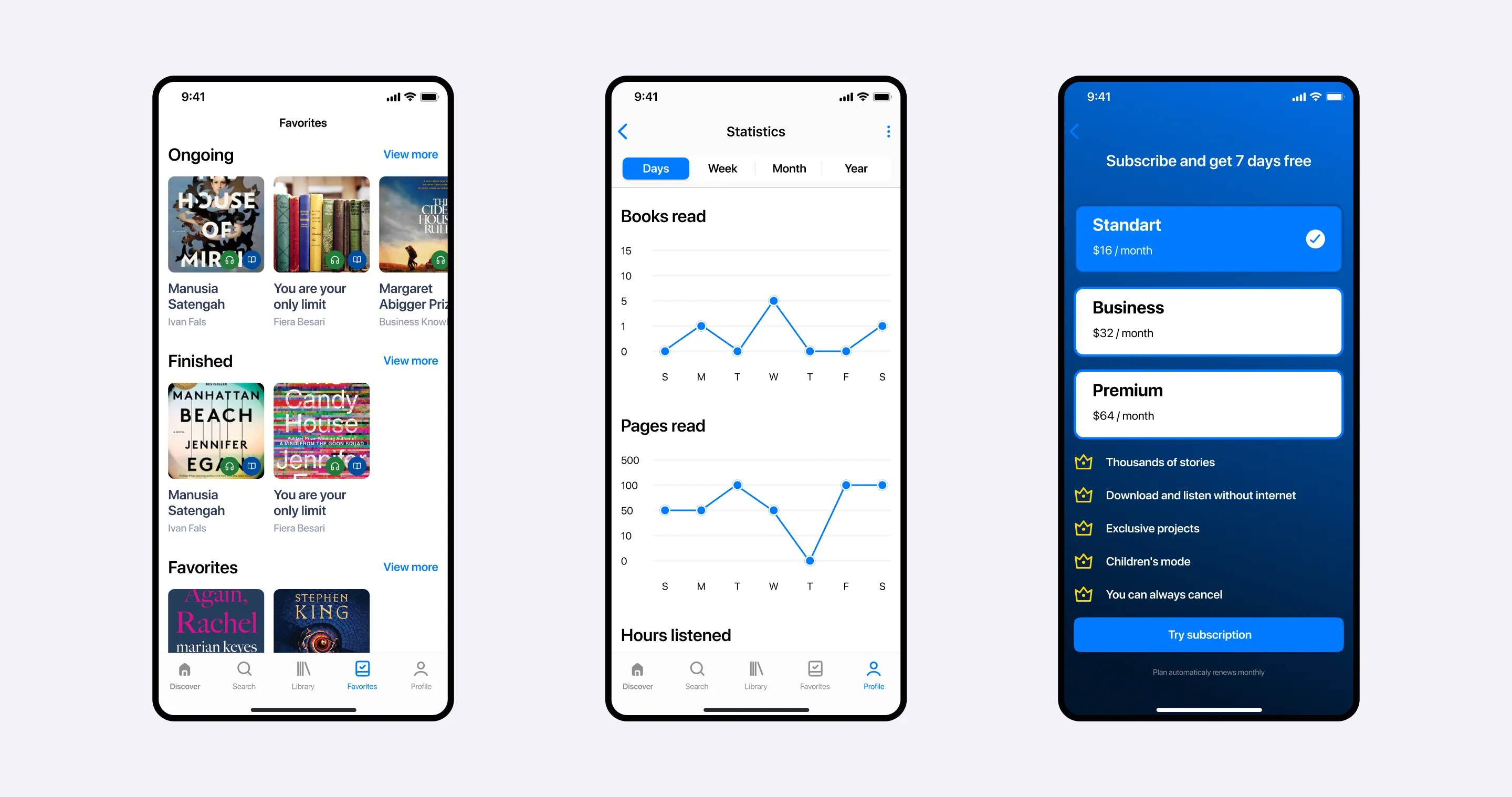
Audiokitab is an audiobook platform focused on delivering a smooth, reliable listening experience on Android devices. The project required a stable architecture, a clean user interface, and a scalable structure that could support content growth and increasing user demand. The framework and technology stack were selected to ensure consistent performance across devices, efficient development workflows, and long-term maintainability. This allowed the product to evolve without technical bottlenecks and ensured predictable scaling as the platform expanded.
This case demonstrates a key principle: success doesn’t come from choosing the trendiest framework – it comes from choosing the right one for the product’s real needs. When business goals, technical requirements, and framework strengths align, development becomes faster, more stable, and more sustainable in the long run.
If you’re planning an Android product and aren't sure which framework best fits your goals, the Lampa team can help. We provide expert consultation to select the right technology stack and support your project from concept to launch – and through long-term growth.