
The discovery phase in software development is the point where ideas stop being abstract and start gaining structure. It is the first real step that helps avoid market misalignment, uncontrolled costs, and product decisions based on assumptions. Instead of jumping straight into code, this phase creates a clear direction for the project and aligns business goals with technical reality. A well-run software development discovery phase reduces the risk of product failure and saves both time and money across the entire project development process. It also sets a strong foundation for building scalable solutions in Hi-Tech software development.
What Is a Discovery Phase in Software Development?
At the very beginning of a project, the discovery phase of a software project brings teams together to analyze business objectives, user expectations, and technical limitations before development starts. At this stage in software development, ideas are no longer treated as assumptions. Instead, they are questioned, refined, and validated. Requirements get clearer, risks are exposed early and weak hypotheses are overturned before they are costly mistakes. The deliverable here is not code or design assets, but a shared understanding of what needs to be built, and why. The following teams collaborate at the inception of the project to define the vision, establish achievable goals, specify the scope of the project, and document requirements for the software to be used in making decision throughout the project development.
As the process moves forward, this phase of a software development workflow gradually turns abstract concepts into actionable plans. Research activities, stakeholder workshops, early prototypes, and technical analysis help connect business expectations with real technical possibilities. These steps create a solid foundation for development and reduce uncertainty. In some situations, the discovery phase of a project can also take place mid-way, especially when changes during development force teams to revisit priorities. This flexibility helps ensure project success and keeps the entire product development cycle aligned with real needs.
When is a Project Discovery Phase Needed?
At the start of many projects, confidence can be misleading. An idea may seem clear, the goal obvious, and the solution already imagined. Yet experience shows that early certainty often hides blind spots. A discovery phase becomes essential when decisions are based on assumptions rather than verified data. It helps teams slow down before moving fast.
This phase is especially important when stakes are high. Limited budgets, tight timelines, or long-term expectations leave little room for mistakes. Discovery allows teams to explore risks early, align perspectives, and define a realistic path forward. In such cases, it is not just helpful but critical for project success.
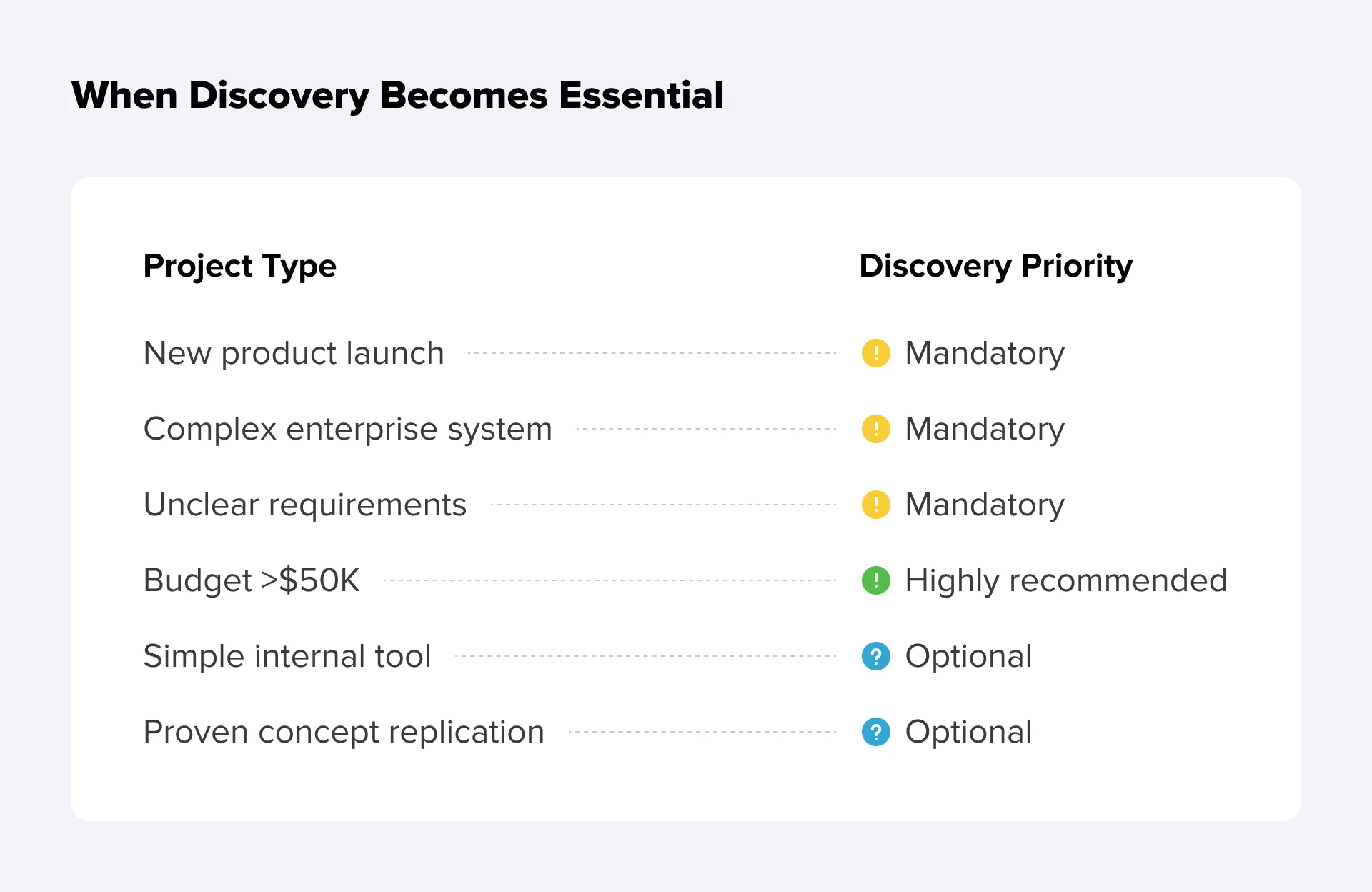
When Your Idea Needs Validation
Many projects start with a rough concept rather than a finished idea. The problem might be identified, but the solution is still forming. There may be doubts about who the users are, how they behave, or whether the market is ready. Stakeholders might also have different expectations, each based on personal assumptions.
The discovery phase creates space to challenge these assumptions. Through user interviews, competitor analysis, and hypothesis testing, ideas are examined in a safe, low-cost way. Instead of guessing, teams collect evidence. Vague thoughts turn into defined features, priorities, and use cases.
This process also helps eliminate weak directions early. Concepts that seem attractive at first may prove impractical or unnecessary. Discovery allows teams to refine or discard them before real development begins. As a result, the project moves forward with confidence, clarity, and a validated foundation.
For Complex or Large-Scale Projects
Complex projects rarely fail due to a big mistake. Issues tend to come in waves of small mistakes. Big systems and products have many features, integrations, teams, and dependencies. Without adequate discovery, you can lose key aspects early when it’s still cheap to fix them. The probability of divergence seems to grow with complexity. Various teams may have different interpretations of the requirements and decisions that are made too quickly on a technical level may limit scalability or performance.
Discovery helps break a complex system into understandable parts. It allows teams to map dependencies, define boundaries, and agree on priorities. This structured approach reduces chaos during development, as risks are identified before they turn into blockers and expectations are aligned across business and technical teams. For large or complex projects, discovery is often the difference between controlled growth and constant firefighting.
When Budget and Timeline Are Critical
Projects with fixed budgets or strict deadlines leave little room for trial and error. Every wrong assumption turns into lost time or extra cost. Starting development without discovery in such cases increases pressure and uncertainty from day one.
Discovery helps teams make informed trade-offs early. Features are prioritized based on value, not guesswork. Technical approaches are evaluated against time and cost constraints. This leads to more accurate estimates and realistic timelines.
Instead of reacting to problems mid-development, teams can plan around them. Discovery does not slow the project down. It protects it from expensive surprises and helps use resources where they matter most.
Projects with Uncertain User Needs
Unclear user needs are one of the most common reasons for product failure, as teams often build based on internal opinions rather than real behavior. The discovery phase provides time and tools to understand users before committing to solutions. Through interviews, surveys, and persona development, teams learn who users are and what they actually need, making patterns and pain points visible. This insight helps shape features that solve real problems instead of imagined ones. Discovery also reveals differences between user groups, since what works for one segment may not work for another. By understanding these differences early, teams can design flexible and inclusive solutions, creating a user-centered foundation that significantly increases the chance of long-term success.
What Happens If You Skip the Discovery Phase in Software Development Project?
Skipping the discovery phase often means starting work without a clear direction for the project. When goals, priorities, and constraints are not fully defined, the team is forced to make decisions on the fly. As a result, the project plan becomes unstable, and the overall vision of the software product may change several times before release.
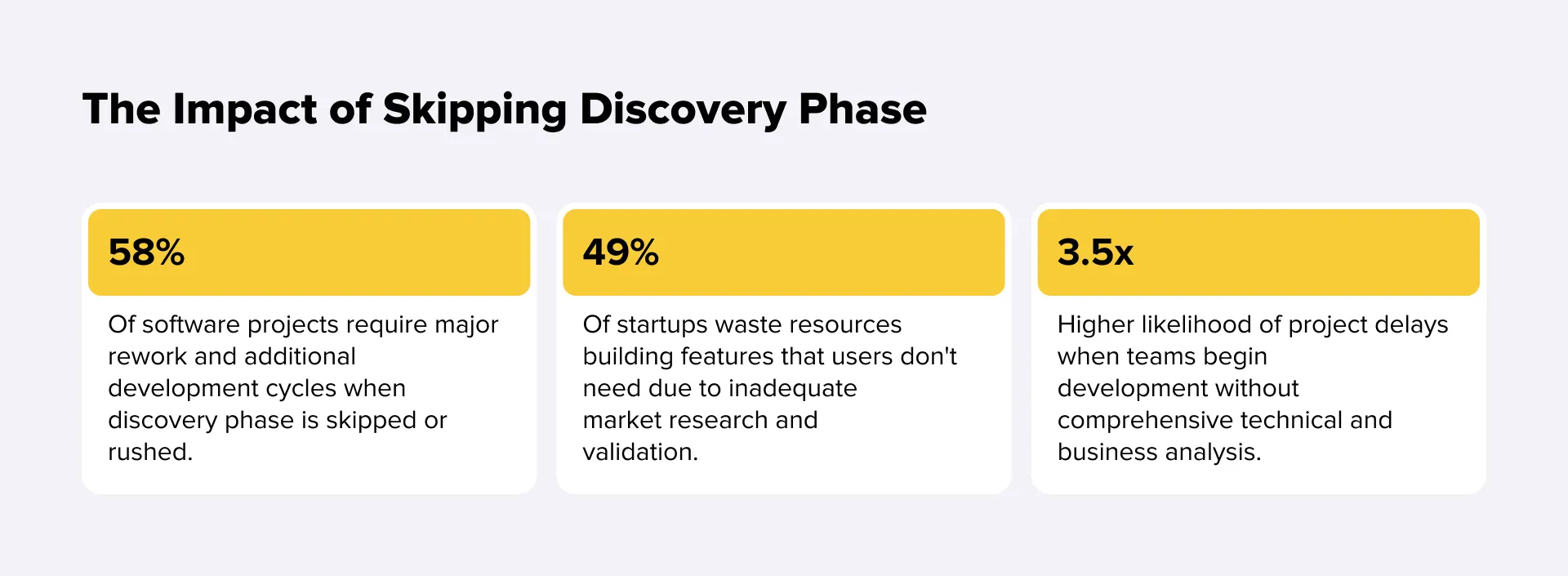
One of the most common consequences is continuous scope changes during development. Without a well-defined project scope and validated software requirements, new ideas and fixes appear late in the process. These changes slow down progress and make it harder to control the project timeline. At the same time, unforeseen technical or business challenges become difficult to handle because no foundation for development was created earlier.
Financial risks also increase. Skipping this phase often leads to budget overruns and wasted time and money, as teams need to rework features or redesign core elements of the software. Product quality may suffer as well. Decisions made under pressure usually affect usability, stability, and user satisfaction. Finally, misalignment with stakeholder expectations can surface too late, increasing the risk of serious delays or even project failure.
Discovery Phase Deliverables
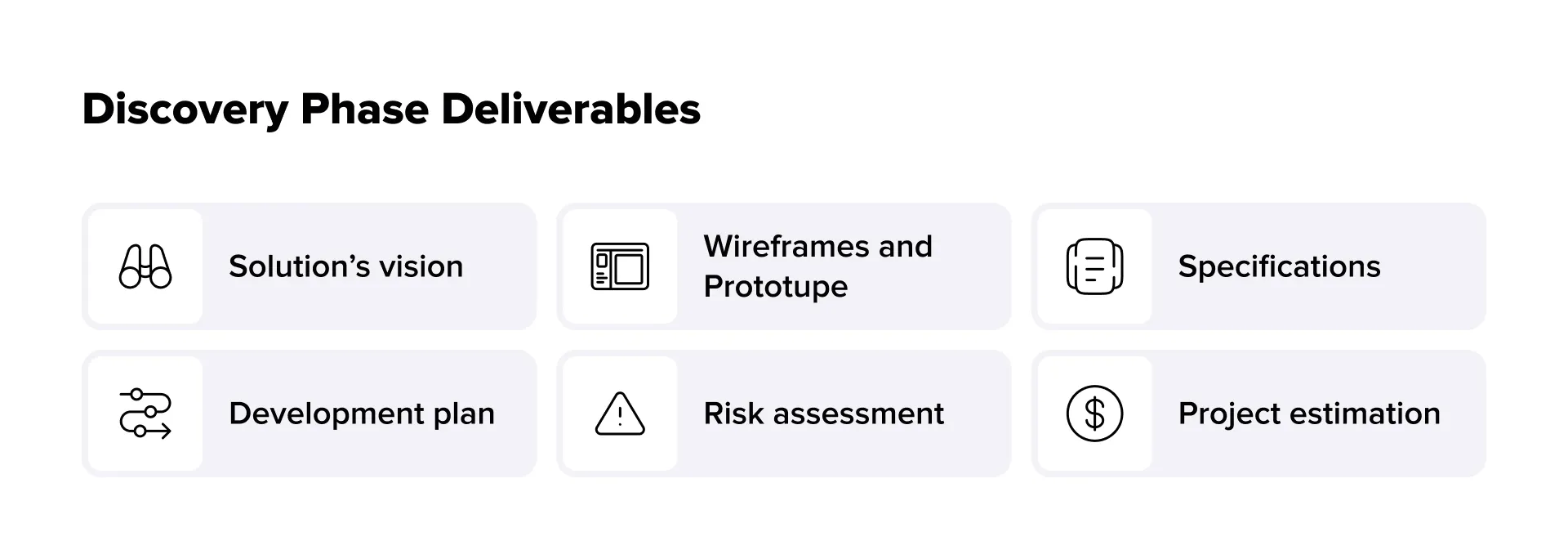
The discovery phase deliverables are tangible outcomes that set the foundation for any project. These include documents, diagrams, and prototypes that ensure the team and stakeholders are aligned. By preparing these deliverables, potential risks are minimized, and the development process becomes more structured. Essentially, they act as a roadmap for the project, helping everyone understand the objectives before coding starts.
Clickable Prototype
A clickable prototype is an early, interactive model of your product that lets users navigate between screens as if it were the real thing. Unlike static wireframes or simple mockups, it demonstrates how the product behaves in practice, giving a sense of flow, responsiveness, and usability. This makes it easier to understand whether the interface works as intended.
Using a prototype, teams can explore user journeys and interactions before any development begins. It allows testing of navigation, transitions, and feature logic, revealing potential problems that might not be obvious in design sketches. Early testing also encourages more informed design decisions.
Beyond testing, clickable prototypes serve as a communication tool. They help designers, product managers, and developers align on functionality and expectations. By making the product tangible early, the team can reduce misunderstandings, save time, and avoid costly revisions later in development.
Functional Requirement Document (PRD)
The Functional Requirement Document (PRD) is the written backbone of your product plan. It outlines what the product must do, how it should behave, and which features it must include. A strong PRD lists user workflows, system constraints, acceptance criteria, and functional logic in clear detail.
This document ensures that technical and business expectations are captured in one place. When developers read the PRD, they should understand the intended functionality without guessing. It also helps teams avoid costly revisions by agreeing on requirements before development begins. Think of the PRD as the story of your product — written and approved before you build
Solution Architecture and Technical Documentation
This set of technical artifacts serves as the foundation for how engineers build and maintain the system. It includes detailed system architecture diagrams, database schemas, API definitions, infrastructure plans, integration patterns, and the outcomes of any code or architecture audits. By providing a clear map of the system and its components, this documentation helps maintain consistency across the codebase, reduces errors, and shortens the onboarding process for new team members. It also ensures that architects and senior engineers can make informed technical decisions that align with the overall product vision. Without thorough documentation, teams risk conflicting assumptions, increased technical debt, and delays in development.
Project Roadmap and Estimates
The project roadmap is a high-level visual timeline that shows milestones, deadlines, major deliverables, and planned releases. Paired with estimates for time, cost, and resources, it gives clarity on budget expectations and helps anticipate potential schedule shifts. Roadmaps make complex plans easier to discuss, allowing teams to understand dependencies, priorities, and risks without getting lost in details.
By providing shared visibility, roadmaps improve communication and coordination across teams and stakeholders. They allow adjustments when priorities change and reduce misunderstandings about project goals.
Who Is Involved in the Discovery Phase Team?
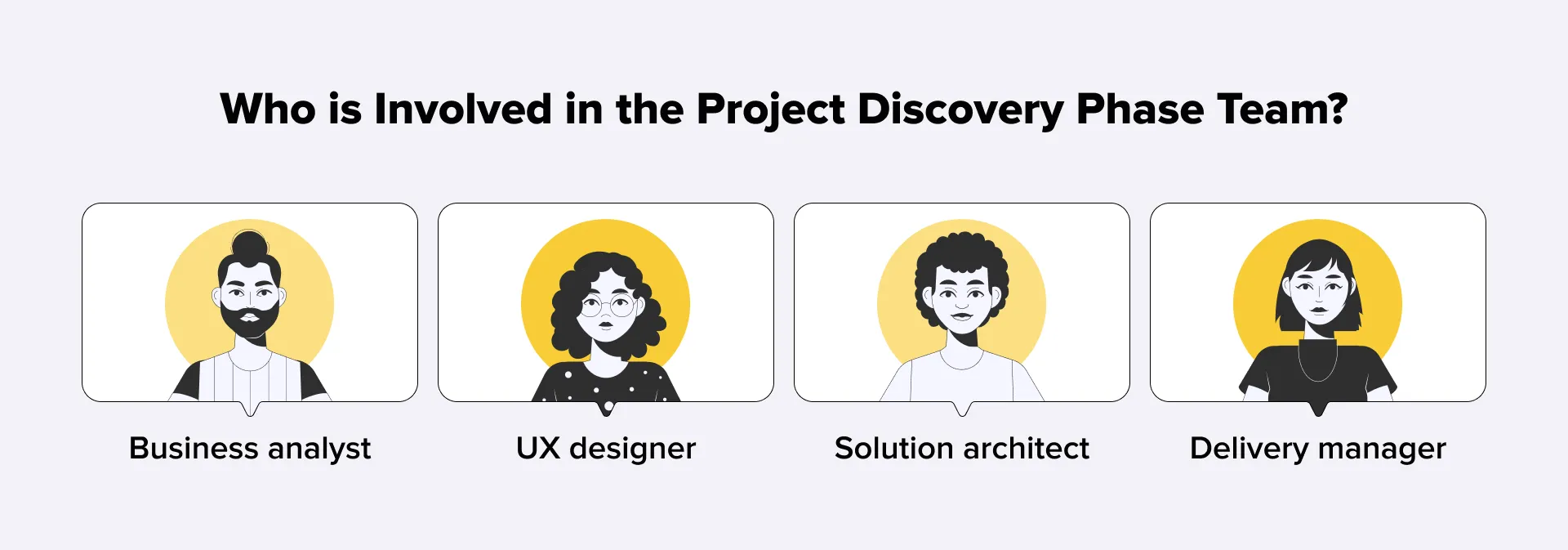
The discovery phase team includes experts that define the project before development begins. It’s a stage of teamwork, not disconnected decisions. Business, design and technical issues are considered concurrently. Every role validates assumptions through its own lens. The result is shared cognitive space, and less blindspots. When a discovery is conducted by a cross-functional team, the entire project is clearer, the expectations realistic and a firm foundation for subsequent decisions.
Business Analyst
It connects business intent with practical execution. They gather requirements through stakeholder interviews, workshops, and document analysis. Market research helps validate ideas against real conditions. The analyst identifies constraints, risks, assumptions, and priorities early. They structure findings into clear, consistent requirements that the team can rely on. These requirements guide the entire discovery phase, support informed decisions, and reduce misalignment, rework, and scope changes during development.
UX Designer
The UX designer focuses on how users experience the product from the first interaction. They research user behavior, expectations, and pain points to shape clear user flows. During discovery, the designer creates wireframes and clickable prototypes that visualize ideas early. These artifacts help test assumptions before development starts.
Feedback from users and stakeholders is collected and analyzed. This process reduces usability risks and avoids costly redesign later. The UX designer also ensures consistency across screens and features. Their work aligns business goals with real user needs and keeps the product intuitive and understandable.
Solution Architect
Technical feasibility is validated early to avoid costly changes later. This role focuses on reviewing whether the product idea can be built, scaled, and maintained over time. The existing technology environment is analyzed to define how new components will interact. Key aspects such as scalability, performance, security, and maintainability are assessed from the start.
Frameworks, infrastructure options, and third-party services are selected with long-term growth in mind. Integration points and data flows are reviewed in detail. Potential technical risks and limitations are identified before development begins. Architecture decisions are documented and shared with the team. This guidance reduces rework and unclear solutions. Early validation ensures the product can adapt to change and remain stable throughout the development lifecycle.
Delivery Manager
Strong coordination keeps the discovery phase focused and efficient. The delivery manager plans activities, sets timelines, and distributes tasks across specialists. Priorities remain clear, and progress stays visible to everyone involved. Risks are monitored early, blockers are resolved, and communication stays structured. Stakeholder expectations are aligned with real project capabilities. A clear process helps the team work without confusion or delays. By maintaining transparency and momentum, the delivery manager ensures the discovery phase runs smoothly and prepares the project for a predictable and well-controlled development process.
Main Activities of the Product Discovery Phase
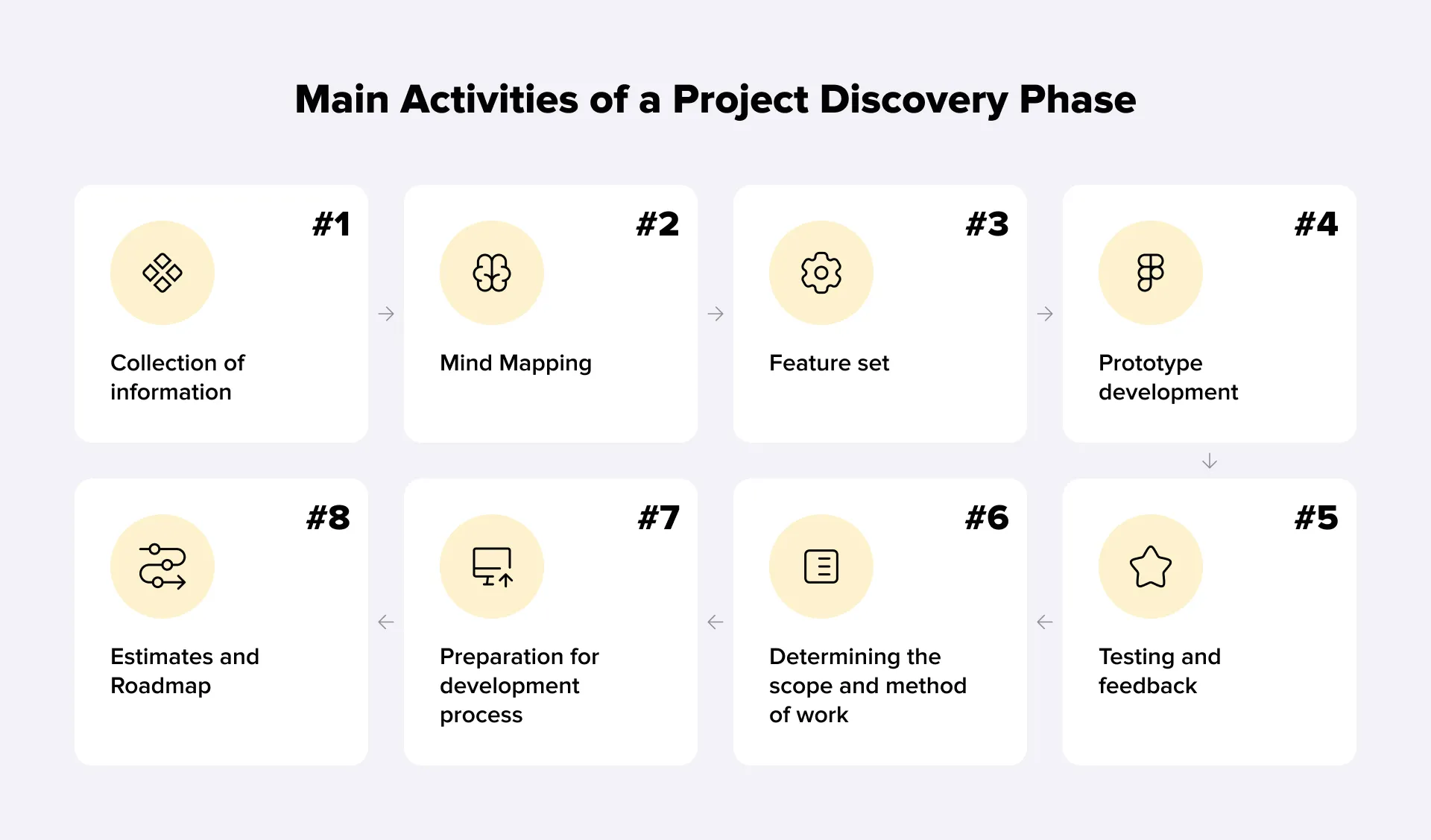
The discovery phase in software development follows a clear structure. It moves step by step, from research to planning. While each phase may vary depending on project complexity, a systematic workflow helps avoid gaps. This approach ensures that assumptions are checked, risks are visible, and decisions are based on facts rather than intuition.
Information Collection and Research
This stage creates the factual base for all further decisions. The team starts with target audience definition, focusing on real user roles, goals, and pain points instead of assumptions. Parallel to this, stakeholder communication helps clarify business priorities, constraints, and success criteria.
Next comes market analysis, which gives context: trends, regulations, and common patterns within the industry. Finally, competitor identification highlights existing solutions, their strengths, and their gaps.
Together, these research activities form a reliable data foundation. They reduce uncertainty and allow decisions to be made based on evidence, not intuition, which lowers the risk of costly changes later.
Mind Mapping and Feature Definition
Mind mapping helps structure ideas visually and reveal connections between features, user needs, and business goals, allowing the team to see the whole picture instead of scattered notes. Based on this structure, the feature set is defined and prioritized, then documented in the Product Requirement Document (PRD), which clearly describes functionality, logic, and constraints in a form that both business and technical teams can follow without misinterpretation.
Prototype Development and Testing
Prototypes are created as interactive models that reflect key user flows and core functionality. They go beyond static screens and allow users to click through scenarios, simulate actions, and experience the product logic early. This helps the team validate assumptions about navigation, structure, and feature behavior.
Testing these prototypes with real users is essential. It reveals usability issues, confusing interactions, and gaps in logic that are hard to predict on paper. Feedback gathered during testing is analyzed and applied to refine layouts, flows, and functional decisions. This iterative process increases clarity, aligns expectations, and significantly reduces the risk of costly rework once development begins.
Scope Determination and Development Process Preparation
At this stage, the project scope is finalized and clearly documented. The team aligns on the complete feature set, reviews priorities, and agrees on what is included and excluded. This clarity helps avoid misunderstandings and uncontrolled changes later.
Next, responsibilities are confirmed across roles. Required resources are identified, including technical skills, tools, and any external dependencies. This ensures the team is realistically prepared for the upcoming workload and constraints.
Finally, technical documentation is completed to remove ambiguity and create a shared understanding. Based on this foundation, estimates are prepared and combined with a roadmap that outlines milestones, timelines, and key delivery points. This step sets a clear direction and allows the team to move into development with predictable expectations.
Best Examples of Discovery Phase in Our Practice
In real projects, discovery rarely exists as a separate step. In our practice at Lampa, it is usually embedded into the very beginning of delivery, when clarity is still missing and early decisions define future outcomes. At this stage, our software development team works closely with clients to align business expectations with technical reality.
One example from our portfolio is a healthcare platform developed by the Lampa team for a US-based client. At the start, the client had a strong business idea but struggled to translate regulatory requirements and user needs into a clear product scope. Before active development, we focused on requirements clarification, stakeholder interviews, and early UX prototyping. Our technical analysis helped assess integrations with third-party healthcare systems. As a result, we refined the scope, delivered an approved clickable prototype, and prepared realistic estimates. This early discovery work significantly reduced compliance risks and helped avoid costly changes later in development.
Another case from our experience involved a fintech product. The main challenges were unclear user flows and concerns around scalability. During project kickoff, our team conducted user research, mapped key scenarios, and reviewed the initial technical concept. Discovery activities led to a validated architecture outline, updated requirements, and a phased roadmap. These outcomes directly influenced technology choices and allowed the client to start development with confidence.
In both projects, our discovery activities shaped key decisions, minimized risks, and supported successful delivery. The Lampa team runs discovery work at the beginning of projects when needed, helping businesses gain clarity, reduce uncertainty, and make informed decisions before moving forward with development.
Project Discovery Phase Checklist
Before any code lands in a repository, there’s an important moment of alignment. This is where the project discovery phase proves its worth. I’ve found that teams who slow down just enough to question assumptions and map out the unknowns save time later. This section gives you a practical discovery phase checklist that feels like a true guide — not a chore.
Think of the list as a quick way to validate whether your team has captured essentials before moving ahead.
Project Discovery Phase in Software Development: A Complete Guide
Define project goals — agree on what success looks like.
Identify stakeholders — know who influences decisions.
Document user needs — collect user problems, not guesses.
Map user journeys — outline main flows and corner cases.
Set success metrics — decide how you’ll measure impact.
Risk assessment — note uncertainties and mitigation ideas.
Technical constraints — outline APIs, platforms, and limits.
Budget and timeline — draft early estimates.
Competitive research — understand alternatives and gaps.
According to the Standish Group CHAOS Report, only about 31–39 % of projects succeed, meaning they are delivered on time, within budget, and with the expected scope. Many projects are either “challenged” or fail, showing why taking time in discovery matters.
Use this checklist as a readiness check before development starts. If you can confidently check each item, you’ve set up a solid foundation. From there, building features becomes a series of informed decisions — not guesswork.