
Traffic congestion, rising operating costs, and safety risks are no longer isolated problems. They define daily reality across the transportation sector. AI in transportation addresses these challenges through intelligent systems built on machine learning, computer vision, and predictive analytics. These tools process traffic data, road conditions, and historical data to support faster and safer decisions. The global market confirms this shift: AI in transportation was valued at $7.3B in 2024 and is projected to reach $21.5B by 2030, according to Allied Market Research. Real use cases and clear business outcomes demonstrate how teams move from concepts to real implementation.
How AI is Revolutionizing the Transportation Industry
The shift is already visible. Traditional transportation management relied on reactive responses to delays, breakdowns, or incidents. Today, artificial intelligence in transportation enables predictive and preventive action. Machine learning detects patterns in traffic flow, computer vision interprets inputs from traffic cameras, while NLP improves passenger communication. IoT devices add real-time context from vehicles and infrastructure. These AI systems do not replace people. They strengthen decision-making where speed and accuracy matter. Safety regulations, sustainability targets, labor shortages, and efficiency pressure continue to push AI for transportation from experiments to core operations.
7 Key AI Applications Transforming Transportation
AI adoption differs across logistics, urban mobility, and public transportation. Still, the core logic is the same: data replaces guesswork. Below are the most impactful applications in transportation, where AI in transportation already delivers operational value and measurable ROI.
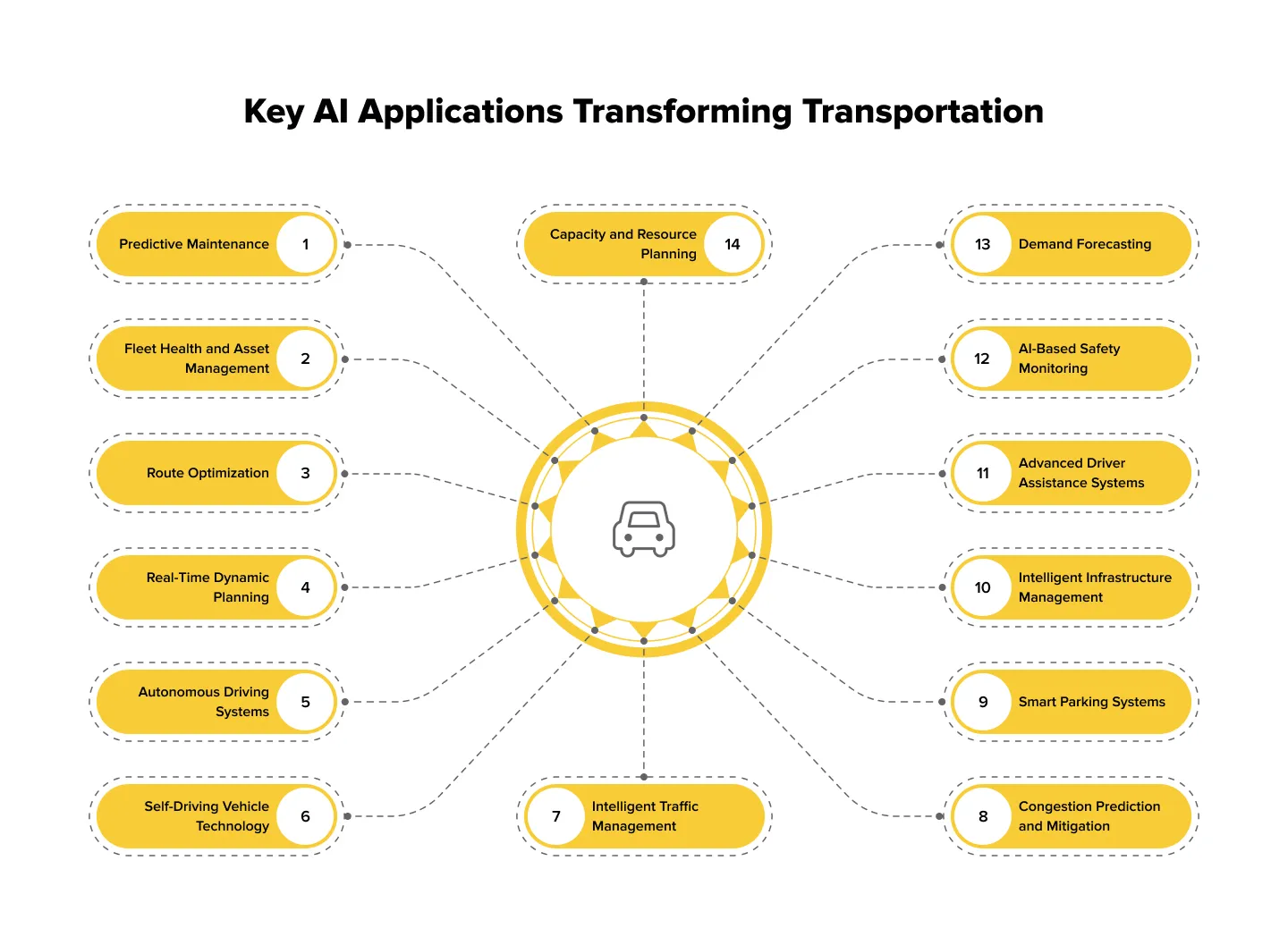
1. Predictive Analytics for Maintenance and Fleet Management
Modern fleets rely on predictive maintenance powered by AI to avoid costly failures. Sensors collect data from engines, brakes, tires, and onboard systems. Machine learning models analyze this data to identify early signs of wear.
The workflow follows a clear chain: data capture → pattern recognition → risk scoring → alerts → scheduled service. As a result, transportation businesses reduce maintenance costs by 25–30% and cut downtime by around 20%. Fleets using artificial intelligence in transportation report up to 35% fewer unexpected breakdowns.
When integrated with logistics ERP software, predictive maintenance becomes part of fleet planning, not a separate tool. Maintenance schedules align with routes, driver shifts, and delivery plans.
2. AI-Driven Route Optimization and Dynamic Planning
Static routes no longer work in dynamic environments. AI for transportation continuously analyzes traffic data, weather conditions, delivery windows, vehicle capacity, and real-time road conditions. By processing live GPS signals and traffic feeds, AI systems adapt routes as situations change. This allows logistics teams to respond faster to delays, avoid congestion, and maintain reliable delivery schedules even under unpredictable conditions.
This approach delivers 15–20% fuel savings, fewer delays, and lower emissions. A well-known example is UPS’s ORION system. AI-powered routing enables the company to save over 100 million miles every year, which directly reduces operating costs and vehicle wear. Fewer miles driven also mean improved sustainability and more consistent service levels for customers.
For logistics companies, route optimization brings the most value when routing logic is aligned with dispatching and order planning processes. When AI-generated routes reflect real delivery priorities, time windows, and vehicle limitations, planning becomes more accurate and execution more predictable across the entire transportation network.
3. Autonomous Vehicles and Self-Driving Technology
Autonomous driving relies on computer vision, LiDAR, sensor fusion, and deep learning. These technologies allow vehicles to detect road conditions, interpret traffic, and make driving decisions independently.
Today, Level 4 autonomy operates in controlled environments such as warehouses, ports, and dedicated lanes. Use cases include autonomous trucks for long-haul freight, delivery robots for last-mile logistics, and shuttles on campuses and airports.
Companies like Waymo, TuSimple, and Nuro demonstrate how artificial intelligence in automotive is already reshaping transportation engineering, even though full Level 5 autonomy remains limited by regulation and safety concerns.
4. AI-Powered Traffic Management and Congestion Reduction
Cities deploy ai-driven traffic management systems to shift from reactive control to predictive coordination. These platforms continuously monitor traffic flow using cameras, connected sensors, and traffic cameras placed at intersections and key corridors. Machine learning models analyze this data to forecast congestion, detect incidents early, and adjust signal timing dynamically. As a result, traffic control becomes adaptive instead of rule-based.
One of the most referenced examples comes from Pittsburgh. After introducing AI-controlled traffic lights, the city reduced average travel time by 25% and cut vehicle emissions by 20%. The system learns from historical and real-time traffic data, allowing intersections to react differently during peak hours, accidents, or road maintenance. This proves that intelligent traffic systems can unlock efficiency without expanding road capacity.
A similar but more advanced approach was implemented in Lampa’s Urban Traffic Management Platform. The solution operates beyond individual intersections and manages traffic at a corridor and city level. Using ML-based vehicle flow prioritization, the platform coordinates public transport, private vehicles, and emergency services in real time. It also includes automated alerts for faulty traffic lights and inaccurate GPS data, which improves overall system stability.
As a result, cities using Lampa’s platform achieved 15–30% faster public transit travel times and up to 40% quicker emergency response. General traffic also benefited from smoother movement and fewer stop-and-go situations. This case demonstrates how data-driven traffic control strengthens urban mobility by maximizing existing infrastructure and improving public service quality.
5. Smart Parking and Infrastructure Management
Searching for parking is a hidden source of urban congestion. Drivers often spend minutes circling blocks, increasing traffic volume and emissions. AI-powered parking systems address this issue by using computer vision, occupancy sensors, and connected mobile apps to detect available spaces in real time. Drivers receive guidance to the nearest free spot, reducing idle driving and improving overall traffic flow.
San Francisco’s SFpark program demonstrated the impact of this approach by reducing parking search time by 30%. Beyond parking, similar AI solutions monitor road conditions, identify potholes, assess bridge safety, and automate toll collection. These systems rely on continuous data analysis rather than manual inspections.
To adapt such solutions to local infrastructure and regulations, cities often partner with providers offering AI development services. Custom AI models ensure accurate detection, seamless integration, and long-term scalability, supporting more efficient and sustainable urban planning.
6. Enhanced Safety through Advanced Driver Assistance
Most accidents result from human error. AI-powered ADAS systems address this by monitoring drivers and surroundings in real time. Features include lane departure warnings, collision avoidance, blind spot detection, and fatigue monitoring.
Using computer vision and sensor fusion, these systems reduce accident rates by up to 40%. Solutions from Tesla, Volvo, and Mobileye demonstrate how use machine learning improves passenger safety and fleet compliance.
7. Demand Forecasting and Capacity Planning
Transportation demand changes constantly due to time of day, seasonality, weather, and local events. AI systems improve planning by analyzing historical patterns together with real-time signals such as bookings, traffic conditions, and external disruptions. This allows operators to anticipate peaks and drops in demand earlier and adjust schedules, pricing, and vehicle allocation before inefficiencies appear.
Public transit providers use demand forecasting to predict ridership and optimize timetables. Ride-sharing platforms rely on similar models to balance supply and pricing during peak hours. In freight transportation, accurate forecasts help reduce empty miles and improve capacity utilization. When demand predictions reflect local routes and operational constraints, transportation networks become more resilient, efficient, and predictable across both urban and long-distance operations.
Business Benefits of AI-Based Transportation Systems
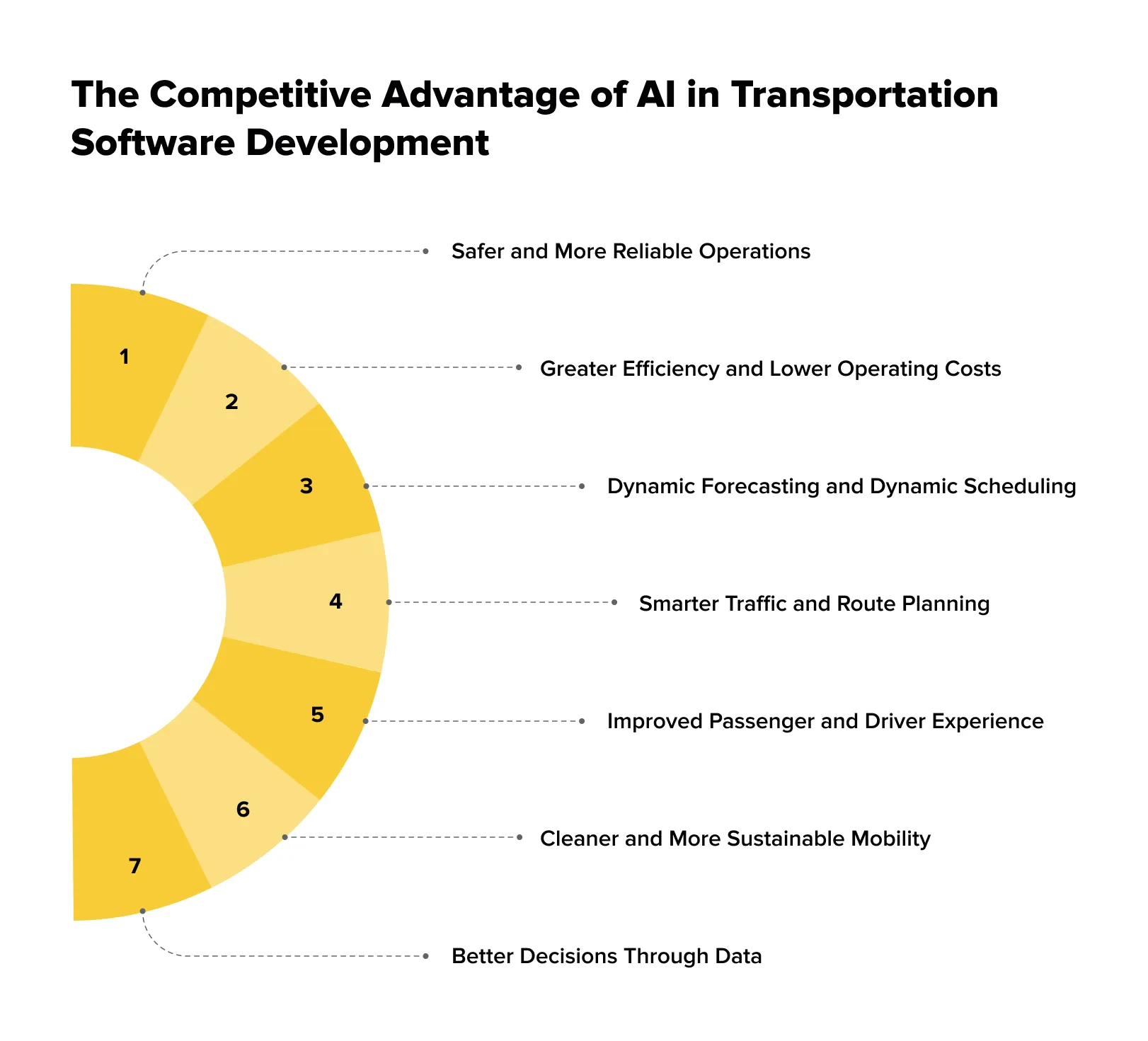
AI in transportation delivers measurable business value across operations, finance, and service quality. Most enterprises justify adoption within 12–18 months due to fast ROI. Core benefits include cost reduction through automation and optimization, improved safety and risk management, and a better customer experience powered by real-time insights. AI also supports sustainability goals, enables scalability without linear cost growth, and strengthens data-driven decisions across transportation management systems.
Use Cases of AI in Transportation
The real impact of AI in transportation becomes clear in live operations, not in concepts. Logistics providers, shipping companies, and cities already apply artificial intelligence to improve efficiency, manage risk, and deliver more reliable services. These cases highlight how AI works in practice.
DHL – AI-Powered Warehouse & Route Optimization
DHL operates a large-scale logistics network where delays, forecasting errors, and warehouse inefficiencies quickly translate into higher costs. To gain better control, the company introduced AI across several operational layers, including warehouse automation, route optimization, and demand forecasting. Machine learning models analyze historical and real-time order data, while computer vision supports robotic picking and sorting. Route planning systems dynamically adapt to traffic conditions and delivery constraints, reducing idle time and unnecessary mileage.
These improvements led to measurable operational and financial results:
25% improvement in warehouse efficiency
15% reduction in delivery times
$300M+ in annual savings
The key takeaway from DHL’s experience is that combining multiple AI systems creates a compounding effect, where gains in one area amplify results in others.
Maersk – Predictive Maintenance for Shipping Fleet
For Maersk, the main challenge was reliability. Unexpected equipment failures disrupted schedules and generated high repair costs across a global fleet. AI-based predictive maintenance shifted maintenance planning from reactive repairs to early intervention. By analyzing sensor data from hundreds of vessels, machine learning models detect early signs of component failure and recommend timely maintenance actions.
Maersk stabilized fleet operations, reduced downtime, and improved long-term asset performance without expanding maintenance budgets.
Singapore Land Transport Authority – Smart Traffic Management
Singapore faced growing congestion as traffic volumes increased, while physical expansion of road infrastructure remained limited by space and cost. Building new roads was no longer a viable option, so the city needed a way to extract more capacity from what already existed. This pressure pushed transport authorities to rethink how traffic could be managed dynamically rather than through fixed schedules.
AI-powered traffic management systems became the foundation of this shift. Using computer vision and real-time traffic flow analysis, the system continuously monitors intersections and corridors across the city. Signal timing adjusts automatically based on live conditions, while public transportation receives priority to maintain predictable schedules and reduce bottlenecks during peak hours.
As a result, traffic moves more evenly through the network, congestion hotspots are addressed before they escalate, and idle time at intersections is reduced. The city improved overall mobility and travel reliability while keeping infrastructure investments under control and avoiding costly physical expansion.
Lampa – Urban Traffic Management Platform
In one urban deployment, the city struggled with congestion, slow emergency response, air quality issues, and unreliable public transport schedules. Lampa developed a cloud-based AI platform that prioritizes vehicle flows across intersections and corridors using machine learning and connected-vehicle data. The system also monitors traffic lights and GPS infrastructure, enabling real-time alerts and rapid response to failures.
The implementation delivered clear improvements across multiple dimensions:
15–30% reduction in public transportation travel times
10–25% faster travel for general traffic
40% improvement in emergency response times
10–20% improvement in air quality
This case shows how integrated AI traffic management can simultaneously improve efficiency, safety, and public service reliability when decisions adapt continuously to real-time conditions.
AI Implementation Roadmap: Practical Steps for Transportation Companies
Moving from interest to execution requires structure. AI in transportation delivers the best results when adoption follows a clear roadmap rather than ad-hoc experiments. A phased approach helps transportation companies reduce risk, control costs, and prove value early while building a foundation for long-term scale.
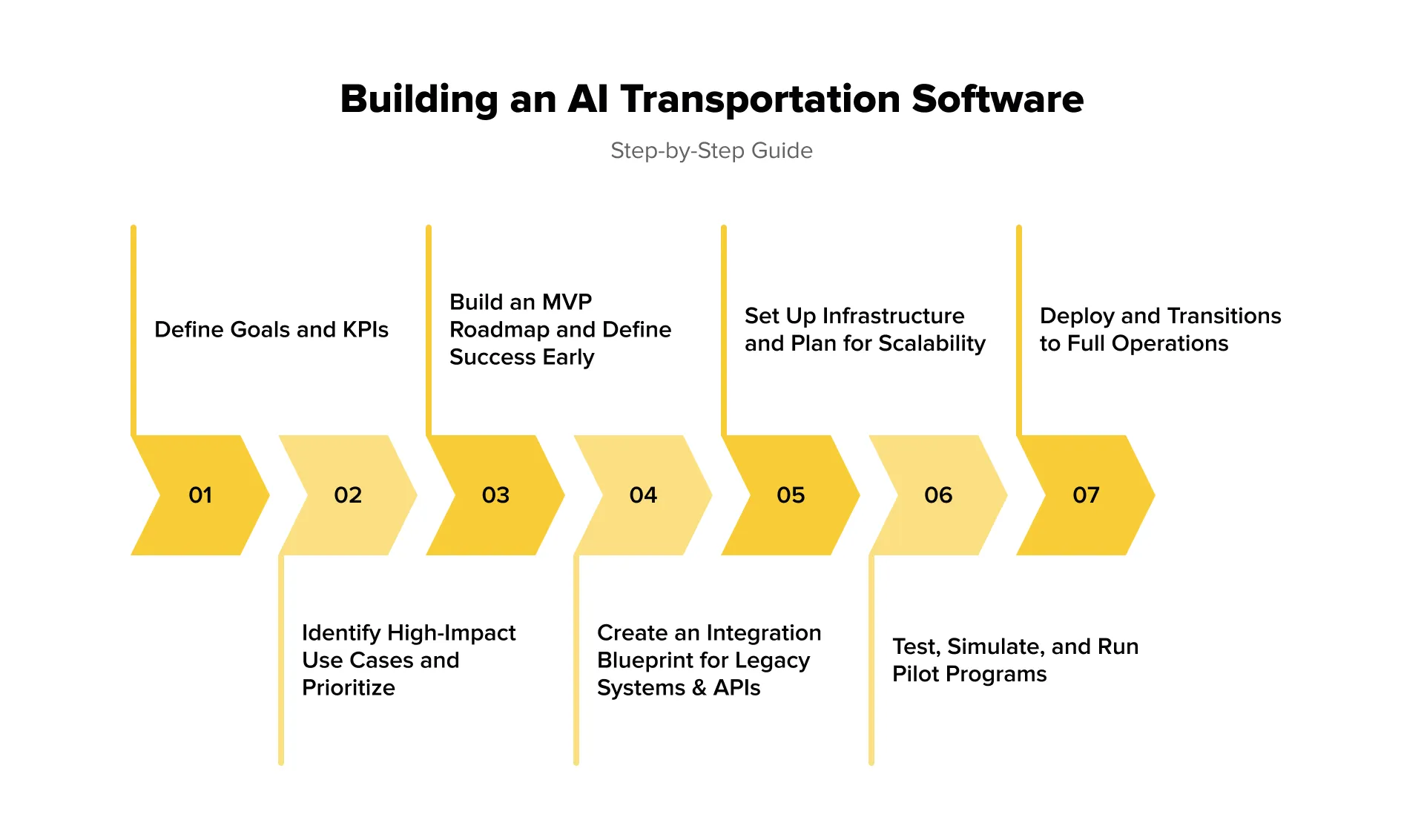
Phase 1: Assessment and Strategy
The first phase focuses on clarity. Transportation companies start by identifying core pain points such as safety incidents, rising fuel costs, delays, or customer complaints. Clear and measurable objectives follow, for example reducing fuel costs by 15% or lowering downtime.
Next comes data readiness. Teams assess what data exists, its quality, and how accessible it is across systems. Technical infrastructure is also reviewed, including fleet software, TMS, ERP, and integration constraints. Establishing baseline performance metrics is critical to measure future impact.
Key deliverables include an AI readiness assessment, a prioritized list of use cases, and preliminary ROI estimates. Executive sponsorship, cross-functional collaboration, and realistic expectations are essential for success at this stage.
Phase 2: Pilot Program
The pilot phase turns strategy into action. Companies select a high-impact but low-risk use case, such as predictive maintenance for a limited fleet segment. The next decision is whether to build internally, buy a ready solution, or partner with AI experts.
Data pipelines are prepared by cleaning, integrating, and validating data sources. Deployment happens in a controlled environment with close monitoring. Results are measured against baseline metrics, focusing on cost savings, time reduction, error rates, and user adoption.
A narrow pilot reduces complexity and builds internal confidence. Proving value early creates momentum and justifies further investment.
Phase 3: Scale and Integration
After a successful pilot, the focus shifts from validation to scale. AI solutions are rolled out to more vehicles, routes, and operational processes, increasing their overall impact. At this stage, seamless integration with ERP, TMS, and fleet management systems becomes critical to avoid data silos and manual workarounds. Structured training for drivers, dispatchers, and technical teams helps embed AI tools into daily workflows rather than treating them as experimental add-ons.
As adoption grows, companies formalize data governance, decision-making frameworks, and ownership of AI-driven outcomes. Common challenges include resistance to change, integration complexity, and uneven data quality across systems. These issues are best addressed through phased expansion, clear communication, and a dedicated support team that monitors performance, resolves issues, and continuously improves system reliability.
Phase 4: Optimization and Innovation
The final phase focuses on long-term maturity and value creation. AI models are continuously refined using new operational and historical data, improving accuracy, reliability, and system performance. Proven use cases scale across planning, safety, and day-to-day operations, while additional automation reduces manual effort and minimizes human error.
At this stage, companies reassess how much AI expertise to develop internally versus relying on external partners. Some teams build in-house capabilities for model oversight and data management, while others prioritize strategic control and delegate technical complexity. Both approaches work when roles, ownership, and accountability are clearly defined.
Capturing institutional knowledge becomes essential. Documenting successful deployments, lessons learned, and edge cases helps accelerate future initiatives and prevents repeated mistakes. Over time, AI stops being viewed as a separate project and becomes an embedded layer within transportation management and decision-making processes.
Transportation companies that partner with AI specialists like Lampa often move faster at this stage. Lampa combines deep transportation domain knowledge with hands-on AI engineering, delivering proven frameworks and custom solutions aligned to real operational needs. This partnership allows organizations to scale AI with confidence while staying focused on measurable business outcomes.
Challenges in AI Transportation Adoption (and How to Overcome Them)
AI in transportation brings clear value, but adoption is rarely frictionless. One common barrier is data quality and availability. Transportation businesses often store traffic data, fleet records, and maintenance logs across disconnected systems. Data may be incomplete or inconsistent. A practical solution is to begin cleanup early, deploy IoT sensors for real-time collection, and set basic data governance rules. Waiting for perfect data slows progress; iterative improvement works better.
Another challenge is integration with legacy systems. Many transportation management and dispatch platforms were not designed for AI. API-based integration, middleware layers, and phased upgrades allow ai tools to work alongside existing infrastructure without full replacement.
High initial investment also raises concerns. Costs include software, sensors, and training. Starting with a pilot, choosing quick-win use cases, and using SaaS models helps control risk. In most cases, payback arrives within 12–18 months.
Workforce resistance and regulatory compliance cannot be ignored. Teams may fear job loss, while regulations demand transparency and safety. Clear communication, training, and human oversight position AI as support, not replacement, and ensure compliance from day one.
Taken together, these challenges are manageable rather than limiting. Transportation companies that approach AI in transportation as a gradual transformation see more stable results. Clear priorities, realistic timelines, and early stakeholder involvement reduce friction at every stage. When technical and human factors are addressed in parallel, AI adoption becomes a controlled evolution instead of a disruptive shift.
Future of AI in Transportation: Emerging Trends
Artificial intelligence in transportation is evolving fast, and the next 3–5 years will bring structural change across transportation networks. Several clear trends are already shaping how mobility systems will operate.
Expansion of autonomous vehicles.
Level 4 autonomy will become common in controlled environments such as highways, ports, and logistics hubs. Long-haul freight is likely to lead adoption, helping address driver shortages and enabling 24/7 operations with predictable routes.Hyperconnected transportation ecosystems.
Vehicles, infrastructure, and cargo will continuously exchange data through V2V and V2I communication. Powered by 5G and edge computing, this connectivity supports coordinated traffic flow, platooning, and network-wide predictive maintenance.Sustainable AI-optimized mobility.
AI will play a central role in managing EV fleets, optimizing charging infrastructure, and planning low-emission routes. Regulatory pressure and carbon targets will accelerate adoption, aligning sustainability goals with operational efficiency.Generative AI and advanced analytics.
Planning will move beyond dashboards. Teams will use generative AI to test scenarios, simulate demand shifts, and assess risks before changes go live. Decision-making shifts from reactive responses to proactive strategy.
These trends show that AI in transportation is shifting from isolated tools to system-level intelligence. The next phase will favor platforms that connect vehicles, infrastructure, and decision-making into a single adaptive ecosystem. Companies that invest early gain more than efficiency — they gain long-term operational resilience.
Conclusion: Building Your AI-Powered Transportation Future
AI in transportation is no longer optional for competitive operations. Proven use cases show 25–40% cost reduction, stronger safety, improved passenger experience, and measurable sustainability gains. Predictive maintenance, route optimization, intelligent traffic management, autonomous vehicles, and demand forecasting already deliver results. The most effective path starts with a focused pilot, validates value, and scales step by step. Success depends on clear goals, reliable data, thoughtful change management, and trusted partners.
Transforming transportation with AI requires more than technology — it requires domain understanding and execution discipline. Lampa works at the intersection of transportation engineering and AI development, helping teams translate complex operational challenges into reliable, production-ready systems. From urban traffic platforms to fleet intelligence and routing optimization, Lampa designs solutions that integrate smoothly with existing infrastructure and deliver measurable ROI. Explore how we modernize mobility through custom AI solutions.