
Running a small business today feels like juggling growth, innovation, and tight budgets — all at once. Technology evolves faster than most teams can keep up with, forcing small business owners to make tough choices: hire expensive full-time IT staff, or find a smarter, more flexible way to manage tech operations.
That’s where outsourced IT services change the game. Partnering with a trusted provider gives you access to global expertise, modern tools, and proven best practices — without the cost and hassle of building an in-house team.
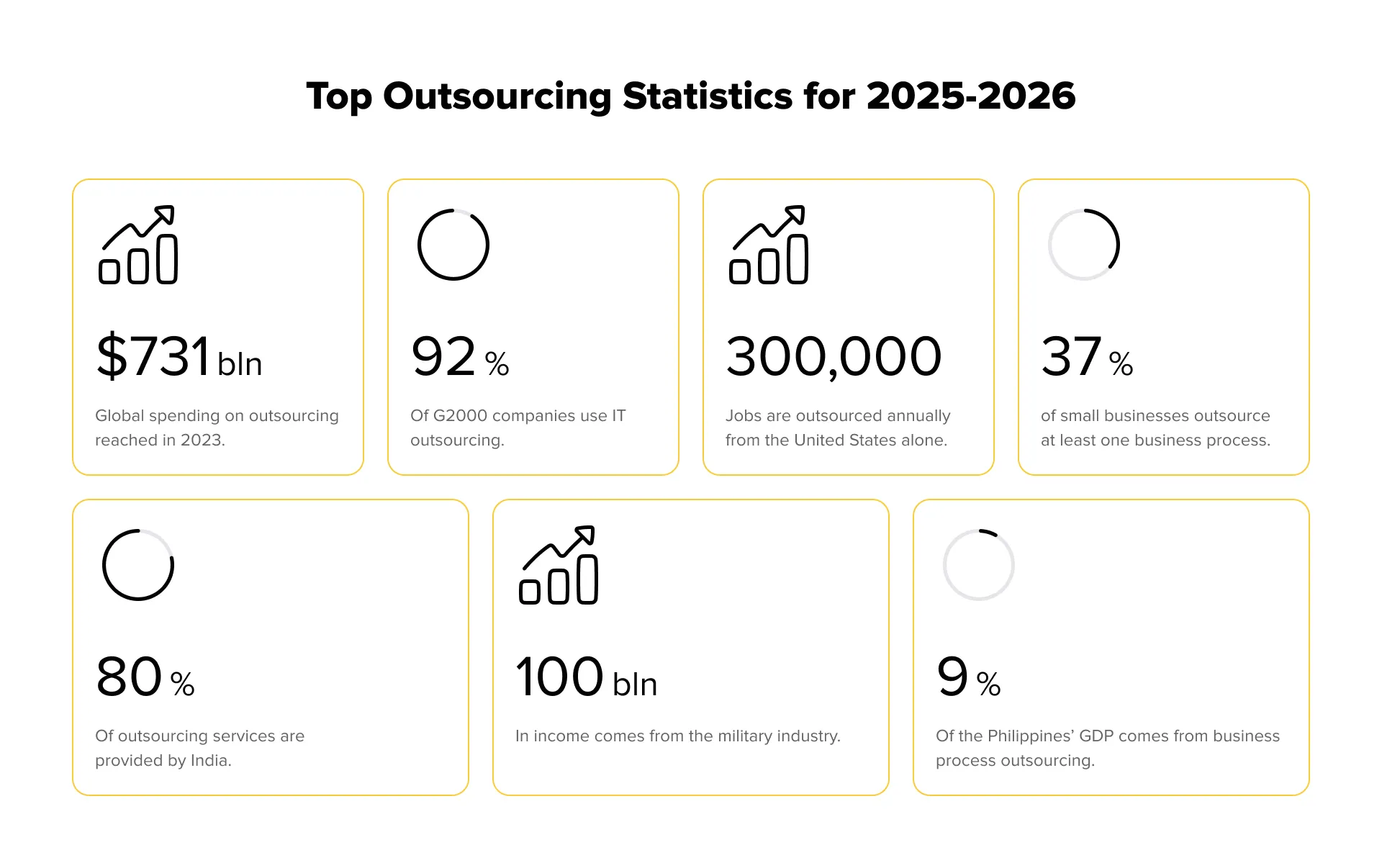
According to Deloitte’s “2021 Global Shared Services and Outsourcing Survey Report”, organizations that outsource IT and related services typically achieve cost savings between 20% and 40%. Moreover, recent studies show that more than 60% of small and mid-sized companies now rely on some form of IT outsourcing to optimize performance and scale efficiently.
But the real benefit isn’t just cutting costs — it’s unlocking freedom. Freedom to focus on what makes your business grow, deliver better customer experiences, and scale with confidence in a fast-changing digital world.
What Does IT Outsourcing Mean?
For small businesses, outsourcing involves delegating IT-related tasks or services to external providers. Small businesses outsource development of software, cloud services, technical support, and even full management of IT operations.
With external resources for their IT needs, small businesses can access a range of benefits that are key to growth, innovation, and competitiveness in the digital age.
Exploring Different Types of IT Outsourcing Models
There are three main types of IT outsourcing services: onshore, nearshore, and offshore. The difference between these approaches is due to the physical location of your service provider.
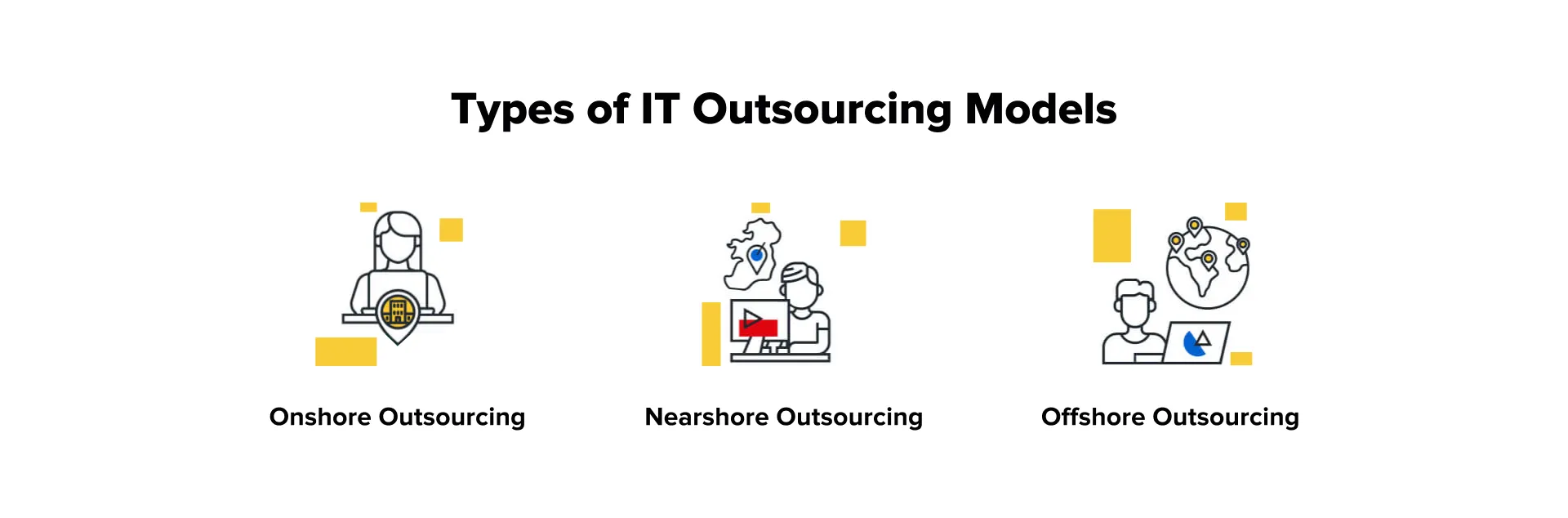
In the onshore model, an organization transfers IT services to a supplier located in the same country. It provides the following benefits:
Why Outsourced IT Services for Small Business Are a Smart Investment
similar time zones;
cultural compatibility;
easier communication.
Offshore means concluding a contract with a service provider located in another country. This approach helps achieve business objectives such as economic advantages due to lower labor costs in certain regions. Difficulties related to the difference in time zones and language barriers are possible, but they are solved with a detailed discussion of the conditions even before the conclusion of the contract.
Nearshore outsourcing is a partnership with a service provider in a neighboring country. This approach helps small enterprises balance between cost savings and proximity, offering benefits such as cultural similarities, simplified travel, and potentially reduced time zone differences.
There is also cloud-enabled outsourcing. Organizations can outsource IT functions to companies that provide services online. So businesses can leverage scalable IT resources on demand without the need for significant hardware investments.
Factors affecting the choice of IT outsourcing model:
costs for the performance of some tasks or the implementation of the entire project;
geographical proximity and work schedule for convenient communication;
compliance of the partner with your requirements and needs of the project.
These factors influence the success of communication, partnership relations, and how well each model of outsourcing empowers small businesses in your case.
Key Benefits of IT Outsourcing for Small Businesses
IT outsourcing opens wide prospects for small businesses aiming for consistent development and expansion of market presence.
Economical Solutions
Outsourcing allows small businesses to convert fixed IT costs into variables, which ensures budget flexibility. Small businesses can avoid significant costs, such as salary, benefits, and training, associated with hiring full-time staff.
Services offered by specific companies help you avoid the need for large investments in infrastructure. This is the so-called domestic outsourcing.
Access to Expertise and Cutting-Edge Technology
If your business has a limited IT budget, which makes it difficult to hire, train, and retain an in-house IT team, outsourcing can provide access to the pool of experts for a small fee. So, it allows small businesses to access qualified developers, the latest technologies, and industry standards at no additional cost.
Improved Focus on Key Business Operations
If managing your IT operations in-house is distracting you from your core business and strategic growth initiatives, it's time to outsource. It will allow your team to focus on what they do best to grow your business.
Improved Efficiency and Adaptability
Outsourcing IT services provides flexibility to scale up or down operations based on business needs without hiring or firing employees. This scalability supports business agility and long-term growth, improving overall business performance.
Security Measures and Risk Mitigation
IT outsourcing companies know how to manage security and data protection. Their expertise helps mitigate risks related to cyber threats, regulatory compliance, and technological change.
Velocity and Innovation
By working with individual outsourced IT teams, small businesses can focus on their core business without being distracted by complex IT solutions. This focus increases productivity, drives innovation, and accelerates growth, time-to-market for new products, etc.
Small businesses currently outsource talents in other parts of the world. If you need specialized help, it often makes sense to expand your search to find software developers with the best know-how and skills.
Top benefits of IT outsourcing:
Access to the latest technologies, tools, and software without a significant initial investment.
Business process outsourcing, the possibility to use new technologies for innovation and competitive advantage.
Outsourcing providers use the latest technological solutions and ensure their rapid implementation into your project.
Top 15 Outsourced IT Services for Small Businesses
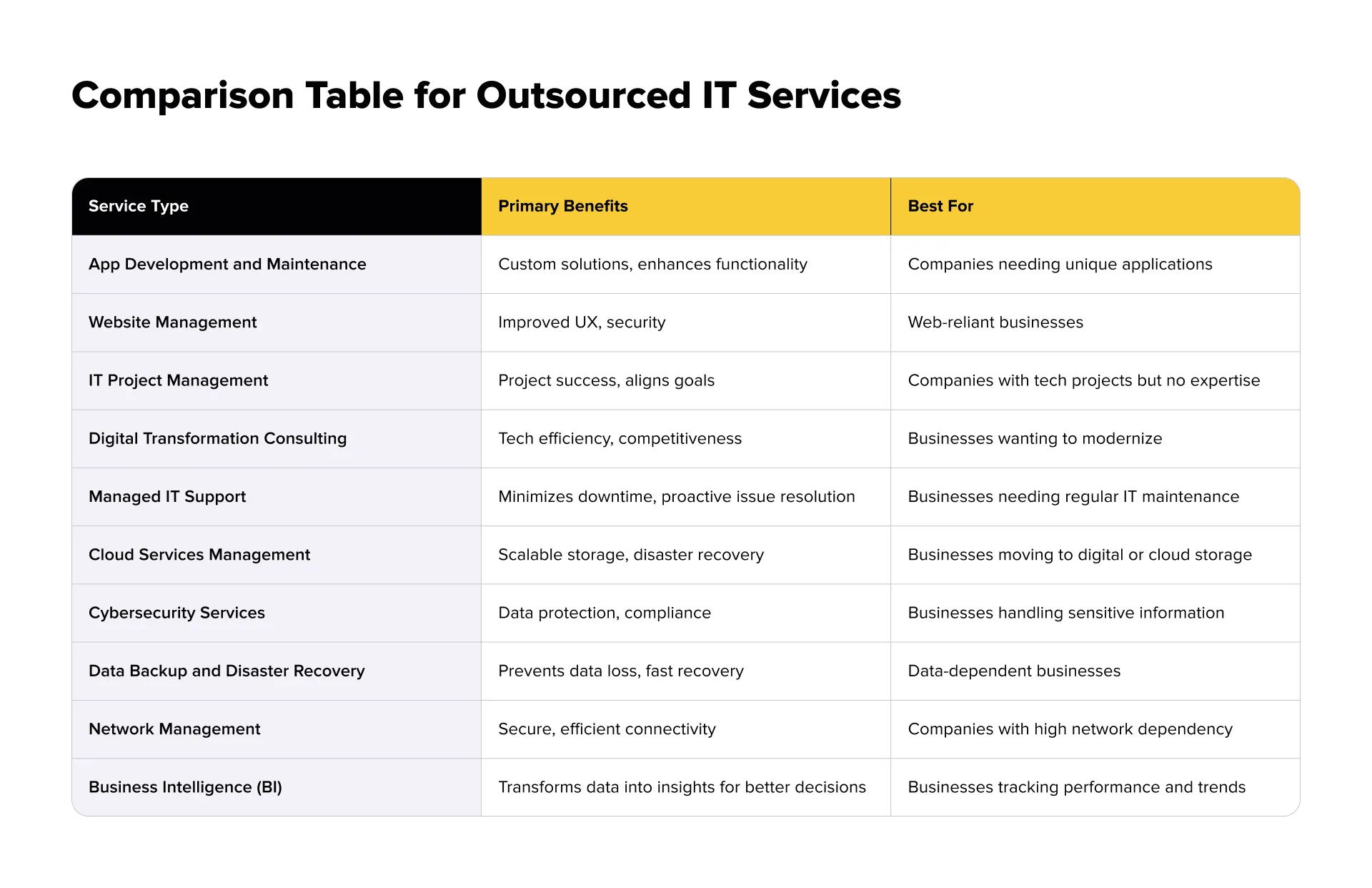
The variety of IT services available today is enormous. Below are fifteen key types of outsourced IT services that help small businesses operate efficiently, scale sustainably, and maintain strong security. Most of these solutions are provided by our team, combining innovation, strategy, and real business value.
1. Custom Software Development
Custom software development helps small businesses solve unique operational challenges, automate routine tasks, and eliminate inefficiencies that packaged tools can’t address. Tailored systems support real workflows, improve productivity, and integrate data across departments. Many companies choose custom development when they need automation or internal platforms optimized for how they actually work.
In our practice, we design solutions that match real business processes — from CRM systems to internal dashboards and full-scale platforms.
2. Web Application Development
Web applications development has turned into just one of the easiest ways small businesses can streamline daily operations without reinventing a wheel. A single web app can bring it all together instead of managing spreadsheets, multiple tools and never-ending email chains. Sales teams get clearer pipelines, managers know what’s happening in real time, and employees aren’t wasting time gathering up run-around information.
Most modern web apps can seamlessly integrate with the systems businesses already rely on — CRMs, analytics dashboards, payment processors, or inventory management. When everything is integrated, processes become speedier, teams make fewer mistakes, and operational expenses are reduced. Plus, there’s no need to buy servers or manage complex infrastructure.
On our end, we develop web applications that scale with the business: security, stability, and chaos-free scalability are the things that we always prioritize in that regard.
3. Mobile App Development
Mobile app development allows small businesses to connect with their customers and users directly on their mobile devices. Apps enable companies to streamline payment for online purchases, provide personalized experiences and offer a continuous line of communication with users. They also enable them to run their loyalty programs, send out push notifications and provide access to services seamlessly, all of which contribute heavily towards bringing the customer back.
We also provide expertise in Mobile App Development. Оur team is dedicated to building high-performance, cross-platform apps for e-commerce, logistics, service based organizations and internal workflows.
4. Digital Fintech Solutions
Fintech solutions help small businesses automate financial workflows, support secure online payments, and build user-friendly financial products. These systems reduce manual operations, increase transaction transparency, and maintain compliance with international security standards. They are especially important for companies handling online transactions or offering financial services.
Many providers, including our team, offer Digital Fintech Solutions such as payment modules and financial dashboards.
5. AI and Machine Learning Development
AI and machine learning technologies enable small businesses to automate customer support, forecast demand, enhance marketing strategies, and deliver personalized user experiences. These tools help companies save time, reduce repetitive tasks, and make decisions based on data rather than assumptions.
We also implement AI-based solutions, such as predictive models, chatbots, recommendation engines, and intelligent analytics systems.
6. Cloud Migration and Cloud Infrastructure Services
Cloud migration is a compelling proposition for small businesses, allowing them to ditch expensive on-premises hardware in favour of flexible, scalable digital environments. When systems are relocated to the cloud, they can be accessed from anywhere, allowing distributed teams to work effectively and enabling companies that operate on hybrid or fully remote work models to do business. Cloud infrastructures also serve as native redundant arrays, perform automated backups and receive incremental updates, enabling companies to change their physical servers without disruption. The cloud infrastructure also enables more rapid delivery of new features, improved data security through enhanced protection, and the ability to scale computing resources as needed.
7. QA Outsourcing and Software Testing
Software Testing and QA Service ensures higher product quality by identifying issues early and verifying how a system performs under real-world conditions. Testing providers check security, usability, and performance before the final release, which helps avoid costly fixes later.
Lampa contributes to this area as well, offering testing practices that range from manual checks to automated frameworks and performance audits.
8. Healthcare IT Solutions
Healthcare Software Development plays a crucial role for clinics, medical startups, and private practices that want to modernize their operations. These systems allow organizations to securely manage patient records, streamline documentation, and integrate diagnostics or appointment scheduling into a single digital environment. By reducing manual work and eliminating fragmented tools, healthcare teams can respond to patients faster and maintain higher accuracy in daily workflows. Compliance with standards such as HIPAA and GDPR is also strengthened when proper digital systems are in place, helping healthcare providers avoid regulatory risks.
9. IT Consulting and Digital Transformation
IT consulting helps small businesses navigate digital change with confidence. Instead of guessing which tools or systems to implement, companies gain clarity on what truly supports efficiency and long-term growth. This process often includes workflow analysis, identifying unnecessary costs, selecting modern technologies, and building a realistic transformation roadmap.
At Lampa, our specialists contribute to this process by guiding businesses through modernization: from evaluating existing infrastructure to planning automation and integrating new digital tools that fit real operational needs. The focus is always on practical improvements — not on replacing technology for the sake of it.
10. UI/UX Design
A strong UI/UX approach ensures that digital products feel intuitive from the very first interaction. Clear navigation, meaningful layouts, and thoughtful user flows reduce friction and increase customer satisfaction — essential elements for any small business that wants to grow online.
At our company, UI/UX Design Services include user research, prototyping, interface design, and usability testing. The goal is to create experiences that reflect the brand while staying accessible, fast, and conversion-focused.
11. Cybersecurity and Compliance Services
Small businesses tend to downplay the risks of cybersecurity, yet attacks on small businesses increase year over year. Today's cybersecurity solutions protect sensitive data at rest, in transit and on endpoints, preventing unauthorized access and exposure to threats such as ransomware or phishing. And it’s easier to comply with standards such as GDPR or HIPAA when you have your systems organized right.
12. Business Analytics
Business analytics also enables small businesses to determine why their processes are performing the way they are and which processes produce the best results. Instead of relying on intuition, teams are armed with clear performance data, customer behavior patterns, financial intelligence and operational information — all in the form of dashboards or automated reports. This, in turn, can help expose bottlenecks, inefficiencies, and even growth opportunities that might otherwise remain hidden.
For many small companies, analytics becomes a turning point: it highlights which marketing channels bring real ROI, shows where customer retention drops, and identifies processes that consume too many resources. With the right setup, businesses can forecast demand, optimize cost structures, improve logistics, and confidently adjust strategy based on evidence rather than guesswork.
At Lampa, our specialists help configure data pipelines, integrate analytical tools, and tailor reporting systems to each business model. Through Business Analysis Services, we work together with teams to define meaningful KPIs, establish transparent measurement frameworks, and translate raw numbers into actionable insights that support day-to-day decision-making.
13. E-commerce Development and Integration
E-commerce development enables small businesses to build a reliable online presence and reach customers beyond their local market. A good platform can automate orders and stock, track deliveries, and sync product information over several sales channels in real time. Today’s e-commerce platforms can also be equipped with other advanced features, such as personalized product recommendations, dynamic pricing, and integrated customer communication tools — all of which contribute to boosting conversion rates and take the team’s workload offline.
Successful e-commerce relies on strong system synergy, and it requires seamless and strong integration. Integration of payment processors, CRM systems, warehouse management systems, and logistics service providers offers ease of operation along with accuracy of information between systems. It reduces the possibility of errors, increases the pace of order fulfillment, and elevates the customer’s experience from browsing to delivery of the finished product.
We support companies in building scalable online stores and marketplaces through our E-Commerce Development Service. Our specialists help configure essential integrations, optimize technical performance, and ensure the entire purchasing flow feels secure, fast, and intuitive for end users.
14. Project and Product Management
Project and product management help small businesses keep development organized and aligned with real goals. Clear planning and communication reduce delays, control budgets, and prevent the team from losing focus. For growing companies, structured management becomes essential for balancing priorities and coordinating work between design, development, and QA. Through our Managed IT Services, specialists at Lampa assist in defining processes, setting milestones, and maintaining steady progress so each iteration moves the product closer to release. This approach also creates transparency across teams, making it easier to track responsibilities and anticipate potential risks. As a result, businesses maintain stability even when projects become more complex.
15. MVP Development and Product Scaling
Building an MVP helps companies validate their ideas rapidly, minimize upfront costs, and gather priceless feedback prior to expanding the product. When companies start small, they avoid unnecessary risk and only build based on what users really want. Once early validation is in place, scaling is much more predictable and affordable.
Lampa is involved in these steps by enabling companies to craft MVPs, to validate functionalities, and to evolve the product step-by-step – allowing for a sustainable growth backed by iterative development.
How to Choose the Right IT Outsourcing Partner
IT outsourcing can be a key part of your business strategy if you need to reduce costs or access highly specialized skills. However, it is extremely important for organizations to carefully evaluate their requirements and choose reliable outsourcing providers. Digital technologies transform the business landscape, so the successful organizations of the future will be those that can move faster and adapt.
How to find the right outsourcing partner and which businesses to tap?
1. Define a clear scope of work
It is important to understand that outsourcing is a way to achieve a specific goal. It is unfair to expect a third-party performer to immediately have the same knowledge about your business as you do. Besides, an ever-evolving business requires constant communication between the two parties when establishing cooperation.
2. Make professional knowledge an essential metric when hiring
Rate a few outsourcing providers of your choice based on the following factors:
technical expertise;
skill set;
access to the latest technologies;
experience in solving complex tasks;
interest in your project.
Remember that technical expertise is critical to the success of any outsourcing collaboration, especially in IT-enabled business processes.
3. Consider market reputation
There are platforms like Clutch and GoodFirms, where you can check reviews from previous clients of a company.
You should hire an outsourcing partner only if you are absolutely certain that the chosen vendor has a good reputation, can align with your business goals, and has a track record of delivering work on time.
4. Communicate the budget clearly
Cost is one of the most underestimated factors that can ruin not only your relationship with an outsourcing provider but your project as well. If you expect excellent outsourcing services from a partner, you should also know that these services often cost more than average.
Be clear about how much to pay for the services, and inform your chosen company about your budget.
5. Protect your data and intellectual property
Privacy and data security are two of the biggest problems in today's world. During project outsourcing, small businesses provide their partners with access to confidential business information. If not managed properly, your data may be mishandled. We recommend that you sign a non-disclosure agreement with your chosen partner before providing them with information.
It is important that the supplier conducts regular network and security audits of their workplace.
6. Use flexible approaches when creating an IT product
Use Agile methodologies to meet the changing needs of your customers. They will create an environment for perfect collaboration and quick results.
7. Choose a flexible partner
Flexibility of the service provider must meet any urgent requirements or problems as they arise and provide services you need. This is especially important when you are in different time zones.
Why Lampa is a game-changer for small businesses?
We enable small business to make smarter decisions about technology. With deep expertise in automation, AI, cloud integration, and human-centric design, we turn challenges into opportunities for growth. Our mindset is flexible and efficient—allowing you to conserve resources as you lead in innovation, and compete in the market.
We give you a committed development team, adhere to best practices and keep a transparent collaboration so that each project flows flawlessly and meets your business goals.
We also prioritize tangible, measurable business outcomes: simplifying processes, enhancing customer experiences, and delivering scalable solutions that evolve with your company. There, technology is a direct enabler of your productivity and long-term success.
To small businesses looking for affordable IT solutions, we are more than just a service provider – we are a strategic partner for sustainable growth.
Let’s Summarize
Choosing the right outsourcing partner can define how quickly your business grows — and how smoothly it scales. Before signing any contract, take time to evaluate your goals, project scope, and the level of expertise you truly need. A reliable IT partner won’t just deliver code — they’ll guide you through digital transformation step by step.
Outsourcing IT services helps small businesses reduce costs, boost efficiency, and stay focused on core goals. From software development to cybersecurity, these partnerships provide flexibility, access to global talent, and faster innovation cycles.
Think of outsourcing not as an expense but as an investment in agility and growth. With the right team, you can modernize faster, react to market shifts, and build systems that evolve alongside your company.