
Generative AI in retail is transforming one of the world’s largest industries by creating new content, designs, and intelligent solutions that go far beyond traditional AI. Unlike predictive models, GenAI can write product copy, draft customer responses, design visuals, and generate personalized experiences in real time. According to McKinsey & Company, generative AI could deliver $400–$660 billion in annual value to the retail sector through higher productivity, deeper personalization, and faster decision-making.
What makes this shift critical is adoption speed. Retailers are no longer asking if GenAI fits their strategy, but where it brings the fastest return and how to implement it without disrupting core operations.
What is Generative AI and How Does It Work?
Generative AI is a type of artificial intelligence that creates new content — text, images, code, or designs — based on patterns learned from large amounts of data. Traditional AI focuses on analysis and prediction, such as forecasting demand or spotting fraud. Generative AI, by contrast, produces original outputs.
Its core technologies include Large Language Models (LLMs), GANs, VAEs, and diffusion models. LLMs are trained on massive datasets to understand language patterns and generate human-like responses.
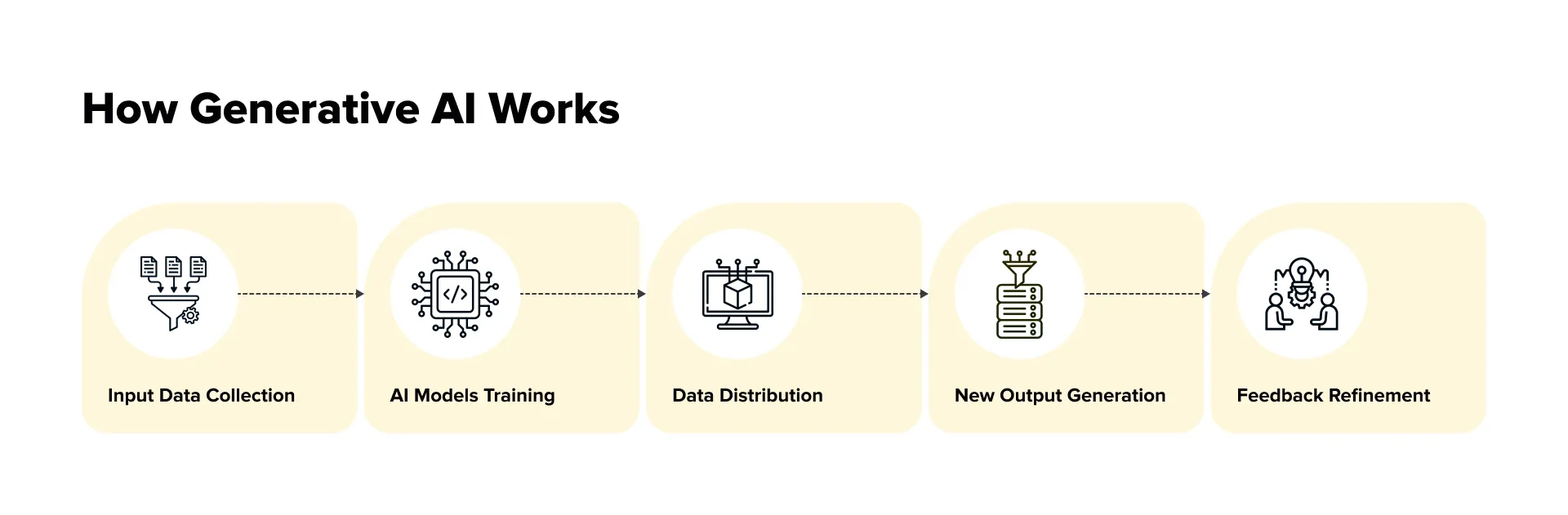
In retail, this works much like a skilled sales assistant. When a customer says, “I need a dress for a wedding,” GenAI uses NLP to understand intent, recognizes patterns from past data, and generates a tailored suggestion that fits the occasion, style, and budget.
How Generative AI Transforms the Retail Industry: Two Key Dimensions
Generative AI in retail reshapes the industry in two fundamental and connected ways. It improves how retail teams work internally while also changing how customers interact with brands. These dimensions reinforce each other, creating value that scales across the entire business.
Augmenting Internal Operations
On the operational side, GenAI acts as a productivity layer for retail teams. It helps automate repetitive tasks such as reporting, content creation, demand analysis, and internal communication. By processing large volumes of structured and unstructured data, GenAI delivers insights faster and in a format people can actually use. Teams spend less time preparing information and more time acting on it. As a result, decisions become more data-driven, consistent, and timely across departments.
Reinventing Customer Experience
At the customer level, GenAI enables more natural and personalized shopping journeys. It adapts product recommendations, content, and support to individual context in real time. Instead of static catalogs and filters, customers interact with intelligent assistants that understand intent, preferences, and constraints. This leads to smoother discovery, higher engagement, and stronger loyalty.
These two dimensions shape how Generative AI fits into everyday retail operations. Internal efficiency supports better customer interactions, while customer insights feed back into smarter decisions inside the business. With this foundation in place, it becomes easier to explore where GenAI brings the most practical value across specific retail processes.
Generative AI Use Cases in Retail
Now we dive deeper into generative AI use cases in retail and explore specific applications. Each example shows how real retailers solve business challenges with e-commerce solutions driven by GenAI. From customer-facing tools to back-office automation, every use case brings measurable value.
Product Recommendations and Personalization
Generative AI transforms how customers discover products. It analyzes customer preferences, purchase history, and browsing behavior to build personalized e-commerce solutions. Instead of showing generic lists, the system generates tailored suggestions in natural language. It also explains why suggestions make sense, spots cross-sell and upsell opportunities, and even anticipates future needs.
Behind the scenes, the GenAI engine combines customer data with product catalogs and uses NLP to understand the shopping context. It generates conversational recommendations that adapt as the shopper interacts in real time. This makes suggestions feel natural and relevant — almost like talking to a helpful store associate.
The impact is clear. At Amazon, AI-driven recommendations account for 35% of total revenue — showing how powerful personalization can be. These solutions typically increase basket size and average order value (AOV), boost loyalty, and reduce time to purchase.
Example conversation:
Customer: “I need a gift for someone who loves outdoor photography.”
GenAI: “Based on your browsing, here are top tripods and weather-sealed lenses under $300 — great for outdoor shots, plus portable gear recommended with quick setup.”
Visual Content Creation and Product Design
Visual content matters in retail. GenAI tools generate or enhance product imagery to fit many contexts. This includes lifestyle images, edited product photos with consistent backgrounds, multi-angle views, and seasonal variants. Virtual try-on features let customers see looks before buying — from makeup to clothing. For example, tools like Sephora’s Virtual Artist offer makeup previews, and Google’s clothing try-on boosts engagement dramatically (with ~98% scale accuracy in look placement).
Generative models also help in product design. Trend analysis and automated design generation speed up creation of multiple variants. Designers can test material and color combinations quickly — from fashion to furniture and electronics.
The benefits are measurable: faster time to market, reduced need for physical prototypes, lower production costs, higher engagement, and fewer returns. Some retailers see double-digit conversion boosts from richer imagery and virtual try-ons.
Conversational Commerce and Shopping Assistants
Conversational commerce moves shopping from search to dialogue. GenAI assistants guide users through multi-step purchase journeys. They suggest options within a budget, help choose gifts, advise on size and fit, and explain product care. This goes far beyond basic chatbot scripts.
Advanced assistants remember past conversations, react to browsing behavior, and connect with loyalty programs through a retail CRM system. If a question becomes complex, the AI seamlessly hands the case to a human agent, keeping full context.
Retailers use different implementation models. Full conversational bots work well for marketplaces and large catalogs. Smart AI search fits smaller stores. Hybrid approaches combine both for flexibility. Costs depend on conversation length, conversion uplift, and LLM usage. Importantly, API costs for large models have dropped by nearly 80% over the last 2–3 years, making these tools more accessible.
Real-world examples include Mercari’s Merchat AI, Carrefour’s Hopla assistant, and Newegg’s ChatGPT-powered shopping helper. Even a 2–4% basket uplift usually covers implementation costs.
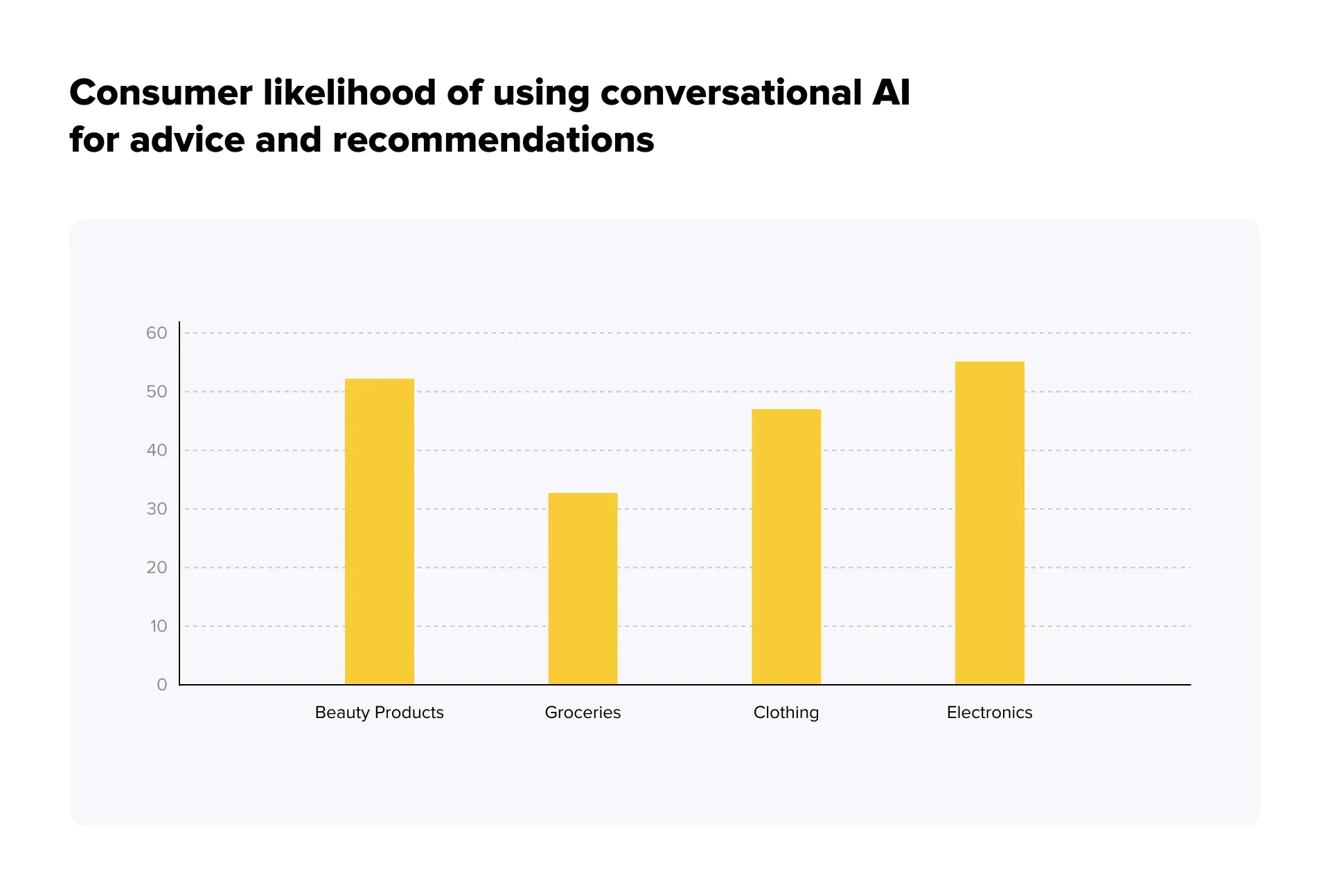
Source: Accenture – Consumer Research 2024
Content Generation and Marketing Automation
Generative AI simplifies content-heavy retail workflows. One of the most common generative AI use cases in retail is product description creation. AI generates SEO-friendly copy, adapts tone to brand voice, supports multilingual output, and creates multiple variants for A/B testing. According to IBM research, 53% of retailers already use GenAI for product content, which shows how quickly this approach is becoming standard.
Marketing teams also automate email campaigns, social media posts, ad headlines, blog articles, and landing pages. Personalized marketing becomes scalable rather than manual. Messages adjust to customer preferences, behavior, and timing without adding operational complexity.
Visual marketing benefits in the same way. AI produces images for social media, email banners, and seasonal campaigns with minimal manual effort. Retailers report up to 70% reduction in time spent on content creation, while keeping a consistent brand presence across channels.
Overall, GenAI shifts content work from repetitive production to strategic control, allowing teams to focus on planning, testing, and optimization instead of routine writing.
Inventory Management and Demand Forecasting
GenAI changes how retailers predict demand and manage stock. It analyzes historical sales, seasonality, promotions, and external factors like weather or social trends. Instead of raw tables, managers receive forecasts explained in natural language with clear “what-if” scenarios.
Inventory optimization tools suggest reorder points, warehouse distribution, seasonal planning, and SKU rationalization. GenAI also automates supply chain communication — from purchase orders to vendor messages.
A known example is Walmart’s vendor chatbot, which helped close 68% of supplier queries automatically and delivered around 3% procurement savings. Zara as well uses AI-driven demand sensing to keep inventory lean while responding quickly to trends.
Customer Service Automation
Customer support is one of the fastest areas to adopt gen AI in retail. AI-powered assistants provide 24/7 support across channels and languages. They handle order tracking, returns, exchanges, and detailed product questions.
Advanced systems analyze sentiment, detect frustration, and respond with empathy. When needed, they escalate issues to human agents with full context. Many retailers deploy agent co-pilots that suggest replies and surface relevant data in real time.
Implementation models include standalone bots, human-AI hybrid teams, and omnichannel platforms. The business value is strong. Response times drop sharply, first-contact resolution improves, and cost per interaction decreases significantly.
Studies show 60% of consumers believe GenAI will transform customer service, and 82% of retailers are piloting or scaling such tools. Solutions like Newegg’s AI support and ShopJedAI report accuracy rates above 85%, reducing support costs while improving satisfaction.
Trend Analysis and Market Intelligence
Retail trends change fast. GenAI helps teams keep up by analyzing massive volumes of unstructured data — social media posts, reviews, forums, and competitor content. It detects weak signals that humans often miss and turns them into clear insights.
These insights support product development, pricing decisions, and marketing message testing. Instead of static reports, teams receive dynamic summaries with recommendations and risks highlighted.
For example, early detection of rising demand for eco-friendly packaging helped several brands launch sustainable variants ahead of competitors — capturing attention and shelf space early. This kind of intelligence strengthens positioning and reduces market risk.
Benefits of Generative AI Solutions in Retail
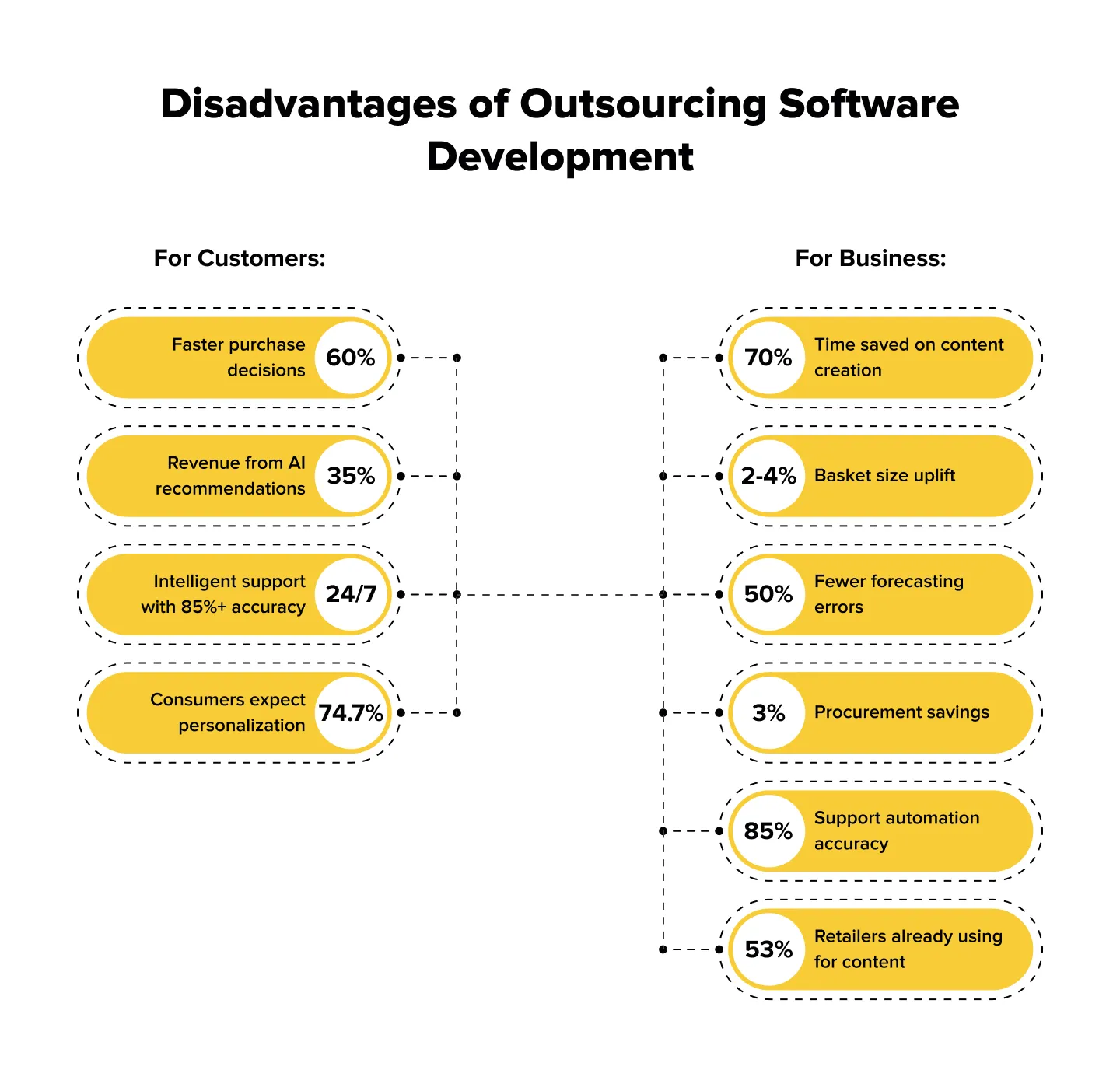
Generative AI brings value to retail not through one feature, but through a combination of small, connected gains that build momentum over time. The first impact most teams notice is operational. Automating repetitive work reduces pressure on staff and shortens execution cycles. A Stanford study links AI-driven productivity to a 2% annual revenue uplift, equivalent to $400–660 billion globally. In daily operations, this often shows up as speed: retailers report up to 70% less time spent on content creation, while 46% adopt AI primarily to control costs. As routine tasks fade into the background, teams gain space for planning and experimentation.
Once efficiency improves, revenue growth follows naturally. Personalization plays a central role here. Research shows 74.7% of consumers prefer brands that offer personalized experiences, and Amazon attributes 35% of its sales to AI-driven recommendations. More relevant offers increase basket size, lift average order value, and encourage repeat purchases without aggressive discounting.
These gains also reshape the customer experience. Shopping becomes faster and less fragmented, with GenAI cutting decision time by 50–70%. Always-on assistance, instant answers, and consistent support across channels set new expectations. It’s no surprise that 60% of consumers believe AI will transform customer service in the near future.
Behind the scenes, operational efficiency continues to improve. Retailers see up to a 50% reduction in forecasting errors, better inventory balance, fewer stockouts, and faster decision-making. Together, these improvements can unlock up to 5% incremental sales.
Over time, GenAI enables scalable personalization, competitive differentiation, and data monetization. Insights extracted from unstructured data support prediction, innovation, and smarter services. According to IHL Group forecasts, AI-driven retailers could reach 51% sales growth, 20% gross margin improvement, and 29% cost reduction by 2029, while McKinsey estimates $240–390 billion in value potential. As systems learn and mature, these benefits compound rather than plateau.
Challenges and Considerations in Implementing GenAI
Despite its clear potential, generative AI in retail is not plug-and-play. Implementation introduces technical, organizational, and regulatory challenges that can limit impact if ignored. Smart retailers approach GenAI with realistic expectations, strong planning, and active risk mitigation. Understanding these constraints early is essential for sustainable results.
Technical Challenges
Data quality is the first barrier. GenAI requires high-quality training data, but many retailers still operate with fragmented data silos. Customer data, product catalogs, and operational data often live in separate systems. Unstructured data adds complexity, while cleansing and preparation take time and resources. The most effective response is investing early in unified data platforms, shared standards, and breaking down departmental silos.
Integration is another challenge. Legacy retail systems were not designed for AI-driven workflows. Real-time synchronization, API limits, and platform dependencies slow deployment. Retailers overcome this by adopting modular architectures, using middleware, and rolling out GenAI in phases.
Model reliability also matters. GenAI can produce confident but incorrect outputs. Pricing errors, poor recommendations, or inconsistent brand tone can be costly. Successful teams use quality assurance layers, human review for critical outputs, and strict guardrails.
Finally, infrastructure costs grow at scale. LLM APIs, compute, and storage require optimization. Retailers mitigate this by starting with smaller models, using hybrid cloud setups, and continuously evaluating ROI.
Organizational Challenges
Talent scarcity is a major constraint. Many retailers lack in-house AI or ML expertise, and competition for skilled specialists remains high. Upskilling internal teams takes time and resources. As a result, retailers often start with partnerships with AI service providers, invest in structured training programs, and rely on off-the-shelf solutions during the early stages.
Change management is equally critical. Employees may perceive GenAI as a threat to their roles or hesitate to trust model outputs. Research shows that more than 40% of employees resist AI initiatives when communication is unclear. Successful organizations clearly explain that AI is meant to augment, not replace, human work, involve teams in implementation, and demonstrate quick, visible wins.
Measuring ROI adds another layer of complexity. The impact of GenAI is often distributed across multiple processes and increases over time. To reduce uncertainty, retailers define KPIs upfront, use controlled experiments such as A/B testing, and accept that part of the value created will not be immediately quantifiable.
Ethical, Legal, and Regulatory Challenges
Regulation is evolving fast. Retailers operating globally must navigate the EU AI Act, China’s GenAI rules, and proposed US legislation such as the Copyright Disclosure Act. Different regions impose different obligations on transparency, data usage, and accountability. The safest approach is building compliance into system design and documenting AI decision-making from day one.
Data privacy is another critical risk. Customer data used for training must comply with GDPR, CCPA, and similar laws. Breaches or opaque data use quickly damage trust. Strong governance, encryption, access controls, and clear consent mechanisms are non-negotiable.
Bias and fairness also require attention. Training data may reflect historical bias, leading to unfair recommendations or pricing. Regular bias testing, diverse datasets, and human oversight help reduce this risk.
Brand reputation is fragile. Poor AI-generated content or inappropriate responses can trigger backlash, as seen in several high-profile campaigns. Clear review processes and transparency about AI use protect trust.
To conclude, intellectual property remains complex. Ownership of training data and generated content must be defined with legal guidance. Responsible GenAI adoption demands proactive risk management, not reactive fixes.
Measuring ROI and Success of Gen AI Initiatives
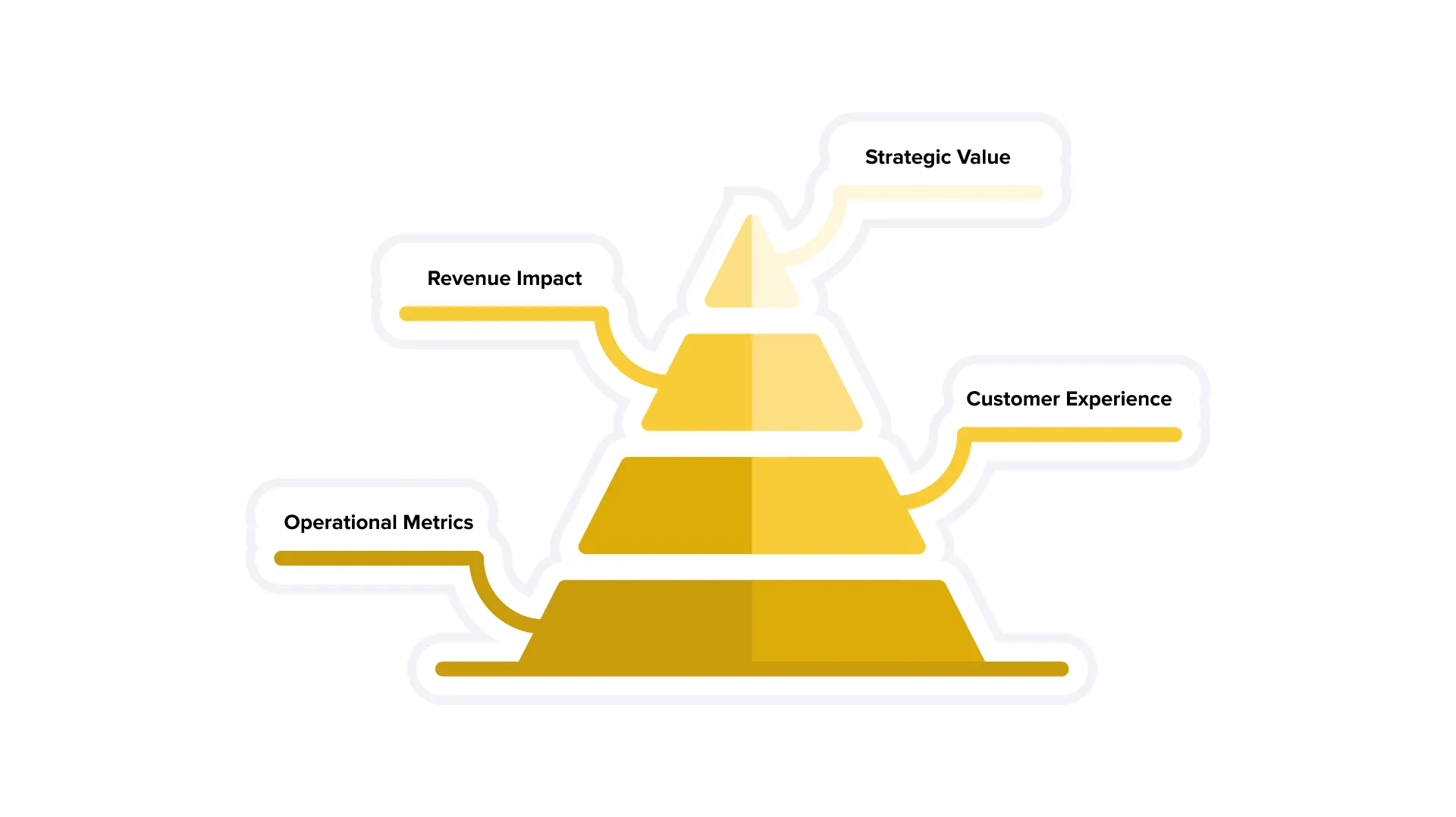
Measuring the impact of generative AI in retail requires a structured approach tied to business outcomes. For customer experience, retailers track conversion rate improvements, basket size uplift of 2–4% for AI chatbots, customer satisfaction (CSAT), reduced time to purchase, and changes in return rates. According to Salesforce, 73% of customers expect companies to understand their unique needs and expectations, which makes these indicators central to evaluating GenAI value.
Operational efficiency focuses on internal gains. Key metrics include time saved on content creation and customer support, lower cost per interaction, employee productivity growth, and process automation rates. According to McKinsey, generative AI has the potential to automate or augment up to 30% of tasks across multiple business functions, including retail operations, which directly impacts operating margins and cost structures.
Revenue impact is measured through incremental sales from recommendations, cross-sell and upsell rates, customer lifetime value growth, and new customer acquisition. Cost savings include labor optimization, improved marketing efficiency, reduced inventory carrying costs, and procurement savings. Walmart has publicly shared procurement efficiency gains of around 3% through AI-driven automation.
To isolate GenAI’s contribution, retailers rely on A/B testing, before-and-after analysis, cohort comparisons, and attribution modeling. Over time, quantitative ROI is reinforced by qualitative outcomes—stronger brand perception, faster innovation cycles, and more resilient competitive positioning.
Conclusion
Generative AI in retail has moved from experimentation to real business impact. Across the article, we explored how GenAI improves productivity, enables scalable personalization, enhances customer experience, and strengthens operational decision-making. Retailers are already using generative AI for retail to reduce manual effort, increase relevance across channels, and unlock value from unstructured data.
What matters most is not isolated use cases, but a connected approach. When gen AI in retail is integrated with commerce platforms, data infrastructure, and customer systems, the benefits compound over time. Systems learn, predictions improve, and teams work faster with better context. This is where measurable ROI appears.
At Lampa, we work with retail businesses at every stage of this journey — from defining strategy to delivery and scaling. Through retail software development services, we help design, build, and integrate GenAI solutions that fit real processes, not abstract ideas. If you’re ready to turn AI potential into clear business results, Lampa is ready to partner with you.