
Choosing monolith vs microservices is one of the first architecture decisions for tech startups. Many entrepreneurs assume that microservices architecture is the only modern option, since this is how IT giants design their software. Nevertheless, at the beginning of their project, companies focus on aspects such as development speed, system maintainability, and product validation.
A monolithic architecture or modular monolith architecture is the best solution for most startups in the initial phase of their work. It allows launching the MVP quickly and obtaining valuable user feedback; moreover, changing the architecture becomes necessary only when business growth requires it.
Why Architecture Decisions Matter So Much for Startups

The choice of software architecture for startups affects more than just code organization. Architecture determines time-to-market, development costs, staffing needs, and future scalability.
There are some factors that are especially important for startups:
Monolith vs. Microservices: Which Architecture Fits an Early-Stage Startup?
development velocity;
infrastructure costs;
tests;
release process;
flexibility of the product;
technical debt;
developers' demands;
investors' and customers' expectations.
In the initial period of the business, each week can become extremely important. The more effort the team invests in managing the complex infrastructure, the worse product development will be.
Thus, implementing a microservices architecture requires additional technologies for monitoring, CI/CD, logging, containerization, and service management. The cost of the project will rise even before getting any customers.
Moreover, investors pay less attention to the latest architectural "trends" and focus more on the team's ability to conduct experiments and introduce innovations.
Thus, the architecture should align with the company's goals at this moment rather than replicating the architectures used by Netflix, Amazon, or Uber.
Before deciding on the architecture, it is worth conducting a business analysis services to understand what the product needs to grow and develop.
What Is Monolithic Architecture?
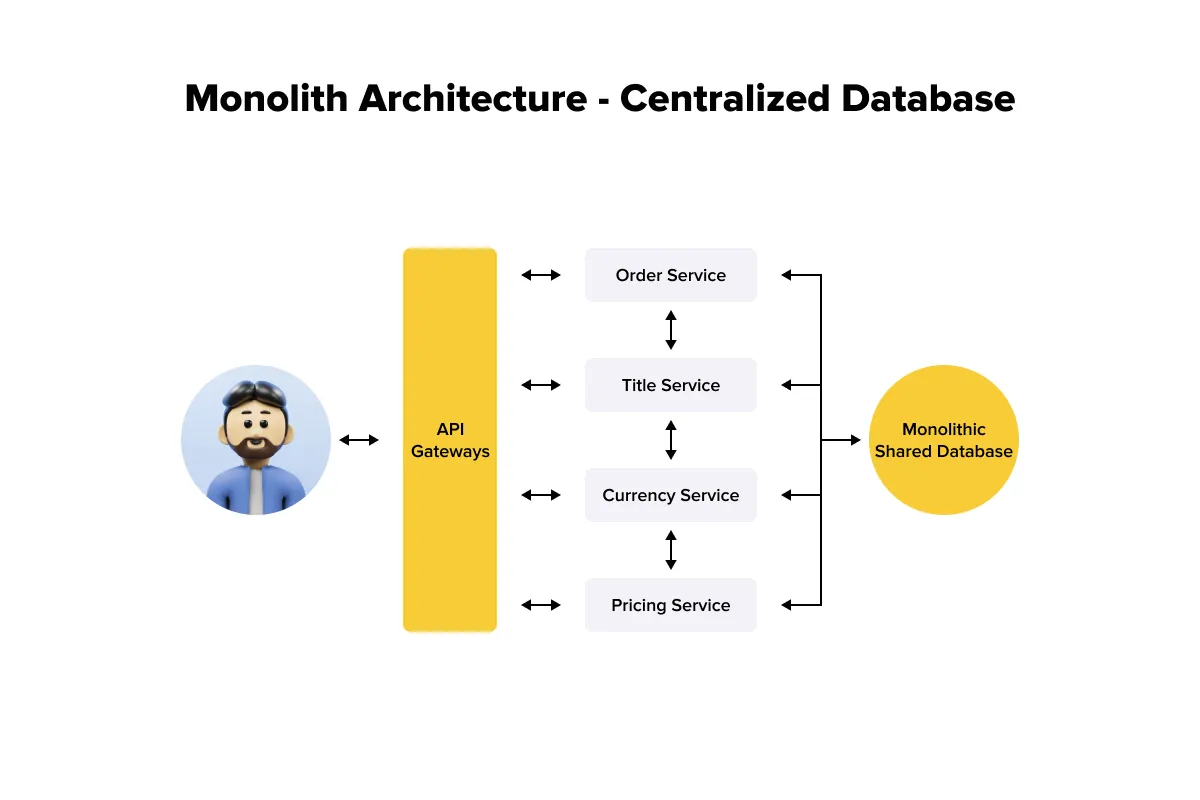
Monolithic architecture is an application that consists of all main components within a single system. Usually, such a project comprises the following components:
single codebase;
deployable application;
shared database;
single business logic;
common development process.
Despite the common opinion, monolithic architecture is far from being obsolete. On the contrary, a well-developed monolithic application can function for many years.
The primary benefits of such an approach are:
easy development locally;
quick tests;
a smaller number of infrastructure components;
easy debugging;
faster MVP development.
This is exactly why, in the MVP architecture of most startups, a monolith is used.
Such architecture is appropriate for:
SaaS platforms;
marketplaces;
admin dashboards;
internal corporate software;
booking systems.
The primary issue here does not stem from the monolith, but from poor code organization. In case the business logic is mixed, there will be strong module dependencies and a lack of architectural separation, making it hard to support the project.
A monolithic architecture startup can stay relevant much longer than one might expect at first.
What Is Microservices Architecture?
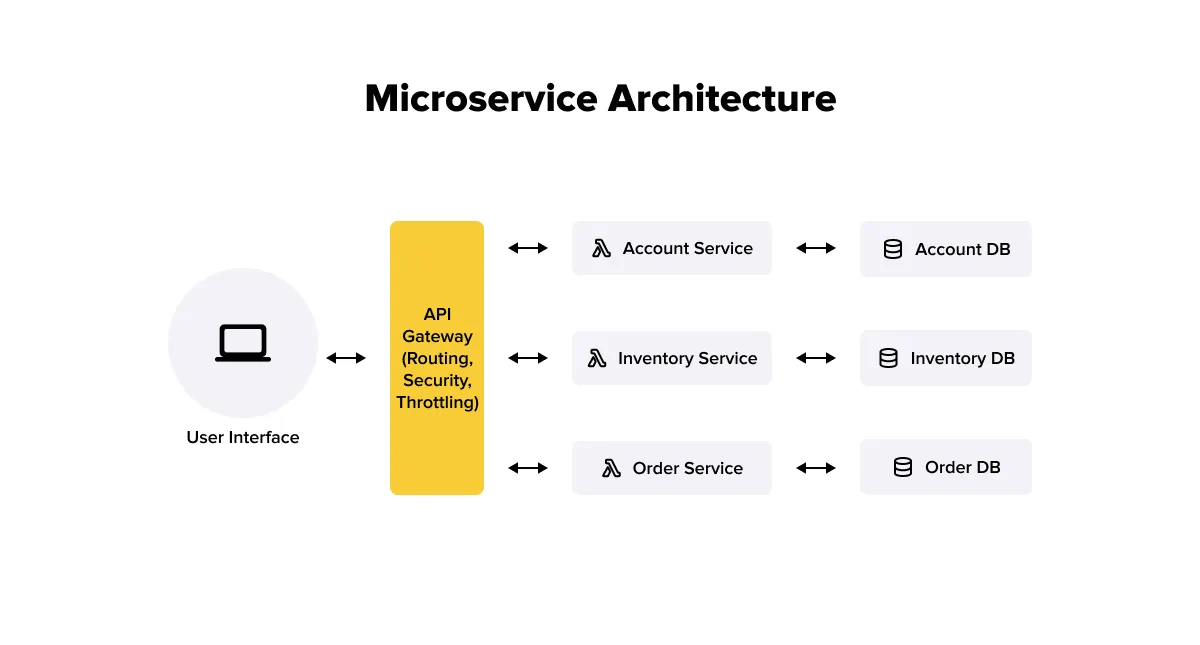
In contrast to a monolith, a microservices architecture splits the system into several separate services.
Every service corresponds to a particular business process:
users;
catalog;
payments;
notifications;
analytics;
search.
Inter-service communication takes place via APIs, message queues, and event-driven architecture.
The strengths of this approach are clear:
scaling of each element separately;
possibility to deploy the services independently from one another;
delegation of responsibility to different teams;
application of distinct technologies when needed.
Yet, there is one drawback to using microservices for startups.
There are extra difficulties in such cases:
network latency;
distributed debugging;
complex monitoring;
data consistency;
increased demands on DevOps;
extra amount of testing.
Therefore, the decision between monolithic vs microservices architecture is about striking a balance rather than about "modernism."
Microservices have a lot of potential, but need much more engineering effort.
Monolith vs. Microservices: Quick Comparison
Factor | Monolith | Microservices |
Best for | MVPs, small teams, early-stage startups | Larger teams, complex systems, scaling domains |
Codebase | One codebase | Multiple services |
Deployment | Single deployment | Independent deployments |
Development speed | Faster at the beginning | Slower initially, faster at scale |
Testing | Simpler | More complex |
Infrastructure cost | Lower | Higher |
DevOps needs | Basic to moderate | Advanced |
Data consistency | Easier with shared database | More complex, often eventual consistency |
Team structure | 2–8 developers | 10+ developers or several independent teams |
Main risk | Growing into a messy monolith | Creating a distributed monolith too early |
One solution cannot be said to be always better than another. The choice between microservices vs monolithic architecture comes down to the product development phase, the number of people, the complexity of the domain, and the company's maturity level in supporting distributed architecture.
Why Most Startups in the Early Stage Should Choose Monolith First
For most startups, early-stage startup architecture should focus on rapid development rather than scalability.
This is exactly why, at the early stage, the choice between monolith or microservices comes down to choosing a monolith approach.
The reasons for this include:
rapid product development;
fewer components to maintain;
simpler deployment;
easy developer onboarding;
lower cloud infrastructure costs;
simplicity of managing database transactions;
rapid bug fixing;
less DevOps expertise.
Moreover, at an early stage, the team usually does not know what the product will look like in half a year. Features emerge every week, user stories change, and different business models are explored.
Splitting the application into services too early entails the risk of making the wrong decisions about what belongs to which service. This might lead to extra expenses on the re-architecture of the system.
Thus, an MVP development architecture should enable quick hypothesis testing and not be concerned with an imaginary user base of millions.
In most cases, a well-designed web application development built on a solid monolithic architecture can provide everything a startup needs before it scales.
The Better Middle Ground: Modular Monolith
Many developers find the modular monolith model to be the best possible compromise between monolithic and distributed architectures. This solution provides all the benefits of the former, along with a better code structure.
The difference between the classic monolith and such a solution is that, while remaining a single application, it is organized into separate, independent modules for a particular business domain, with minimal dependencies on other parts.
The system can include such modules as:
users;
billing;
notifications;
catalog;
orders;
analytics;
admin panel.
In this case, you are able to:
have one deployment point;
keep separate business logic;
facilitate maintenance;
get ready for future splitting into services.
This is why modular monolith startup is now one of the best solutions for many startups.
The main advantage is that the team can enjoy the flexibility of developing a monolith without the problems typically caused by a lack of architectural boundaries.
In other words, the key lesson is that it is better to develop the first product version as a modular monolith, with predefined domains that modules can be easily split into separate services if needed.
When Microservices Make Sense for a Startup
Although monoliths remain popular for MVPs, there are cases when microservices are well-suited for startups.
This is not about a desire to adopt the latest technologies, but rather about specific technical or business needs.
Microservices are appropriate when:
different pieces of the product need to be scaled separately;
more than one team works on the product;
different domains need to release versions of their codebase independently;
performance requirements of individual parts are significantly different;
there are high security or compliance requirements;
mature DevOps practices are already available in the company;
the product has been designed based on the API-first philosophy.
For example,
for a fintech startup, it is logical to separate the payment functionality from user accounts; for a marketplace, search, product catalog, and order functionality;
for a logistics platform, routing, tracking, and notifications;
for an AI-powered product, inference services and the core application.
Lampa THD is an example of such a project. There were no trends that drove the need to develop microservices; rather, the necessity was to process data streams, build an event-driven architecture, and conduct real-time analysis.
This is exactly what the microservices and real-time data processing case demonstrates: it is possible to scale the parts of the system that bear more load without affecting the overall product load.
When Microservices Are a Bad Idea for Early-Stage Startups
Often, a microservices architecture approach leads to additional issues.
This applies to those projects which are looking for product-market fit. You need to think twice about using microservices when:
fewer than 5–8 developers work on the project;
there is no DevOps engineer;
requirements change frequently;
domain boundaries are not established yet;
the project is budget-restricted;
there is no experience in creating distributed applications;
processes of CI/CD are being shaped up;
no monitoring exists.
Under such circumstances, even small changes can affect a broad range of services at once and require the cooperation of all developers.
Microservices do not remove complexity. They move it from the codebase into infrastructure, communication, testing, and operations.
This is why early adoption of microservices usually slows things down rather than accelerate them.
The Biggest Risk: Building a Distributed Monolith
One of the most common problems is the development of a "distributed monolith."
On the surface, it appears that the application is built out of different services. However, in fact, they are so much connected that no independence exists.
Features of the distributed monolith include:
all services use the same database;
changes require changes in several components at once;
one error results in the failure of several services;
most of the requests are processed via synchronous calls;
separate deployments by different teams are not possible.
Hence, the company experiences all the disadvantages of the microservices architecture without the benefits.
Thus, when choosing between monolithic vs microservices architecture, one should bear in mind that the decomposition of an application is meant to provide for its independence, not merely to add more services.
Architecture Decision Factors for Startups

When choosing a startup architecture, one needs to consider not only the project's current size but also its potential future development.
Team Size
Small teams tend to be much faster when using a monolith. With the formation of several independent teams for each separate domain, the benefits of microservices start to manifest.
Product Stage
At the pre-product/market fit stage, the most important thing is the speed of hypotheses verification. At a later stage, when the business model is validated, scalability and stability start to matter more and more.
Domain Complexity
If there is not much complexity in the business processes, the choice is to use monoliths. With several independent domains emerging, it would be useful to define the architectural boundaries in advance, even if it is just one app for now.
Scalability Needs
It is not necessary to build the system for millions of users who may never come to your product. First, you have to identify which parts of the product could become bottlenecks in the future.
DevOps Practices Maturity
A mature microservices architecture is characterized by a mature CI/CD pipeline, centralized logging, monitoring, request tracing, and deployment automation.
Startup Scenarios: Which Architecture Fits Best?
These are the most common cases for selecting startup architecture based on specific circumstances.
Startup Scenario | Recommended Architecture | Why |
MVP for SaaS dashboard | Monolith | Fast delivery, simple deployment |
Local marketplace MVP | Monolith or modular monolith | Business model still changing |
Fintech product with payment isolation | Modular monolith + isolated payment service | Security and compliance may require separation |
High-traffic media platform | Modular monolith first, microservices for heavy workloads later | Scale bottlenecks may be isolated |
AI startup with model inference | Core monolith + separate inference service | Different compute and scaling needs |
eCommerce startup | Modular monolith | Catalog, cart, checkout can be modular from day one |
Logistics platform | Modular monolith, later service extraction | Routing/tracking may need future separation |
Real-time analytics or data-heavy operational platform | Microservices for specific workloads | Separate services can support analytics calculation, stream processing, and real-time data handling |
If the software application is intended for use on the internet and mobile platforms, the system architecture should account for the following aspects of mobile app development.
For products with a heavy mobile application workload—such as fitness apps featuring personalized recommendations, activity tracking, and data synchronization—the architecture must account for future user growth. In such cases, it is crucial to plan the API, scalability, and the separation of responsibilities between components in advance. For instance, developing a scalable cross-platform fitness app might require a modular approach where the mobile client, server-side logic, and data processing services evolve independently.
Impact of System Architecture on MVP Development
The MVP architecture determines how quickly the product reaches the market. The truth is that MVP development is not about building the perfect application, but about getting user feedback as soon as possible.
Monolith helps you to:
implement new features faster;
release new versions of the product without complicated coordination;
fix bugs;
and adapt to changes in requirements.
At the same time, a modular monolith will have all the benefits mentioned above and prepare the system for the future.
It takes time to deploy a microservices architecture because it requires implementing the infrastructure, deployment process, service interactions, and other testing procedures.
Thus, the chosen architecture should help the startup get the learning and validation experience rather than prepare for scaling.
Cost Comparison: Monolith vs. Microservices
When selecting a Monolith or Microservices architecture for a startup, it is crucial to consider not only development time but also costs. The architecture affects infrastructure, DevOps, testing, maintenance, and staffing.
In the early stages, a monolith will require less effort to create. For many young startups, monolithic applications can be hosted on a single cloud that costs $20-$100 monthly depending on the vendor and the amount of resources needed. On the other hand, a production-ready microservices environment needs at least a few services, databases, container orchestration, etc., which increases expenses to $300-$1,000+ monthly, not counting users yet. One server, one database, and unified deployment are enough to start selling the product with a limited budget.
Using microservices will require extra expenses:
setting up the infrastructure;
monitoring of each service;
containers management;
delivery automation;
more test environments;
developers familiar with distributed systems.
Cost Area | Monolith | Microservices |
Infrastructure | Typically $20–100/month for an MVP | Often $300–1,000+/month depending on infrastructure |
DevOps setup | Simpler | More complex |
Testing | Cheaper and faster | Requires more tooling |
Monitoring | Centralized | Distributed |
Hiring | Generalist-friendly | Requires distributed systems experience |
Maintenance | Easier early | Easier at scale if well-designed |
It should be recognized that microservices can help reduce future maintenance costs for a large system, but only if the business has reached a point where the benefits of the architecture outweigh its complexity.
Testing Differences Between Monolith and Microservices
Testing is often underestimated when making an architectural choice. The testing process in a monolithic application is much simpler, as everything is placed in one system.
Monolithic Testing
The main types of testing are:
unit tests;
integration tests;
end-to-end tests;
database sharing checking;
debugging in local environment.
Microservices Testing
Additional layers of validation appear in microservices architecture:
validation of each individual service;
contract validation;
verification of API interaction;
test containers;
dependency validation;
distributed tracing;
canary deployments;
feature toggling.
The problem is that the mistake can occur not in a single service but in the intercommunication among several parts.
Thus, before switching to microservices, the team should have a quality strategy in place.
Professional software testing will ensure the system's stability as the complexity increases.
DevOps and Infrastructure Requirements
Many organizations adopt microservices for startups and overlook the extent of changes in infrastructure requirements.
To fully support the microservices architecture, you need:
CI/CD pipelines;
Docker containers;
orchestration tools such as Kubernetes or others;
API gateway;
monitoring;
centralized logging;
distributed tracing;
secret management;
rollback;
cost optimization in the cloud.
In practice, even a basic microservices platform often includes Kubernetes, an API gateway, centralized logging, metrics collection, distributed tracing, container registries, and deployment automation. Setting up and maintaining this infrastructure may require a dedicated DevOps engineer or platform team, which many early-stage startups cannot yet justify.
When a startup does reach that point, the first DevOps hire rarely has to be a full-time role opened from scratch. Many teams bring in an experienced engineer for the migration period instead, using platforms like Cortance that match startups with pre-vetted developers, and decide on a permanent role once the infrastructure settles.
At the early stage, it is more important for a startup to release the product, attract its first customers, and prove the concept than to create complex infrastructure.
As a result, the software architecture for startups should consider not only technical skills but also the team's level of maturity.
How to Move From Monolith to Microservices Later
Changing from a monolithic architecture to microservices doesn't necessarily require a full rewrite of the product. The gradual transition would be the right method.
Step 1. Begin with Clear Modules
At first, you need to create modules for your monolith according to business domains:
users;
payments;
orders;
analytics;
notifications.
It is crucial to split the architecture by business logic and not by technical layers.
Step 2. Find the Real Bottlenecks
There is no need to split off the services without any reason. So, you should find some bottlenecks in your system:
part of your application works too slow;
you need to scale a certain component;
there is an overlap between teams while developing;
the module has its special needs.
Step 3: Start With Decoupling Low-Risk Services
Some of the low-risk services include:
Notifications,
Reporting,
Search,
File processing, and
Analytics.
This can be done without any risk to the core product.
Step 4: Keep an Eye on Data Ownership
It is imperative that data be properly owned by each service. Having a single database for all services leads to coupling.
Step 5: Include Observability before Additional Services
Before adding additional services, you should have:
monitoring;
logging;
error tracking;
performance monitoring.
Otherwise, it is hard to manage a distributed system.
Step 6: Migrate Gradually
There is no need to migrate the entire product. It is always better to remove individual components only if they provide business value.
Decision Checklist: Monolith, Modular Monolith, or Microservices?
Architecture selection depends on the context you find yourself in.
Select Monolith Architecture If:
you’re creating an MVP;
you have a small team;
your product evolves frequently;
you need fast delivery;
your budget is constrained;
domains of your business aren’t clear.
Select Modular Monolith Architecture If:
you need fast delivery and well-structured code;
you’re developing a product that covers several business domains;
growth is anticipated;
future move to services architecture is considered.
Select Microservices If:
you have several engineering teams;
domains of your product are well-separated;
you need independent scaling;
you need separate security procedures;
DevOps and testing culture are already established.
For most startups, the choice between a monolith or microservices boils down to choosing between regular monolith architecture or modular monolith architecture.
Common Architecture Mistakes Startups Should Avoid
Often, problems occur not because of the wrong choice of technologies but because of their inappropriate use. Startups should not do the following things:
copy the architectures of big corporations for no reason;
go microservices just because it is trendy now;
create a messy monolith;
skip automated testing;
forget about database design;
create too many services;
solve scalability problems while there are no users yet;
refactoring the whole product rather than implementing small changes.
The basic idea is that architecture should make the business work faster.
How Lampa Can Help Startups Choose and Build the Right Architecture
Choosing the proper architecture involves a combination of product and technical approaches.
At Lampa, we help startups build solutions aligned with their current stage of product development and future plans.
We can provide:
Analysis of business requirements;
Architecture design;
Building an MVP;
Web applications development;
Mobile app development;
Development of modular monolith;
Migration from monolith to microservices;
QA;
Software testing services;
DevOps preparation;
Development teams dedicated to specific projects.
If your startup wants to develop an MVP, update your current solution or figure out which architecture is better for you – monolith or microservices, at Lampa we can choose the proper one for your business needs.