
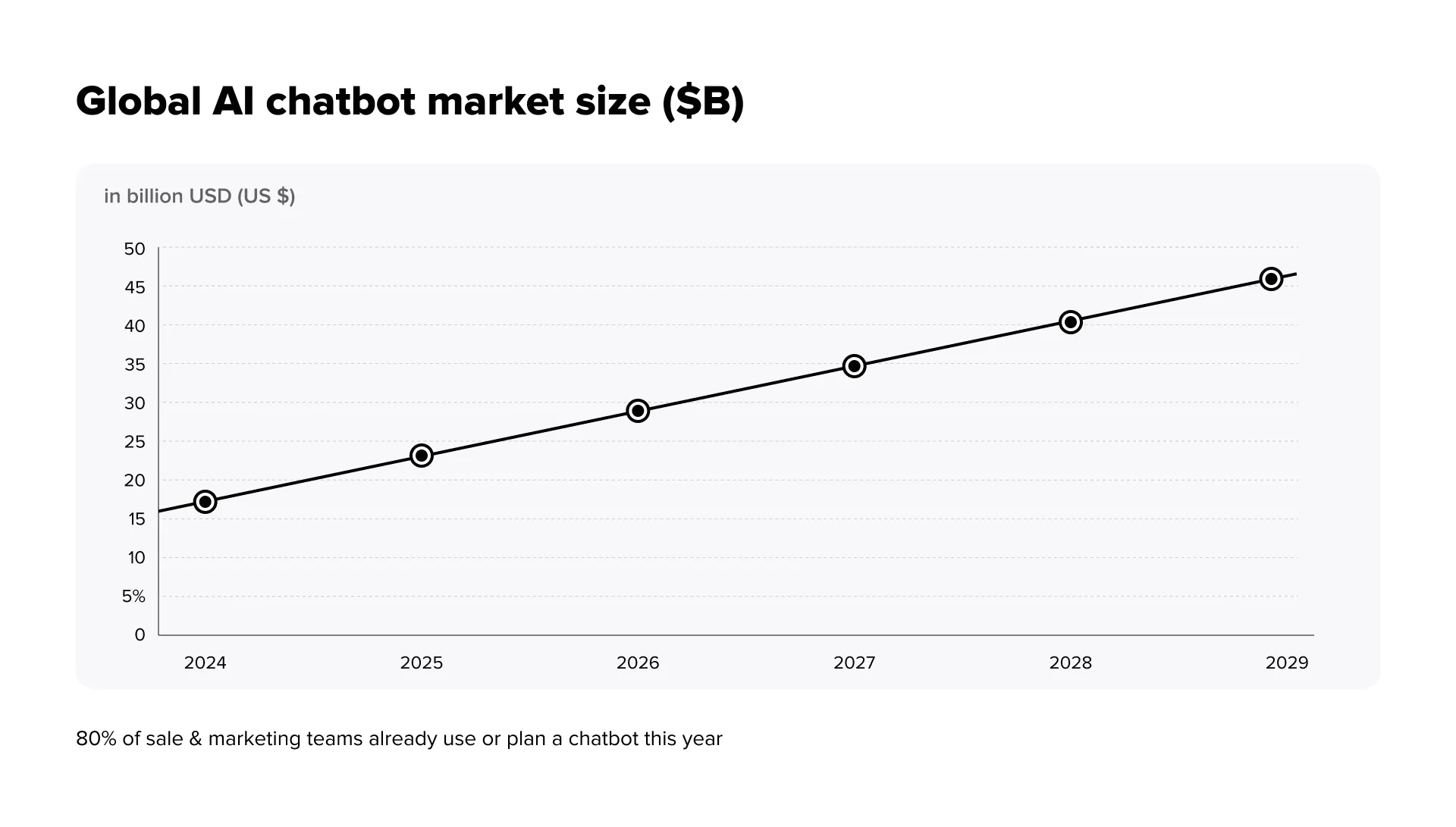
The global AI chatbot market was valued at about $15.6 billion in 2024 and is expected to grow almost three times to $46.6 billion by 2029. Nearly 80% of sales and marketing professionals already have a chatbot for their company or are planning to implement one this year. That shift changes the real question companies face — it's no longer whether messaging apps are a passing trend; it's why your business needs a chatbot right now, and when adding one actually pays off. This guide covers both, plus how to pick the right type for your team.
What Is a Chatbot, Exactly? (Rule-Based vs. AI vs. AI Agents)
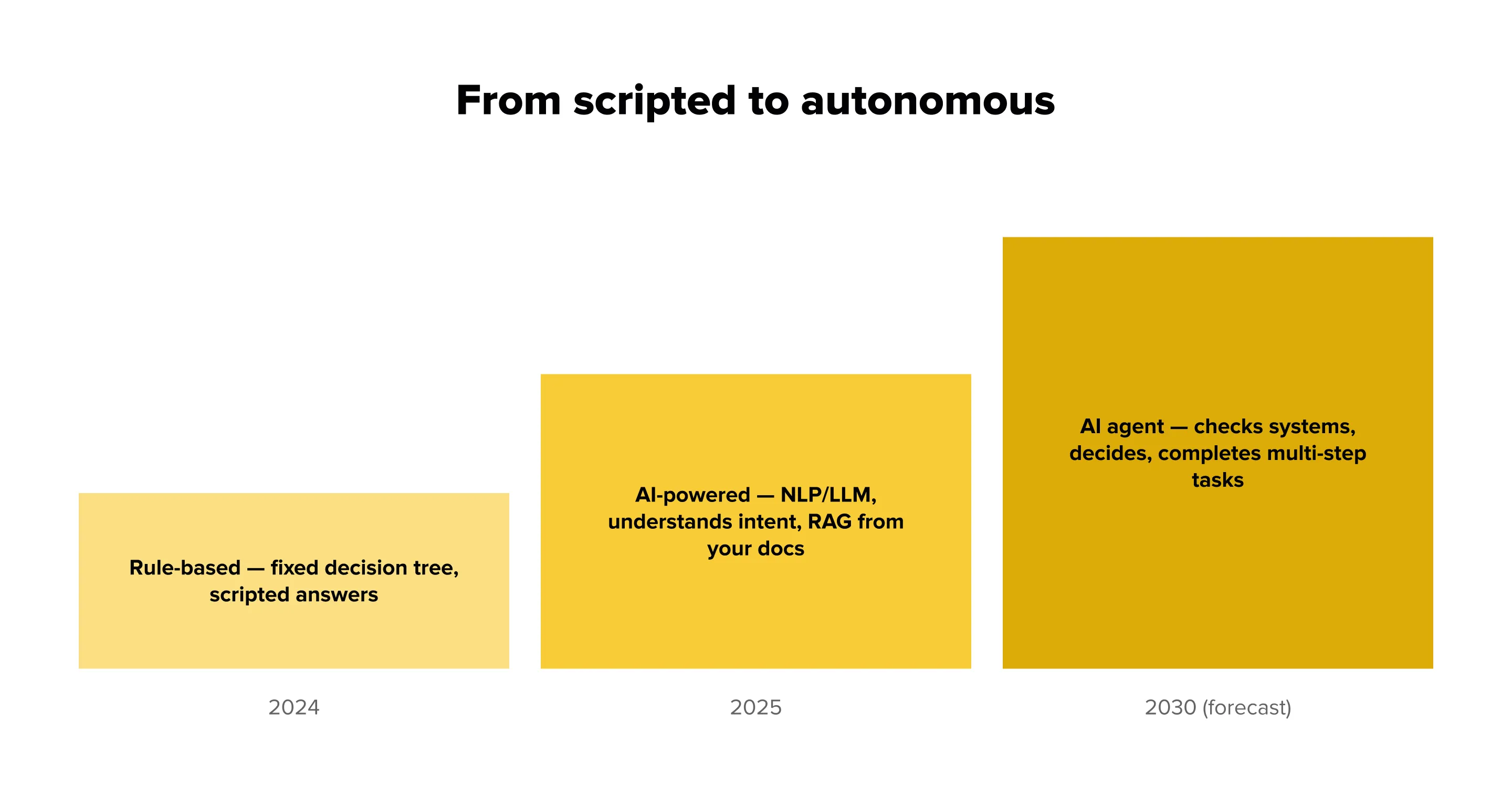
A chatbot — sometimes called a virtual assistant — is, at its simplest, a program that simulates a conversation with customers on a website or inside a messenger app. Before choosing a solution, it helps to understand the three levels business owners typically run into:
A rule-based chatbot follows a fixed decision tree — like a vending machine: press a button, get a predetermined answer. Reliable for narrow, repeatable questions, but it can't handle anything outside its script.
An AI-powered chatbot uses natural language processing and machine learning — often a large language model under the hood — to understand what a customer actually means, not just which keyword they typed. Many are now built with retrieval-augmented generation to pull answers straight from your own documentation instead of a fixed script.
An AI agent goes a step further: instead of just answering, it can independently check systems, make decisions, and complete multi-step tasks — closer to an assistant who can actually go and get something done for you, not just tell you where to find it.
Most businesses don't need the most advanced option on day one — they need the one that matches their actual questions.
When Does Your Business Need a Chatbot?
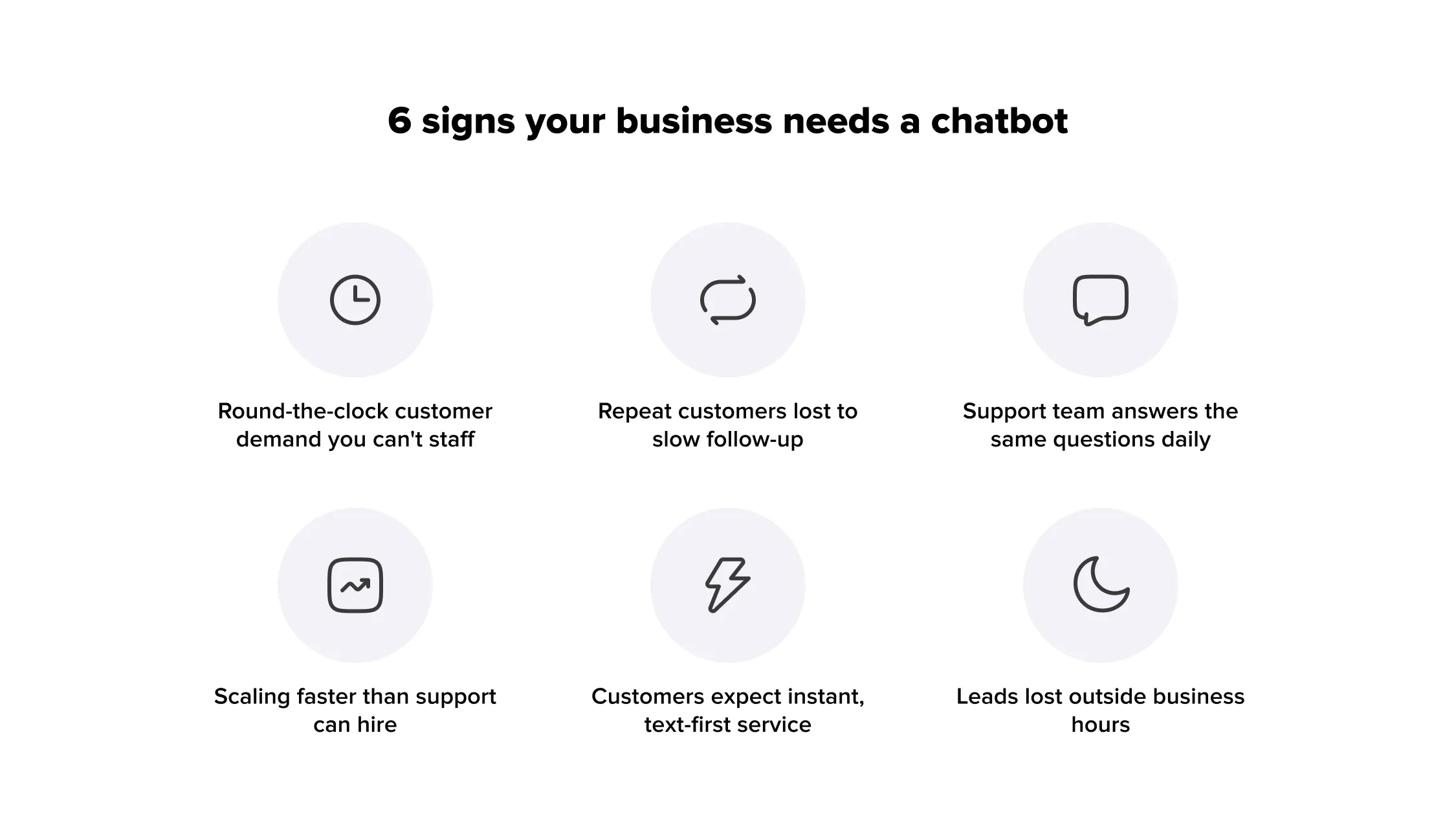
Why does your business need a chatbot in the first place, and when does a business need a chatbot specifically? Rather than list generic benefits, here's a faster way to check: scan the situations below. If two or three sound familiar, that's usually a clear sign it's time — not because a chatbot is trendy, but because a specific cost is already adding up.
You Can't Keep Up With Round-the-Clock Customer Demand
This isn't only a large-enterprise problem. Any business with customers across time zones — or just customers who browse after 9 PM — hits the same wall: a human team can't realistically staff round-the-clock coverage without a serious payroll increase. A chatbot for business closes that gap at a fraction of the cost, answering questions about orders, pricing, and availability the moment someone asks. You don't need round-the-clock staff to offer 24/7 support and real-time support — you need one properly configured chatbot platform doing the first pass.
You're Losing Repeat Customers to Slow Follow-Up
Repeat purchases are what keep most businesses profitable, but email alone struggles to drive them — open rates drop every time you send another newsletter. The moment that actually works is right after checkout: offer the customer a chatbot in their messenger of choice to track their order, and you've created a channel that doesn't get buried in an inbox. From there, the same bot can flag restocks, relevant offers, or shipping updates on its own—a small addition to messenger marketing that turns a one-time sale into ongoing customer retention instead of a closed ticket.
Your Team Answers the Same Questions, Every Day
Take a look at your support tickets for the past month. Most of them fall into the same few categories: delivery time, returns, store hours, and prices. This is the repetitive-question problem every support team faces. The chatbot can resolve these easily, and only complex questions that need human intervention through escalation to a live agent. That frees up the team to focus on harder cases, not take work away from them — the result is fewer support tickets, faster response time, same headcount.
You're Scaling Faster Than Your Support Team Can Handle
One customer service agent can handle two to three chats simultaneously; perhaps even four on a good day. However, there is no limit to the number of simultaneous chats a chatbot can handle, all without any decrease in response times, which becomes relevant the second you grow faster than you can hire new people. Hiring and training new agents takes time and money, and it doesn't scale back down during slow periods. A chatbot gives you that scalability in both directions, without diluting your conversion rate — customers still get an instant answer during a traffic spike instead of waiting in a queue and leaving.
Your Customers Expect Instant, Text-First Service
This isn't a generational quirk — it's how communication has shifted for nearly everyone. McKinsey research shows that a large majority of both Gen Z and millennial customers now say they'd rather message or use live chat with a business than call, and that preference keeps spreading. People text a friend before they'd phone one; they expect the same from a business. A chatbot meets that expectation by default — already text-first, already instant, and already on the channels people check throughout the day.
You're Losing Leads Outside Business Hours
A visitor lands on your site at 9 PM with a real buying question, doesn't get an answer, and leaves. That's not a missed chat — it's a lost conversion, and it happens every night your sales team is offline. A chatbot can qualify that visitor in real time: ask a few pre-sale questions, capture their contact details, and hand a warm lead into your sales funnel by morning instead of losing it to a competitor's tab. For lead generation specifically, this is often the highest-value use case for a first chatbot — it works while your team is asleep.
Types of Chatbots for Business (and Which One Fits Your Case)
Chatbot for business isn't one product — the right chatbot builder or platform depends entirely on the chatbot use cases you're solving for, and whether you need omnichannel support from day one. Here's a quick map of the five main types.
FAQ / Information Bots
These answer the repetitive questions every business gets — hours, pricing, delivery, location — pulled straight from a knowledge base. They're the fastest, cheapest type to launch, and give customers real self-service without a wait.
Best for: any business drowning in the same five questions.
Support Bots
Support bots check order status, walk customers through returns, and escalate anything genuinely complex to a human. They plug into existing systems through CRM integration and other chatbot integrations, so the bot isn't guessing—it's pulling real account and order data before it answers.
Best for: teams that want to cut support tickets without cutting service quality.
Sales & Lead-Generation Bots
A sales bot qualifies site visitors, answers pre-sale questions, and captures contact details before a prospect has a reason to leave the page. Instead of a static contact form, the visitor gets an actual conversation—which tends to convert better and reduce cart abandonment when placed at the right moment in the buying journey.
Best for: businesses that lose visitors to silence during business hours, not just after them.
Transactional Bots
Transactional bots go beyond answering questions — they take orders, process bookings, and even handle payments directly inside the chat window, without redirecting the customer to a separate checkout flow. This works especially well for an e-commerce chatbot where every extra click costs a sale.
Best for: e-commerce and booking-heavy businesses.
AI Agents
AI agents represent the most sophisticated approach: rather than performing a set of scripted actions, they can review multiple systems, offer personalized recommendations based on account history, and perform multi-step actions independently. Creating such a tool usually requires more than a ready-made builder, and you'll need to work with a company that provides AI development services.
Best for: companies that require something more complicated than a bot is capable of delivering.
Chatbot type | Best for |
FAQ / Information bot | Businesses drowning in the same five questions |
Support bot | Cutting support tickets without cutting service quality |
Sales & lead-gen bot | Businesses losing visitors to silence during business hours |
Transactional bot | E-commerce and booking-heavy businesses |
AI agent | Complex or high-volume needs a simple bot can't keep up with |
What Business Value Can You Actually Expect?
There are plenty of reasons to use a chatbot for business, but it's easy to say a chatbot "helps" without saying what that actually means. This is how a chatbot helps, and how chatbot roi and chatbot analytics demonstrate its impact.
On cost: IBM estimates chatbots can cut customer service operational costs by up to 30% by absorbing routine queries that would otherwise need a paid agent. On speed: one internal study found that after deploying a chatbot, 90% of customer inquiries were resolved without any human handoff at all — a direct hit on response time and customer satisfaction. On conversion: a Glassix analysis found chatbots that engage visitors immediately can lift conversion rate by around 23%, simply by answering a question before the visitor decides to leave and improving user experience along the way.
Lampa has seen this pattern firsthand. For Pacaso, a real estate platform, the team built the kind of AI chatbot business owners actually need — a concierge chat feature inside the product.
“I'm still confident that, were it not for engaging with Lampa Software on this project, we wouldn't have been able to build this feature in parallel with the other high-priority features our own team was working on.” — Dan Pinciotti, Director of Engineering, Pacaso.
That's the real benefit of a chatbot for business in one sentence: not novelty, but time and workload it gives back to the team.
When a Chatbot Might Not Be the Right Move Yet
A chatbot isn't the right first move for every business, and it's worth saying so plainly.
If your inquiry volume is genuinely low — a handful of messages a week — the operational costs of building and maintaining a bot may not be worth it yet. If your questions don't follow any repeatable pattern, a script-based bot has nothing to learn from, and an AI version may add cost without solving anything. And if most conversations are judgment calls — pricing negotiations, legal nuance, an upset customer who needs empathy, not automation — that's still a job for a person today. Where a bot does touch sensitive account or payment data, data privacy controls need to be part of the setup from day one, not an afterthought.
None of these rules out a chatbot for good. Even in these cases, a simple FAQ bot can often start small, prove itself on the easiest questions, and grow from there.
How to Get Started
Knowing how to use a chatbot for business without wasting the first few months doesn't require a big rollout. Three things matter more than the tool itself:
Define the one problem the chatbot should solve first — cutting response time on FAQs, catching after-hours leads, or reducing support tickets. Trying to solve everything on day one is how projects stall.
Choose the type that matches that problem, using the breakdown above rather than whatever a vendor is pushing this month.
Work with a chatbot development company that treats chatbot implementation as an integration project, not a template — a team offering real chatbot development services that can connect the bot to your CRM, knowledge base, and existing systems properly during onboarding, rather than a generic bot bolted onto your website.
Conclusion
Chatbots have moved past novelty. They're now a standard part of customer support automation and broader business automation infrastructure, on par with a CRM or a help desk, and part of most companies' digital transformation plans — and the right time to add one isn't some future milestone. It's the moment repetitive questions, missed leads, or slow follow-up start costing real time and money every week.
If that moment already sounds familiar, waiting doesn't save you anything.
Lampa builds chatbots — for an enterprise chatbot rollout or a small business chatbot just getting started — that connect properly to the systems you already run. If you need additional custom software development for the bot, we can handle that too. Contact Lampa to discuss the kind of chatbot that best fits your company’s needs, budget, and problem.