
While businesses are always looking to increase efficiency without constantly expanding staff, automation doesn't necessarily have to apply everywhere. Customer service chatbots can answer repetitive questions, AI assistants can make sense of situations and perform certain actions, while an AI with a human-in-the-loop approach ensures that people remain responsible for making important decisions. This guide compares the three approaches by complexity, risk, cost, and integration needs, whether you already run an AI customer support chatbot or are just getting started.
Why This Decision Matters for Customer Support Teams
Several factors pressure support teams at once: increasing ticket volumes, agent burnout, rising operating costs, and customers who want instant responses, pushing many teams to explore AI for customer service. According to McKinsey, two-thirds of millennials require real-time customer service, and three-quarters of customers want consistency across channels.
This makes AI customer service appealing; however, the level of automation matters. A simple FAQ does not need the same architecture as a refund requiring access to billing data. Gartner reported in 2026 that 91% of customer service leaders surveyed were under pressure from executives to implement AI, while leaders also emphasized the need for human expertise in complex and emotionally sensitive interactions.
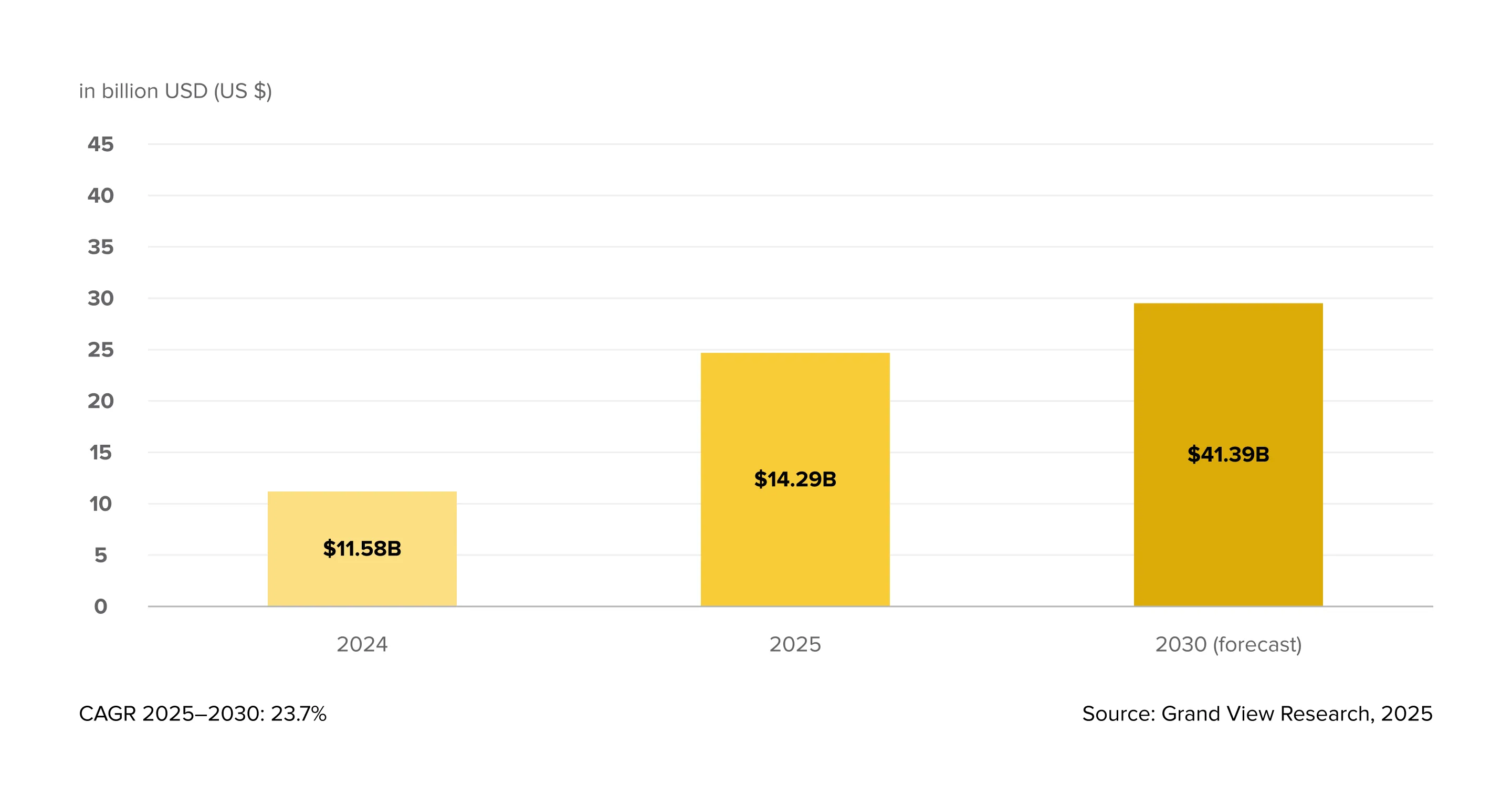
The stakes are also becoming clearer. Gartner foresees that in 2029, agentic AI will be capable of resolving 80% of typical customer service queries independently, and even reducing costs by up to 30%. However, according to Gartner's 2026 findings, customers are almost three times more likely to use third-party GenAI than company-provided chatbot solutions.
Ineffective automation can harm brand reputation because it makes it difficult for customers to escape the system when it fails to help. Consequently, rather than asking how many processes can be automated, the real question is whether they should be automated or done by people.
That is why some teams might find it useful to get some AI consulting services before picking a platform.
What Are AI Chatbots?
An AI chatbot is the most accessible layer of support automation. In traditional approaches, a chatbot works on rules with pre-built dialog trees. The customer picks an option, inputs data, and follows a pre-defined path. This approach is still relevant when outcomes are predictable, and this layer of customer service AI works well for high-volume, low-complexity requests.
An AI-powered chatbot applies natural language processing or a large language model, or both, to analyze customer questions. Unlike rule-based matching, it can detect the user's intent and find the necessary data in a knowledge base.
Typical applications include:
FAQs and product information;
order tracking;
appointment scheduling;
returns and delivery questions;
basic troubleshooting;
password resets;
simple technical support.
Chatbots can be multi-channel by working on websites, in applications, via SMS, and on social media, enabling an omnichannel experience. Chatbots can also offer round-the-clock support and handle multiple conversations at once. A well-configured customer support chatbot can handle each of these tasks without added complexity.
One significant advantage of this architecture is that it ensures a predictable result. If the same question occurs hundreds of times and the answer remains unchanged, automation can reduce the time required without requiring sophisticated decision-making.
One clear example of conversational AI from McKinsey shows the potential behind this technology: a telecommunications company used conversational AI to reach out to customers as soon as a service problem was identified remotely, reducing unnecessary repair visits by 50%.
Hence, while a chatbot may serve as a good benchmark for the business, it must not become an automatic architecture for all support cases.
What Are AI Assistants?
AI assistants go beyond responding to pre-programmed queries by analyzing context and determining whether the required data or action is relevant. This is the critical difference between a chatbot and an AI assistant: a chatbot mostly responds, while an assistant can analyze the customer's situation and take action if necessary.
The assistant will draw data from the CRM, billing software, inventory databases, customer accounts, and other documentation within the organization.
More advanced systems use agentic AI. An AI agent can call APIs and use connected tools to complete several steps, such as verifying an account, checking inventory, updating customer details, and initiating an approved refund.
That creates opportunities for AI agent development, particularly where support work involves several systems. The same technology can support a virtual assistant for employees or customers, rather than limiting AI to a conversational front end.
Assistants can also become proactive. Instead of waiting for a customer to report a failed delivery, the system can identify the problem from operational data and contact affected customers with available options.
McKinsey has described similar uses of AI in service operations, including proactive outreach, contact analysis, and systems that identify triggers for personalized conversations.
However, greater autonomy creates a larger risk surface. A wrong FAQ answer is inconvenient; a wrong update to an account or billing record can create a business problem. Assistants therefore require stronger permissions, monitoring, machine learning evaluation, and human oversight than basic bots.
What Is Human-in-the-Loop (HITL) AI?
Human-in-the-loop AI refers to an operating mode in which AI handles scale and pattern recognition, while humans handle judgment and accountability. Human-in-the-loop AI is not just a failed chatbot waiting for an agent to take over.
A typical workflow looks like this:
A trigger starts the process.
AI analyzes the request and relevant customer data.
The system produces a recommendation or proposed action.
A confidence score estimates how reliable the result is.
High-confidence, low-risk cases proceed automatically.
Low-confidence or high-risk cases receive escalation to a human.
The human agent approves, changes, or rejects the recommendation.
The result enters a feedback loop for future improvement.
This type of model performs exceptionally well at handling ambiguity and complex issues, including complaints, difficult situations, disagreements, claims, or decisions with monetary implications.
The benefit of human-in-the-loop customer service is the balance between automation and accountability. Automation can classify thousands of cases and find patterns, while humans focus on conversations that require judgment.
For instance, an insurance process leverages AI to detect missing paperwork, sort out the most important claims, and compile the case history. The human reviewer decides on disputed or high-value claims.
This is responsible automation, not a temporary workaround. The objective is to determine where AI is reliable enough to act and where human judgment should remain part of the process.
Chatbots vs. AI Assistants vs. Human-in-the-Loop: Quick Comparison
Factor | Chatbots | AI Assistants | Human-in-the-Loop |
Best for | High-volume, repetitive queries | Personalized, multi-step, cross-system tasks | Ambiguous, sensitive, or high-risk cases |
Understanding | Scripted / keyword-based | Context-aware (NLP, LLM) | AI-assisted, human-verified |
Autonomy | Fully automated, fixed paths | Mostly autonomous, can act across systems | AI recommends, human decides |
Setup complexity | Low | Medium–High | Medium (requires review workflow) |
Risk if wrong | Low (simple, correctable) | Medium (wrong actions across systems) | Low (human catches errors before impact) |
Typical cost | Lowest | Higher (integrations, LLM usage) | Ongoing (human review time) |
Main risk | Frustrating customers with rigid scripts | Acting confidently on a wrong interpretation | Bottlenecking if too many cases need review |
The right combination depends on query complexity, risk, support volume, and how much work is genuinely repetitive rather than ambiguous. In practice, the chatbot vs AI assistant decision usually comes down to how much context and action a request actually needs.
When to Use Simple Chatbots
A chatbot is the right choice when a support queue contains large numbers of predictable questions with established answers. The simpler the workflow, the less value there is in adding autonomous reasoning. This is usually the sweet spot for AI chatbot customer service tools: high volume, low ambiguity.
Typical examples include:
shipping and delivery questions;
pricing and opening hours;
returns and cancellation policies;
order tracking;
appointment scheduling;
password resets;
basic IT support;
straightforward troubleshooting.
A chatbot is also suitable when the company has a limited budget or needs rapid chatbot implementation. If the knowledge base is accurate and the conversation has a clear beginning and end, a simple system can provide effective self-service.
Risk should be part of the decision. A wrong answer about opening hours is easy to correct. A wrong change to a financial account is not.
That's where AI chatbot development is most practical: it works best with well-defined processes, escalation procedures, stable data, and clear performance metrics already in place. The deflection rate, resolution rate, response time, and customer satisfaction can be tracked without any additional technical complications.
When to Use AI Assistants
The more contextual, personalized, or multi-action a customer task is, the more value an AI assistant adds.
For example: "I have not received my replacement, and I would like to change the delivery address." This request may involve finding the order, checking its status, determining whether the address can be changed, and making the necessary changes.
Assistants are particularly suitable when:
requests involve several systems;
customer history affects the answer;
personalization improves the result;
proactive support can prevent incoming tickets;
the support operation has enough volume to justify integration work.
A CRM can provide customer history, while billing and inventory systems supply transactional information. With appropriate CRM integration, the assistant can combine those sources rather than asking customers to repeat information.
This is also where AI agent development can deliver value. An autonomous agent may complete approved actions instead of merely suggesting them. But permissions should be explicit: the system needs boundaries around which operations it can perform without approval.
An assistant can also support lead qualification, account management, and technical support, making it useful beyond a conventional customer service queue.
When Human-in-the-Loop Is the Right Approach
Automation should not act independently when the consequences of a mistake are difficult to reverse or when the interaction requires empathy and judgment.
HITL is particularly appropriate for:
emotionally sensitive complaints;
bereavement or hardship requests;
insurance claims and disputes;
legal or regulatory decisions;
large refunds;
account closures;
safety-related cases;
unfamiliar edge cases.
A grievance workflow demonstrates the model well. AI can perform sentiment analysis, categorize the issue, summarize previous interactions, and prioritize urgent cases. A human then determines the appropriate resolution.
The same approach works in regulated environments where compliance, data governance, and GDPR obligations influence how customer information and decisions are handled.
The advantage is not merely risk reduction. Human reviewers can also identify patterns that automated systems miss and provide structured feedback for future improvements. HITL can therefore become part of quality assurance, rather than an obstacle to automation.
The Risk of Full Automation Without Human Oversight
Full automation can look efficient because every interaction appears to follow the same process. Real customer support AI is rarely that uniform.
A model can misunderstand intent, especially when a short message has several possible interpretations. It can also produce a technically correct answer that is inappropriate for an emotionally difficult situation.
Policy-heavy cases create another problem. A customer may meet several conditions at once, requiring an exception or managerial judgment. A system trained on common cases may confidently select the wrong path.
There is also an accountability issue. When an automated decision causes financial or reputational harm, the company needs to know what happened, which data was used, and why the system took the action.
Customer expectations also make human access important. Gartner's 2026 research found that customers expect an option to reach a human when companies use AI in customer service.
Remove humans, and you remove trust.
The objective should therefore be safe automation, not automation for its own sake.
Customer Support Automation Decision Factors
The correct model for AI customer support depends on the interaction and the operating environment. Five factors provide a useful starting framework.
Query Complexity and Ambiguity
Simple questions suit a chatbot. Context-dependent or multi-step tasks require an assistant. Ambiguous requests should have a clear human escalation route.
Emotional Sensitivity and Brand Risk
The higher the emotional stakes, the more important human involvement becomes. AI can classify sentiment or draft a response, but the final communication may need an agent.
Compliance and Regulatory Requirements
Finance, healthcare, and insurance often have additional requirements for authorization, records, and review. AI confidence does not automatically replace required human approval.
Support Volume and Team Size
A small team can start with tier-1 automation. A large contact center or call center may have enough volume to justify more advanced routing, assistants, and review workflows.
Existing Tech Stack and Integration Readiness
Advanced systems depend on reliable CRM, ticketing, knowledge, and API infrastructure. If the underlying data is inconsistent, automation can multiply existing process problems.
Customer Support Scenarios: Which Approach Fits Best?
A scenario-based approach makes the decision more concrete.
Scenario | Recommended Approach | Why |
High-volume FAQ for e-commerce | Chatbot | Repetitive, low-risk, high volume |
Order tracking and delivery updates | Chatbot | Structured data, clear conversation flow |
Personalized product recommendations | AI Assistant | Needs context and purchase history |
IT helpdesk password resets | Chatbot | Simple, scriptable, low risk |
Multi-step account changes across systems | AI Assistant | Spans CRM, billing, and account systems |
Insurance claims or dispute handling | Human-in-the-Loop | High stakes, regulatory and trust implications |
Bereavement, hardship, or cancellation requests | Human-in-the-Loop | Emotionally sensitive, brand risk |
Enterprise B2B support with strict SLAs | AI Assistant + Human-in-the-Loop | Complex cases need AI triage and human sign-off |
In a broader AI development services context, the key is to see how these layers work together, not which technology wins on its own.
How to Combine Chatbots, Assistants, and Human-in-the-Loop
Most advanced support operations can use the hybrid model effectively. They do not have to follow the same process for every client.
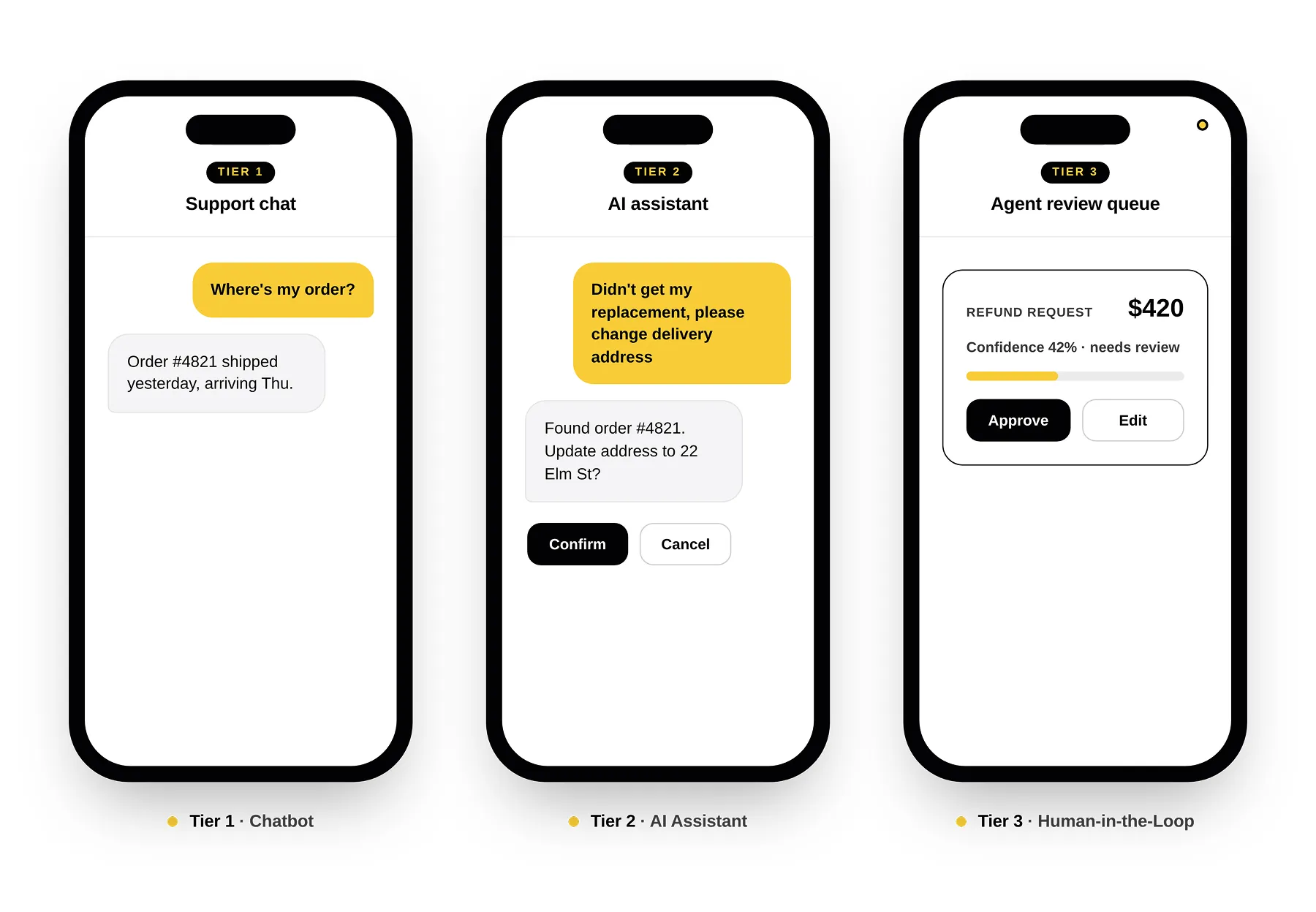
A practical architecture can look like this:
Tier 1: A chatbot handles repetitive questions and self-service.
Tier 2: An assistant manages context-heavy or cross-system tasks.
Tier 3: HITL handles low-confidence, sensitive, and high-risk cases.
Ticket routing: Rules and AI classify the request and send it to the appropriate layer.
Feedback: Human decisions and outcomes improve future automation.
This approach also supports customer engagement because the customer experience can remain continuous across automation levels.
For example, a customer can start with a chatbot, move to an assistant when an account action is needed, and then reach a human agent without repeating the conversation. The same architecture can support multilingual support when language detection and response generation are properly tested. For many teams, this is exactly how an AI chatbot for customer service program should start — narrow, then expand.
Best Practices for Implementing AI-Powered Customer Support Automation
Good AI support implementation begins with boundaries. Teams should decide what the system may answer, what it may recommend, and what it may actually change.
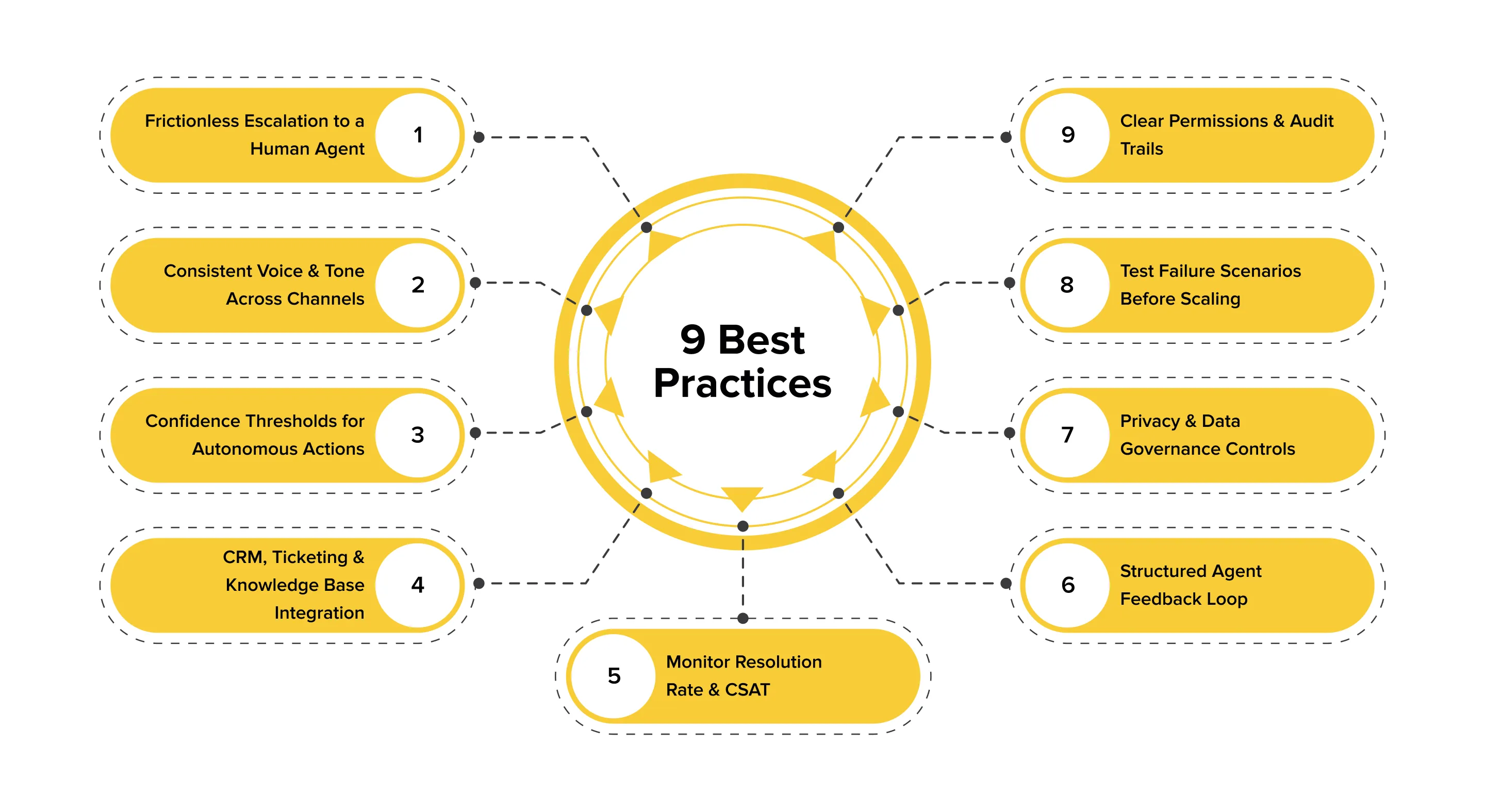
Key best practices include:
provide frictionless escalation to a human agent;
maintain consistent voice and tone across channels;
establish confidence thresholds for autonomous actions;
connect AI to the CRM, ticketing system, and knowledge base;
monitor resolution rate, customer satisfaction, response time, and accuracy;
use structured agent feedback to improve the system;
apply privacy and data governance controls;
test failure scenarios before expanding automation;
maintain clear permissions and audit trails.
An AI copilot development can also support agents without communicating directly with customers. It may summarize tickets, retrieve policy information, draft replies, or suggest troubleshooting steps.
This model can improve the customer experience while keeping a human responsible for the final interaction. It is particularly useful during digital transformation, when support teams are changing processes rather than simply installing a new chatbot.
Common Mistakes When Automating Customer Support
The most common failures come from treating automation as a single product rather than a service architecture.
Automating 100% of interactions. Some cases require human judgment.
Using one chatbot for everything. Different risk levels require different automation.
Skipping the feedback loop. Recurring errors remain invisible without structured review.
Ignoring integration quality. Poor CRM or ticketing data produces poor outcomes.
Measuring only deflection. A higher deflection rate does not necessarily mean better service.
Ignoring compliance. Privacy and governance requirements should be part of the initial design.
Overlooking the human workflow. Agents need clear queues, context, and permissions when AI escalates a case.
Assuming generative AI solves every problem. Generative AI is useful for drafting and knowledge work, but it still needs controls around accuracy and action.
A strong chatbot implementation therefore starts with one measurable workflow on your AI customer service platform and expands only after the results justify the next level of automation.
How Lampa Can Help Build the Right Customer Support Automation Stack
Choosing between automation levels requires more than selecting an AI customer service solutions vendor. Lampa can help businesses map support processes, evaluate technical constraints, and design an architecture that combines automation with appropriate human oversight.
The work can include AI-assisted tooling for support agents, generative AI solutions for knowledge-intensive workflows, AI chatbot development for predictable interactions, and AI agent development for multi-step tasks. Lampa can also help establish confidence-based routing, CRM and API integration, permissions, monitoring, and testing.
The goal is not to replace people wherever possible. It is to identify where automation improves customer engagement, reduces repetitive workload, and preserves accountability when the risk increases.
Lampa has been building custom software and AI-powered products for more than ten years, and support automation is a recurring part of that work. For Pacaso, a real estate platform, the team implemented a concierge chat feature that the client's own engineering lead credited with letting them ship the capability alongside other high-priority work rather than delaying it. The same approach — assessing existing systems, defining clear boundaries for what AI can act on, and building in human review where the risk warrants it — applies directly to chatbot, assistant, and HITL projects.
For teams moving from experimentation to production, the right architecture can evolve. A chatbot may become the first layer, an assistant can handle more complex work, and HITL can govern decisions where human judgment remains essential.
If you are planning AI customer support automation, talk to Lampa about building a stack that matches your team, budget, risk level, existing technology, and long-term goals.